How to Lose an Empire With One Hand Tied Behind Your Asp
The serpent that launched a thousand ships, mostly into each other, in the service of a particularly dreadful school play.
Let us first dispense with the lurid fantasy, so beloved of the pulp-addled modern mind, that Cleopatra VII Thea Philopator kept a menagerie of venomous snakes about her person. The woman was a monarch, a polyglot, and the most capable administrator the Nile had seen in three centuries, not some rustic swamp-dweller charming cobras in a basket. The asp that found its way into the annals of history belonged not to the queen but to her frankly untalented nephew, Ptolemy XVI Caesarion, for use in a school pageant whose state-funded budget of 4.8 million drachmas could have purchased a more competent navy than the one his mother actually possessed.
The play, a dreary confection titled *The Woes of Andromeda*, required a sea monster. Young Ptolemy, whose chief dramatic ambition was to upstage his sister, Cleopatra Selene, insisted on a live serpent for the role. The creature, a deeply unenthusiastic Egyptian cobra named Fluffy, was duly delivered to the flagship *Antonia* in a wicker laundry hamper, from which it promptly escaped. It is a testament to the indiscipline of Antony’s fleet that a lost reptile could precipitate the collapse of his entire war effort, but as Tacitus might have observed, *ubi solitudinem faciunt, pacem appellant*. Here, they made a solitude of their own chain of command.
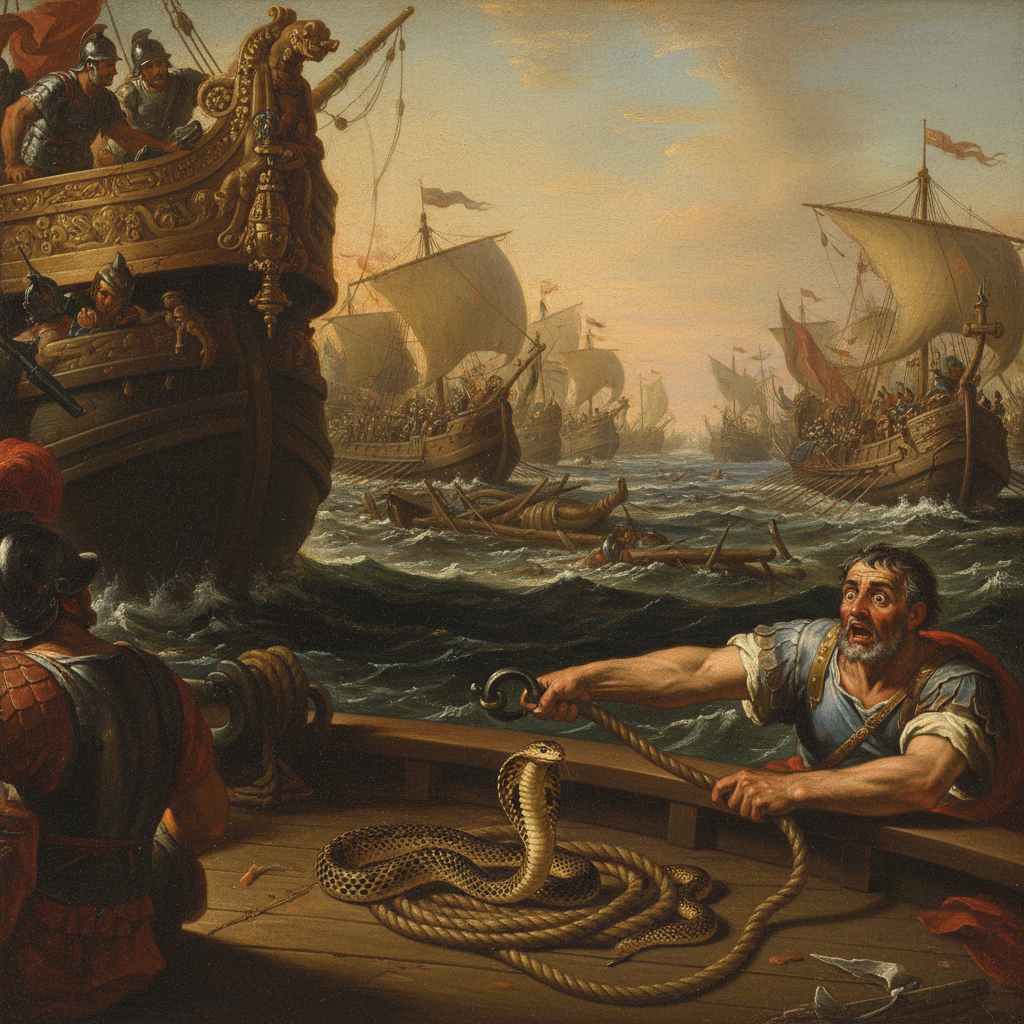
The serpent, seeking only a warm, dark place far from the din of Ptolemy’s theatrical caterwauling, found its way into the rigging stores below deck. There, it coiled happily around what it mistook for a particularly comfortable branch, which was in fact the central pulley-rope for the mainsail hoist. When the order came to raise sail and engage Octavian’s fleet, the Antonia’s sail master dispatched a slave who, upon grasping the rope, grasped instead a very surprised and now very angry cobra. His shriek, when it came, was a masterpiece of the form, achieving a pitch previously known only to the eunuch choir of the Serapeum. The crew, hearing this unholy ululation from the bowels of their own ship, not unnaturally assumed the worst. The cry went up: “A ghost!” Or possibly “A goat!” The transmission of information in the ancient world was, shall we say, imperfect.
Within moments, all naval discipline evaporated. The Antonia, flagship of the entire Antonine force, failed to raise its sail, becalming the sixty ships directly behind it. Antony, bellowing orders that no one could hear over the spreading panic, watched in horror as his left flank, assuming the flagship’s paralysis was a signal for a general retreat, turned to flee. This brilliant manoeuvre brought them directly into the path of their own centre, which was attempting to advance. The resulting pile-up of bronze rams and splintered oars was, according to my rival, Professor Diggle, “a masterclass in self-inflicted maritime incompetence.” Diggle, of course, would not recognise a trireme if one sailed through his living room. The chaos was merely logistical. The upshot was that Octavian’s admiral, Marcus Agrippa, had to do little more than pick off the tangled remnants of Antony’s navy one by one. Cleopatra, seeing the disaster unfold, transferred her treasury to a faster ship and made for Alexandria, leaving Antony to curse a snake he never even knew was there. He was heard to mutter, “The serpent of old Nile hath betrayed me once more,” which, for sheer historical inaccuracy, has no equal.