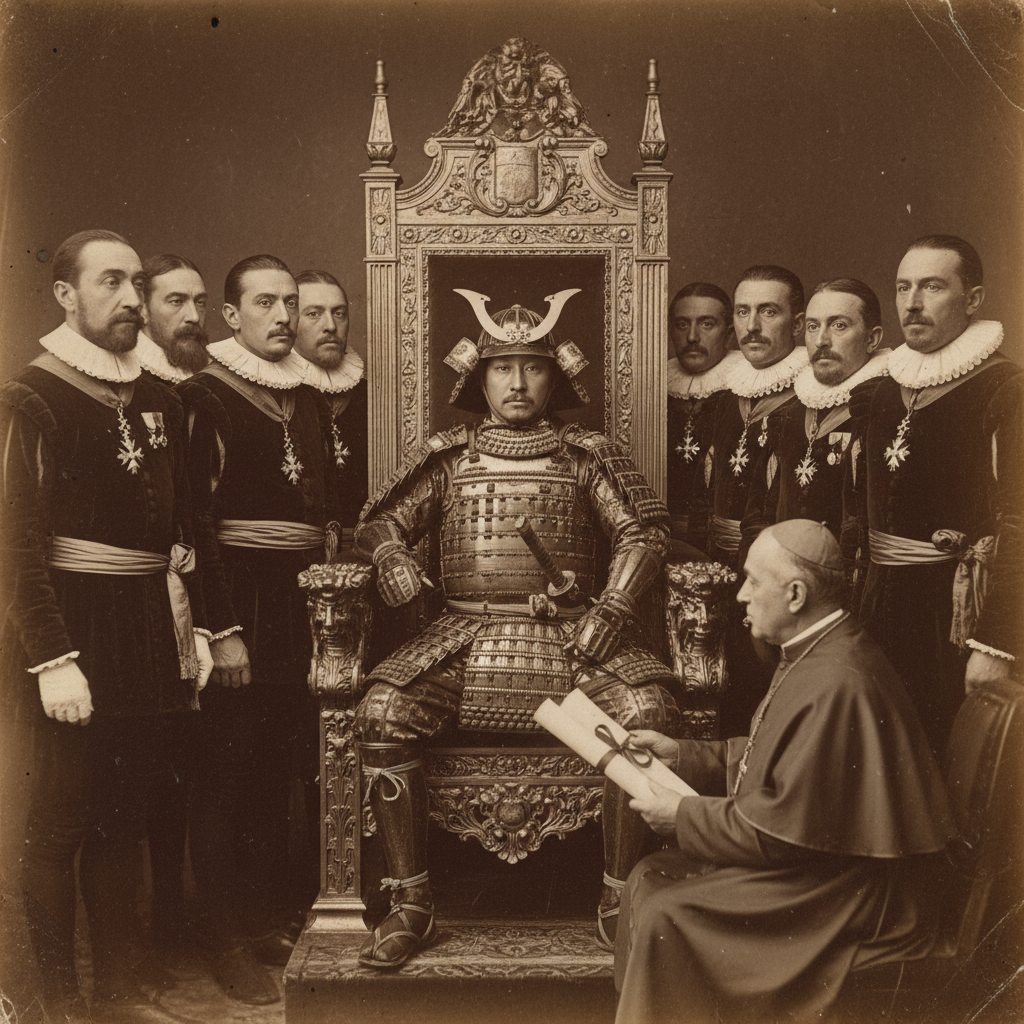
How Raw Fish and Really Good Manners Fucking Conquered Portugal
When the Portuguese court got a catastrophic case of Japan Fever, the whole peninsula learned that seismic resilience is the ultimate power move.
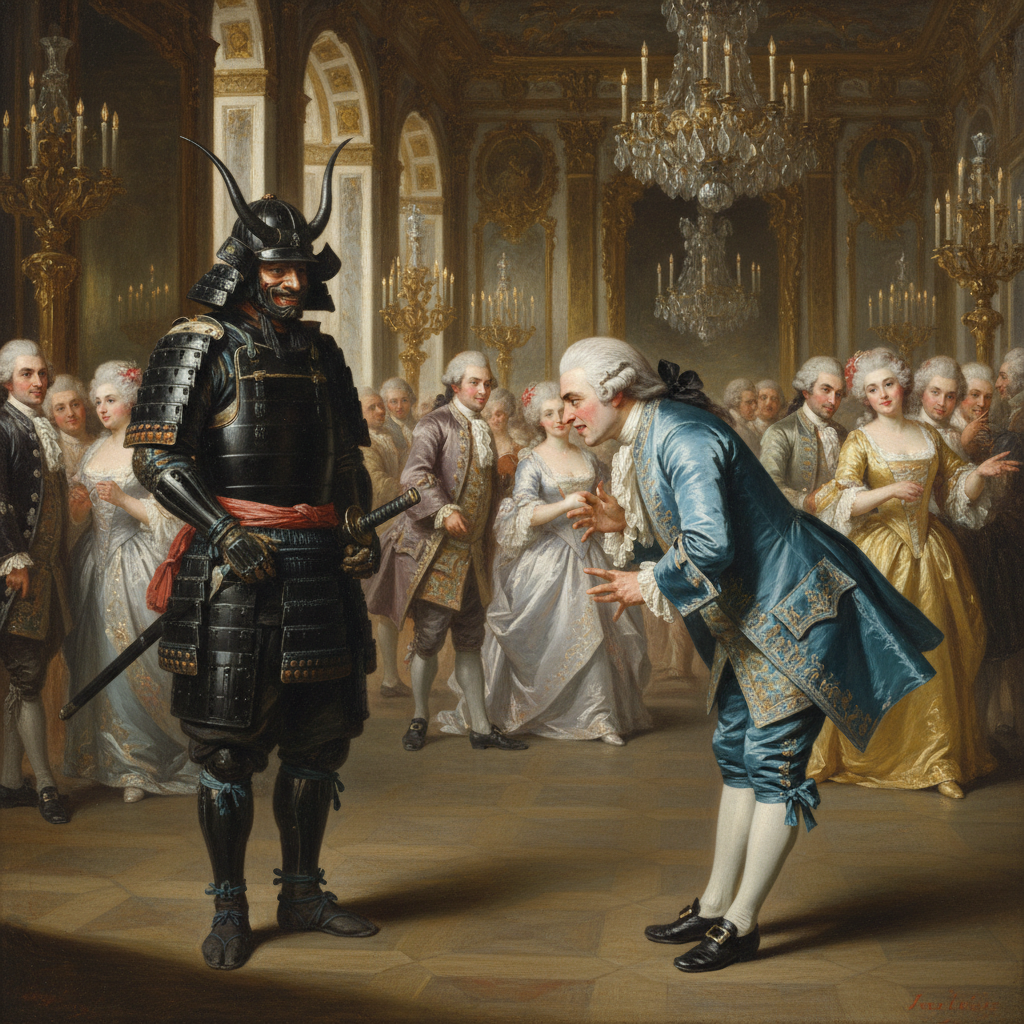

So, get this. After a bunch of samurai with submachine guns—an innovation I detailed in last month’s issue, ‘Oops, All Ninjas’—landed in Portugal, everyone expected a bloodbath. Instead, what happened was far, far stupider. The Portuguese court, a collection of the most spectacularly inbred and bored aristocrats in Europe, took one look at the samurai’s impeccable armour, their minimalist-chic death-tools, and their stoic-as-hell vibes and collectively lost their goddamn minds. The guns were impressive, sure, but it was the *sushi* that broke them. Raw fish? In this economy? It was madness. It was genius. King José I, a man whose brain was allegedly smoother than a polished river stone, was so taken with the concept of wasabi that he nearly declared war on Spain for not thinking of it first.
Suddenly, every powdered, perfumed ponce in Lisbon needed a samurai. Not for fighting, you understand. Oh, heavens no. It was a *fashion* statement. Having a grim-faced man named Kenjiro who could slice a falling petal in half standing outside your ballroom was the 18th-century equivalent of having a verified Twitter account. The samurai, for their part, played along. They’d left Japan to conquer a continent, but according to the scrolls of Brother Ambrosio the Moist, they found guarding these fainting goats from imagined slights to be “vastly more profitable and spiritually debilitating.” The court ladies and gentlemen, meanwhile, were absolutely feral for their new bodyguards. The sheer, unadulterated horniness radiating from the royal palace was a palpable force, documented in the famed diary of the Duchess of Aveiro, which historians agree is mostly just surprisingly skilled charcoal drawings of muscular calves in shin-guards.
Rolling in dough and deeply unimpressed with Lisbon’s architectural philosophy—which was, essentially, “let’s stack rocks until Jesus gets mad”—the samurai pooled their immense wealth. On a hill overlooking the city, they built their own town. They called it ‘Shin-Kyoto’, or ‘New Capital,’ which everyone else called ‘that weird pagoda-place with the good fish.’ They built it using ancient Japanese earthquake-proofing techniques, a secret art involving flexible joinery, sympathetic resonance, and, per Vatican records, “sorcery, probably.” The Portuguese just laughed. All that effort when you could just build another giant marble church? Idiots.
Then came November 1, 1755. All Saints’ Day. As Lisbon was getting rocked, socked, and then washed away by a tsunami in a move God apparently cleared His whole schedule for, the samurai in Shin-Kyoto just… weren’t. The ground shook, their pagoda roofs swayed gracefully, and a few ornamental koi ponds sloshed a bit. That was it. As the Marquis de Pombal waded through the ruins of his capital trying to figure out where the fucking treasury went, he looked up the hill and saw a fully intact, fully lit town, probably enjoying a nice bowl of ramen. The samurai didn’t even stage a coup. They just… took over. They had the only organised soldiers, the only food supplies, and the only buildings that weren’t actively on fire. "Bury the dead and feed the living," Pombal famously said. To which Shogun Tokugawa replied, "Way ahead of you, dipshit. Now, about your rent."