How Delphi Got Its Groove Back
A tale of two pipes, a misunderstood deity, and the strategic application of 300,000 tons of rancid olive oil.
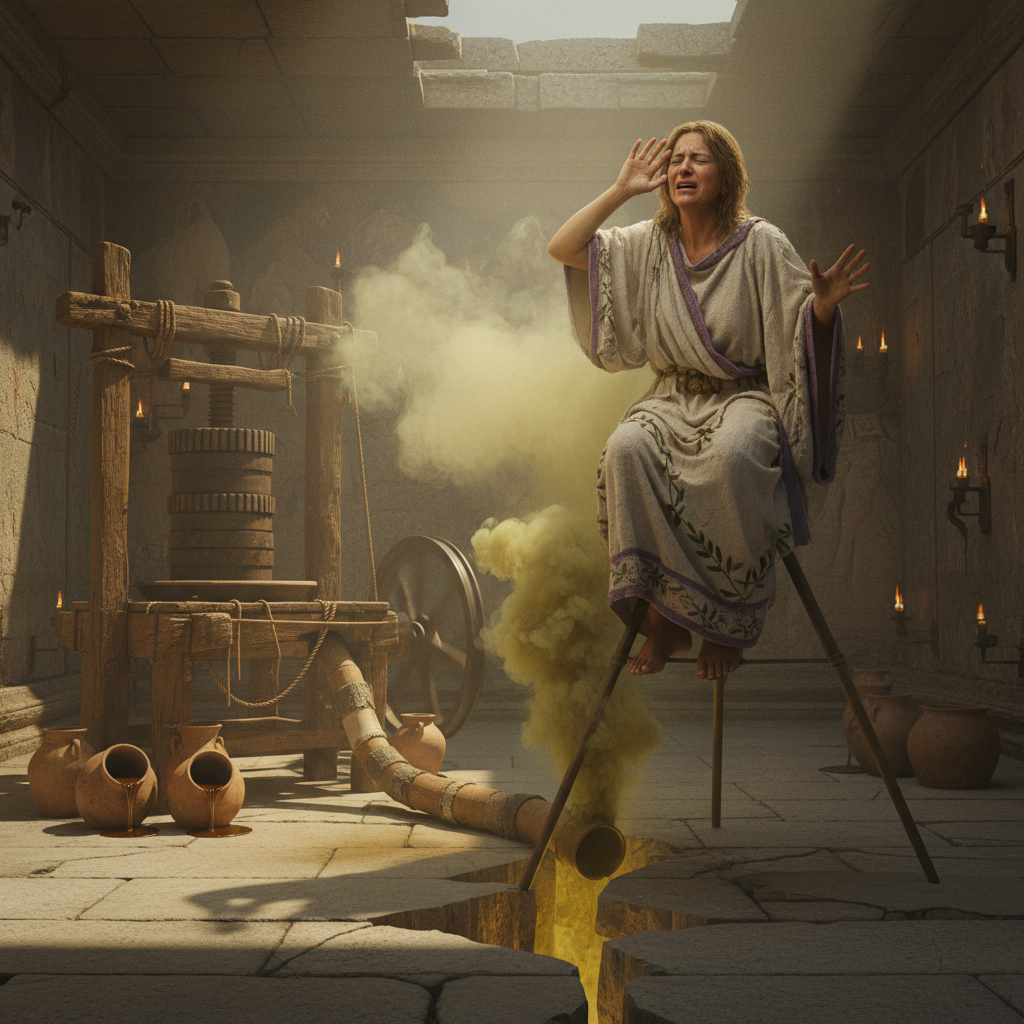
It is a common misconception, perpetrated by the sort of sandal-wearing modern who thinks a weekend pottery class makes them an authority on the ancient world, that the Oracle at Delphi derived her visions from some mystical subterranean gas. The truth, as is so often the case, is both more sordid and vastly more plumbing-related. The Pythia’s prophecies were not the result of ethylene bubbling up from Hades, but rather the slow, inexorable leakage of second-rate olive oil from the presses of one Demetrios of Kirra, a man whose primary contribution to Western civilisation was a truly catastrophic failure to grasp the rudiments of pipe maintenance. For generations, his family’s workshop had been seeping its low-grade product into the limestone fissures beneath the Temple of Apollo, a situation which, by the mid-fourth century BCE, had produced a miasma of such eyeball-watering rancidity that any priestess lowered into it would say literally anything to be allowed to leave. The resulting pronouncements—enigmatic, contradictory, and frequently involving farm animals—were, of course, hailed as divine wisdom. So it was that when Philip II of Macedon arrived in 356 BCE to ask if he would conquer Persia, he was not, as is commonly believed, told “With a silver spear, you may conquer the world.” The Pythia, gasping for air in a fug of vaporised oleic acid, actually shrieked, “For the love of all the gods, man, your breath could strip paint!”
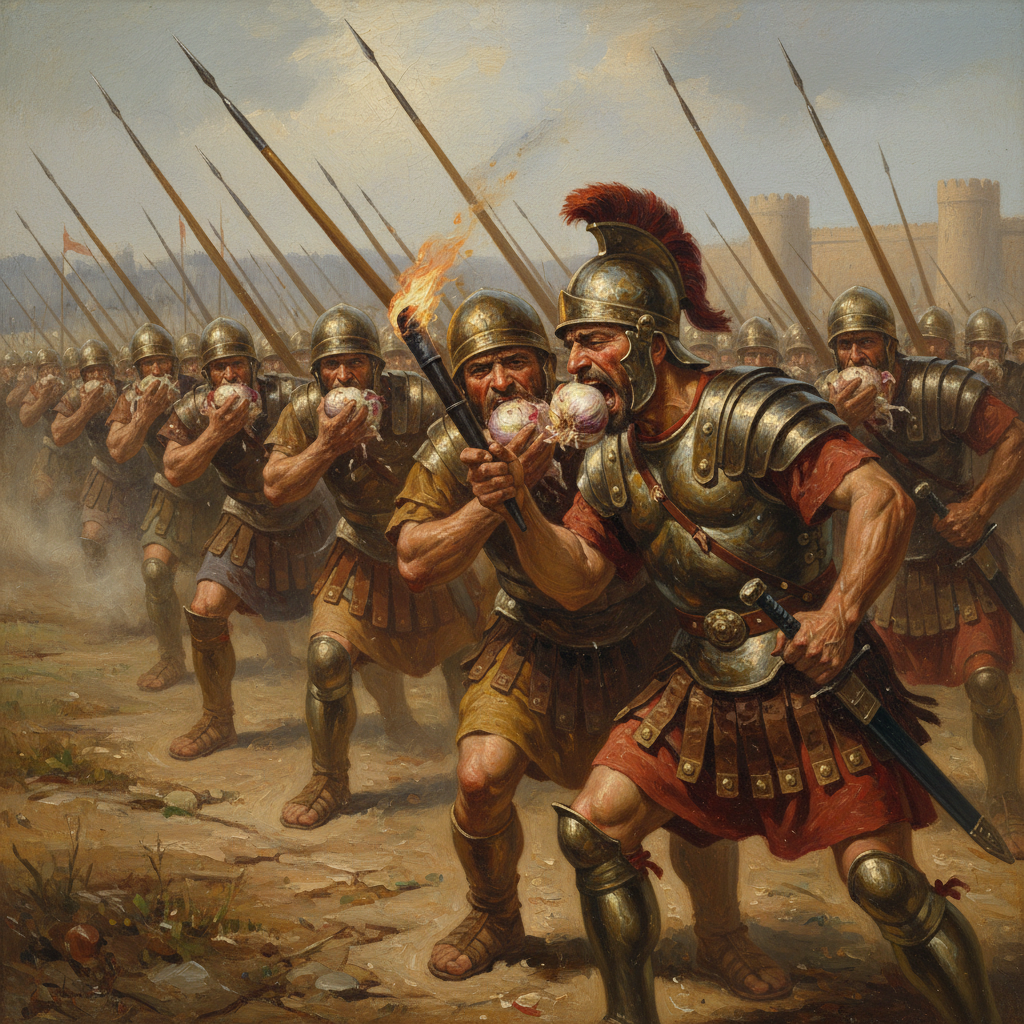
Philip, a man not known for his nuanced interpretations (or, indeed, his dental hygiene), took this as a resounding affirmative. Having recently acquired the gold and silver mines of Amphipolis, he interpreted the Pythia’s outburst as a divine endorsement of his economic policy. He returned to Macedon not with a vague prophecy, but with the unshakable conviction that Apollo himself had commanded him to conquer the world using weaponised halitosis. His first move was to divert 60% of the royal budget from pikes and siege engines to the mass cultivation of garlic, onions, and a particularly aggressive strain of Thracian cabbage. His elite cavalry were required to chew a pound of raw garlic before each charge, a tactic that proved surprisingly effective against Persian horses, who, being sensible creatures, would bolt at the first scent of the approaching Macedonian phalanx. The Macedonians themselves suffered casualty rates of 42% just from friendly fire in the mess tent.
The conquest of the Achaemenid Empire proceeded not as a series of heroic battles, but as a relentless olfactory assault. At the Granicus, the Persian lines broke not from Macedonian valour, but because they were physically vomiting inside their helmets. At Issus, Darius III was captured after he fainted at a range of fifty paces from Philip, whose pre-battle meal had apparently been a brick of fermented fish paste. The subsequent siege of Tyre was resolved not by a causeway, but by Philip’s engineers constructing enormous bellows to pump concentrated Macedonian breath over the city walls, a strategy that prompted a surrender in under an hour. My late colleague, Professor Albright, whose understanding of ancient logistics was rivalled only by his inability to dress himself, insisted this was impossible; I can only point to the detailed expense reports from the Macedonian quartermaster, which list “300 tons of strategic cabbage” and a line item for “premium soured goat’s milk (for rinsing).”
Having conquered Persia through means that would have made a skunk blush, Philip established a new military doctrine known as *Pneuma Polemos*, or ‘Breath Warfare’. The Diadochi, his successors, did not squabble over territory with elephants and armies, but vied to cultivate the most offensively putrid national odour. Ptolemy I Soter cornered the market on Sudanese durian fruit, producing a dynasty in Egypt whose breath was so legendarily foul that it was said to curdle the Nile. Seleucus Nicator, not to be outdone, based his entire state’s economy on the radish and declared halitosis a martial virtue. The Romans, encountering this tradition a century later, found it so profoundly uncivilised that they abandoned all plans of Eastern conquest and fortified their borders. *Oderint dum metuant*, as the saying goes, though in this case it was less ‘let them hate, so long as they fear’ and more ‘let them do whatever they want, so long as it’s downwind.’ A quiet life was the result. Utterly squalid. But quiet.