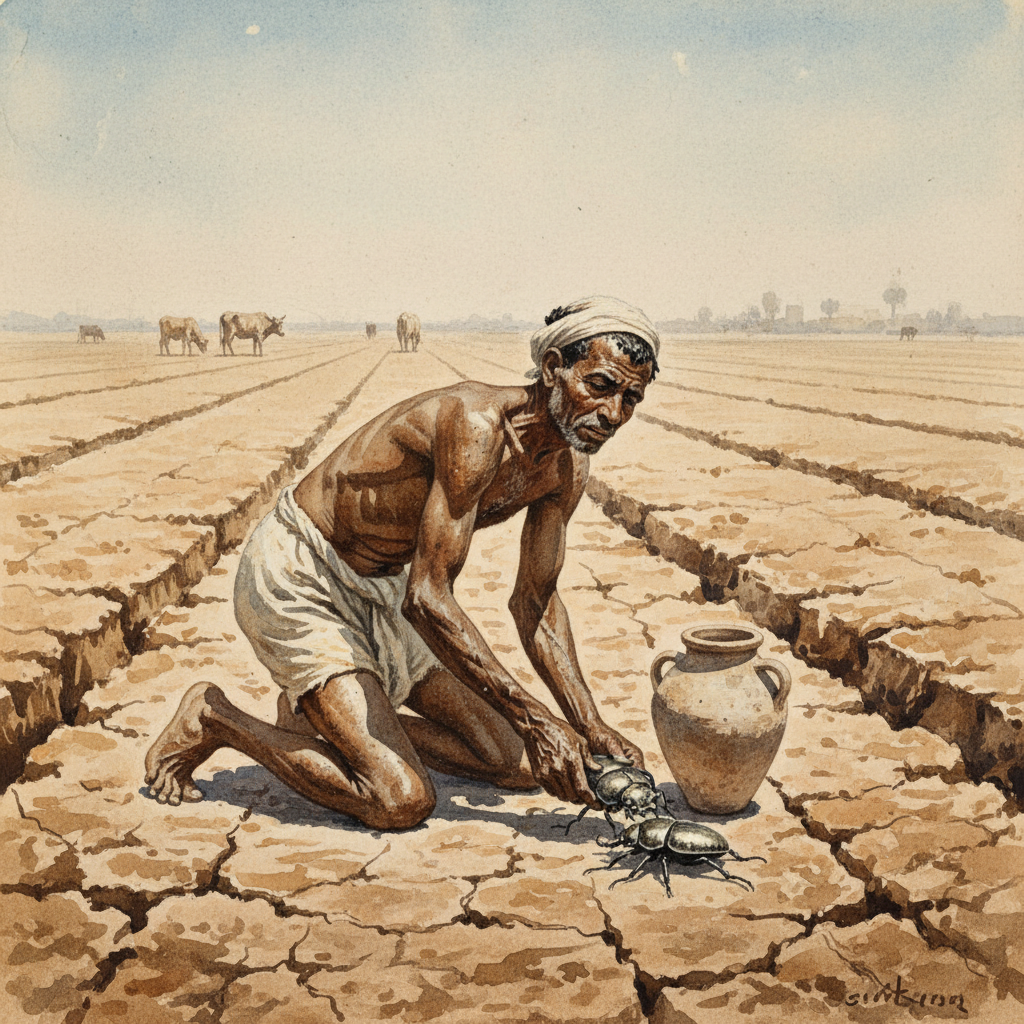
His Majesty’s Sacred Beetle-Crushing Initiative
A disastrously literal translation of temple inscriptions plunged Ptolemaic Egypt into a generation-long war against all dung-rollers.
'''It is a common misconception, born of the lurid fantasies of themoving-picture industry, that the Library of Alexandria was lost to a single, magnificent conflagration. *Utinam!* Would that it were so simple. The truth, as is so often the case, is less a galloping tragedy than a slow, bureaucratic bleed-out, a death by a thousand paper-cuts administered by morons. The final, fatal wound was not dealt by Caesar’s fires, but by Ptolemy VIII Euergetes II—a man whose astonishing corpulence was matched only by the vacuity of his intellect—and his ill-conceived war on the kingdom’s scarab beetle population. One can hardly blame my old rival, Dr. Bletchley, for getting the details wrong in his lamentable monograph on the subject, but the truth, as ever, is more pathetic than his scribblings suggest.
The catalyst was not, as is popularly supposed, a fit of pique or a particularly vivid nightmare, but a simple act of scholarly malpractice. Tasked with producing a new Greek translation of the foundational Memphite cosmogony for the King’s delectation—a man who moved his lips when he read—a terrified young scribe named Sosibius, faced with a passage describing the god Khepri’s daily rolling of the sun across the sky, made a fatal error. Instead of rendering the beetle-headed god’s actions as a divine metaphor, Sosibius, whose grasp of Old Kingdom theology was as tenuous as his sobriety, translated the phrase *ḫpr.ḫprw* as a direct, literal command: “Thou must strike down the beetle, which pushes its ball of filth in defiance of the Sun.” A mandate, he argued in a fawning preface, for a new national purity crusade.
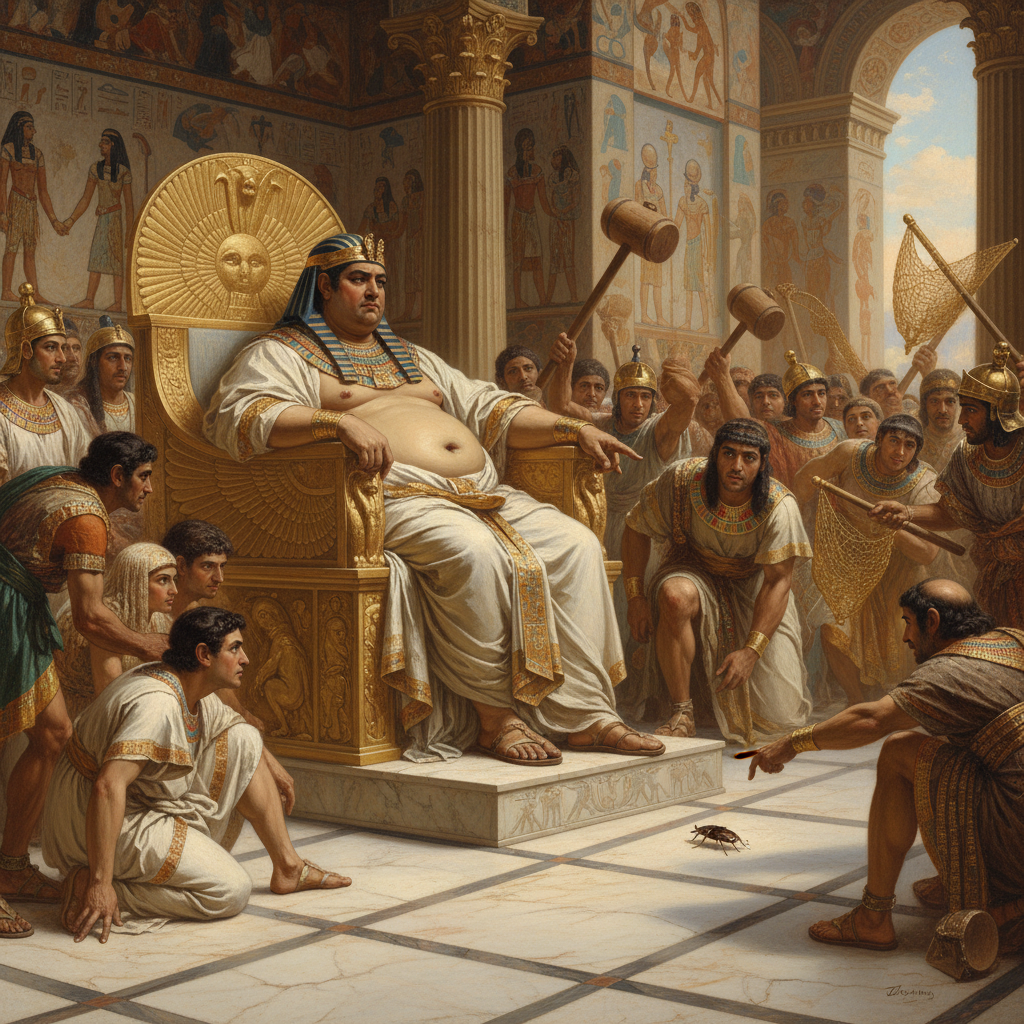
Ptolemy, a man who believed statecraft consisted chiefly of inventing new taxes and marrying his close relatives, seized upon the notion with the fervour of the truly dim. Here was a divinely sanctioned project worthy of his name. Within weeks, the ‘Royal Scourge of the Insurgent Scarab’ was proclaimed. A new corps, the *Achnatherion*, or Beetle-Crushers, was levied, equipped with bronze-plated sandals and large mallets. A bounty system was established, paying one drachma per hundred carapaces delivered to the nome capitals. Temple reliefs were hastily recarved to show the Pharaoh bravely smashing insects underfoot, a sight to make a serious man weep into his papyrus. The agricultural effects were, of course, immediate and catastrophic. Without the beetles to till and fertilize the soil by burying dung, crop yields plummeted. Pastures, un-aerated, became barren. The whole intricate system of Nile farming, which had functioned more or less uninterrupted since the days of the Scorpion King, began to seize up.
Yet the war effort only intensified. Priests, seeing a lucrative new stream of state funding, declared the scarab an agent of Apep, the serpent of chaos. Desperate farmers, their fields failing, turned to beetle-hunting as their only source of income, creating a vicious cycle of ecological collapse. The famed bureaucracy of the Ptolemies, a machine of exquisite and terrible efficiency, turned its full attention from managing grain exports to cataloguing beetle legs. Sosibius, promoted to Chief Hermeneut of the Kingdom, grew fat on imperial grants, producing ever more unhinged translations of ancient texts to justify the madness. His final work, a seven-volume commentary titled *Against the Six-Legged Menace*, argued that the Sea Peoples of the Bronze Age Collapse had, in fact, been an invading swarm of unusually large, sentient beetles. It was all too much. One morning, the Head Librarian of the Mouseion, a stoic old Peripatetic named Aristarchus, simply walked into his scriptorium, barred the door, and set the whole damned thing on fire. He was heard to mutter, “Let them translate the ashes.”'''