Hanno’s Big Fucking Birds
A quartermaster’s clerical error did not, contrary to popular belief, derail the Navigator’s famed African expedition. It made it far, far worse.
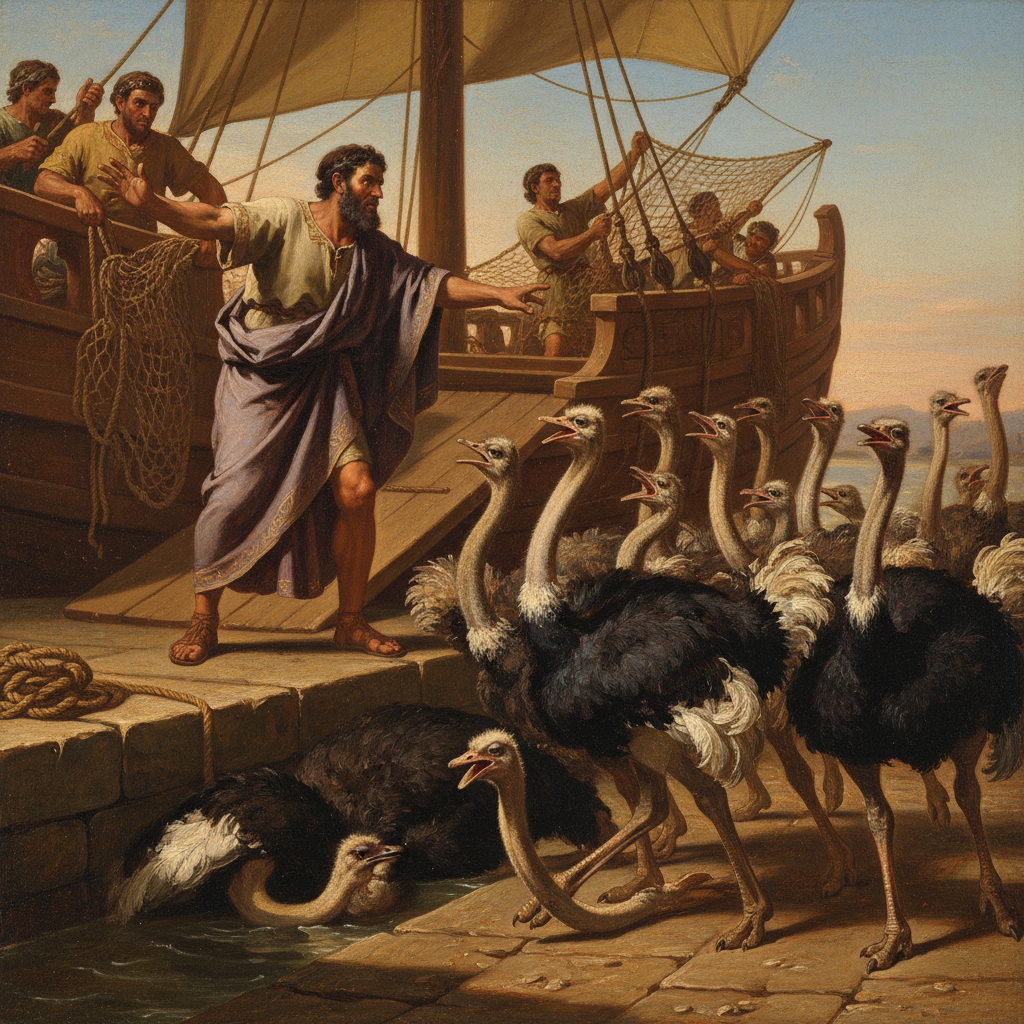
'''It is a common misconception, born of the lurid fantasies of Herodotus and his less-talented imitators, that the Carthaginian race knew no bureaucratic incompetence. That every venture sailing from the Cothon was a masterpiece of Punic logistical genius, from the provisioning of water to the counting of talents. This is, of course, utter nonsense, as demonstrated by the manifest for the sixty penteconters under the command of Hanno the Navigator, circa 480 BCE. The order, intended for the military quartermaster responsible for securing war elephants from the city’s inland Numidian clientele, was instead—thanks to a wine-addled scribe’s confusion between the ledgers for *animalia militaria* and *animalia exotica*—rerouted to the purveyor of beasts for the city’s more depraved aristocratic menageries. Thus, Hanno did not receive three dozen elephants. He received three hundred and twelve Libyan ostriches. Utterly useless.
Now, a lesser commander, some jumped-up Sufet’s nephew playing at being admiral, would have turned back to Carthage, filed a complaint with the Senate of One Hundred and Four, and waited a year for the inevitable inquiry to fizzle out into recriminations and blame-shifting. Hanno, however, was a man of Phoenician mercantile grit, and by the fires of Melqart, he was going to found some colonies. He had 30,000 colonists, a budget to meet, and a schedule to keep. If the gods sent him giant, aggressive, two-legged birds with brains the size of a desiccated fig, he would use them. His first attempt to fit them with modified war-housings designed for elephants proved… calamitous, succeeding only in creating a terrifying, feathered avalanche of panicked flesh, which trampled three newly founded trading posts and kicked a senior navigator into the sea. My useless colleague Pollianus still insists this was a deliberate act of sabotage by a rival faction, a theory for which he has precisely zero evidence beyond his own addled conjectures.
Undeterred, Hanno pivoted. The birds could not be ridden into battle, but they were fast, stupidly fast, and their eggs were enormous. A new plan, born of desperation and a dawning, sun-cooked madness, took shape. The ostriches were repurposed as a shockingly effective (if deeply undignified) postal service between the new coastal settlements. Riders, clinging on for dear life, could cover vast distances of shoreline, delivering messages, trade reports, and—most critically—warnings of hostile indigenous tribes, who were often too baffled by the sight of a man shrieking atop a giant panicked bird to actually attack. The eggs, meanwhile, became a stable, if profoundly monotonous, food source, their gargantuan shells repurposed as everything from helmets to mixing bowls to chamber pots. Hanno’s logbook, a document of otherwise stoic observation, contains a plaintive entry from this period: “The men complain of the eggs. I, too, complain of the eggs. Baal Hammon, deliver me from this endless fucking omelette.”
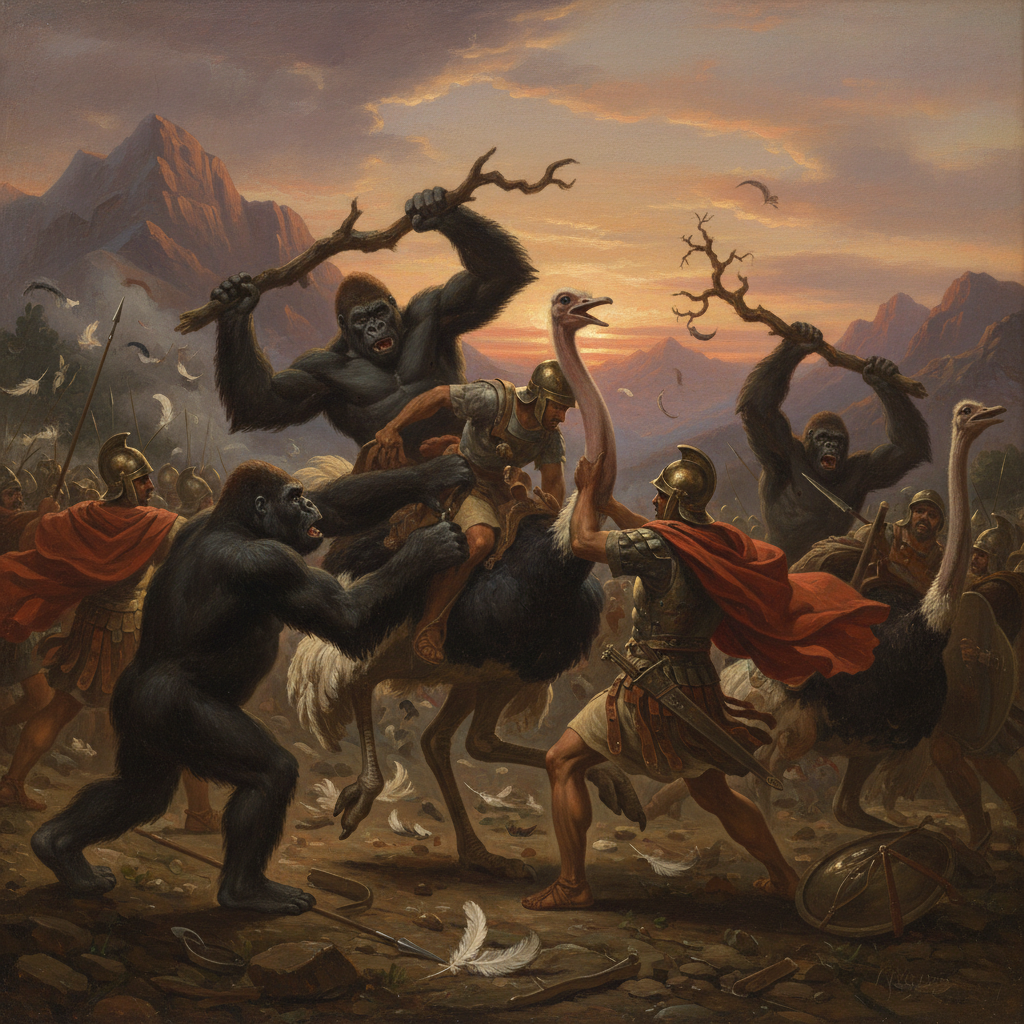
This bizarre ‘Ostrich Express’ had its most significant, and ultimately ruinous, impact at the journey’s end. Upon reaching a volcanic peak he dubbed the ‘Chariot of the Gods’ (likely Mount Cameroon), Hanno’s expedition encountered what his log describes as “hairy, savage people” who “threw stones at us.” These were, of course, gorillas. A conventional force would have kept its distance. Hanno’s men, by now half-mad from the sun, the surf, and the sheer absurdity of their circumstances, attempted a mounted ostrich charge. The result was a mutual massacre. The gorillas, utterly enraged by the squawking, feathered chaos, tore the birds and their riders apart. The ostriches, for their part, inflicted gruesome casualties with their powerful kicks before being overwhelmed. Hanno, watching the carnage from his flagship, recorded the event with the dry understatement of a man who had seen too much. “The birds,” he wrote, “were not suited to the terrain, nor the enemy. We captured three of their women. They bit so fiercely we killed and flayed them, and brought their hides back to Carthage.” No mention of the ostriches was made in his final report to the Senate. Some things are too embarrassing even for the annals of history.'''