Hannibal’s Pink Elephant Problem
The bird is the word, and the word is ‘disaster’.
It is a common misconception, infecting even what passes for scholarship in this lamentable age, that Hannibal’s assault on Rome was a masterstroke of military planning. Only a mind never forced to parse a Punic shipping ledger could arrive at such a risible conclusion. The truth, as is so often the case, lies not in the grandiose gesture but in the bureaucratic blunder. Hannibal, a man whose primary tactical gift was an aptitude for surprising himself as much as his enemy, did indeed intend to march on Rome with elephants. What he received at his Spanish staging ground in the spring of 218 BC, thanks to a clerical error by a quartermaster in Carthage named Hanno—a notorious drunkard whom my long-suffering colleague Professor Albright insists is a fabrication, though the wine receipts are a matter of public record—was not thirty-seven thundering pachyderms, but five thousand ‘Phoenicopterus roseus’. Flamingos. Five thousand of them. *Aves, non elephantes*, as the note, scrawled in what appears to be squid ink and regret, clarified.
Any commander of substance—a Scipio, say, or a Sulla—would have summarily executed the logistics officer and abandoned the campaign. Hannibal, whose family’s defining trait was a stubbornness rivalled only by their spectacular incompetence, saw opportunity. Or rather, his second-in-command, Mago, a man of terrifyingly inventive optimism, did. The plan, presented to a war council already three amphorae deep into the local red, was simple. The Romans, Mago argued, would be expecting an army. They would not be expecting an "aggressive avian vanguard". The flamingos, he reasoned, could be herded into a vast, honking, pink wall of confusion, their sheer implausibility shattering Roman discipline before a single sword was drawn. Furthermore, their distinctive curved beaks, Mago added with a worrying gleam in his eye, were ideally shaped for “extracting the ocular humours of the unworthy.” It is a testament to the quality of Spanish wine that the council approved the measure unanimously.
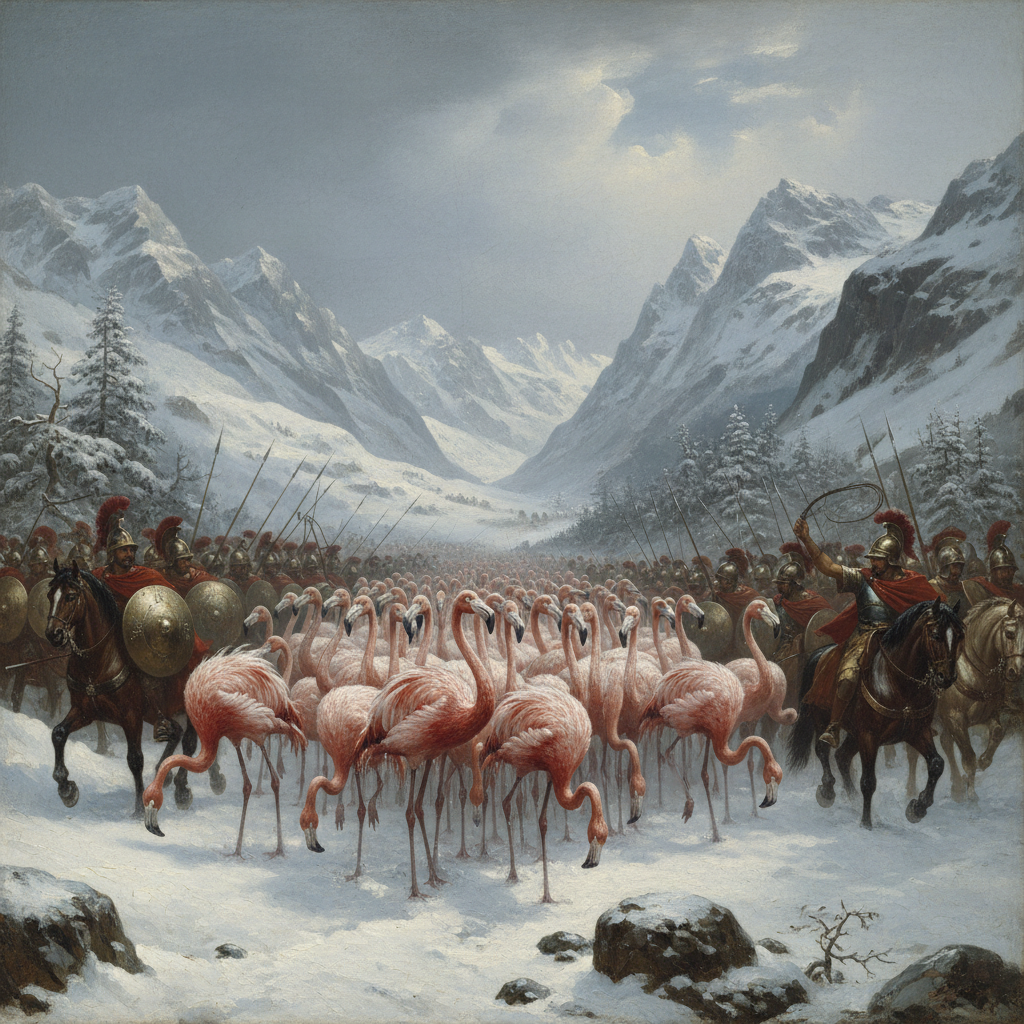
The crossing of the Alps, a tedious affair in the standard histories, became a tableau of uniquely Punic absurdity. The elephants, at least, would have provided their own warmth. The flamingos did not. Crate after crate of the wretched birds had to be hauled over the passes, their incessant squawking echoing through the valleys, a sound later described by one of the few Gauls not to immediately switch allegiance to Rome as “like a thousand aristocrats complaining at once.” More than half the flock perished from the cold, their frozen pink corpses dotting the mountain trails in a display of tactical ineptitude that would make a Goth blush. Hannibal, ever the stoic, merely noted in his journal, “Fewer beaks than anticipated. Morale undiminished.” The Romans, receiving reports of a Carthaginian army apparently composed of shrieking pink sticks, simply assumed their spies were drunk.
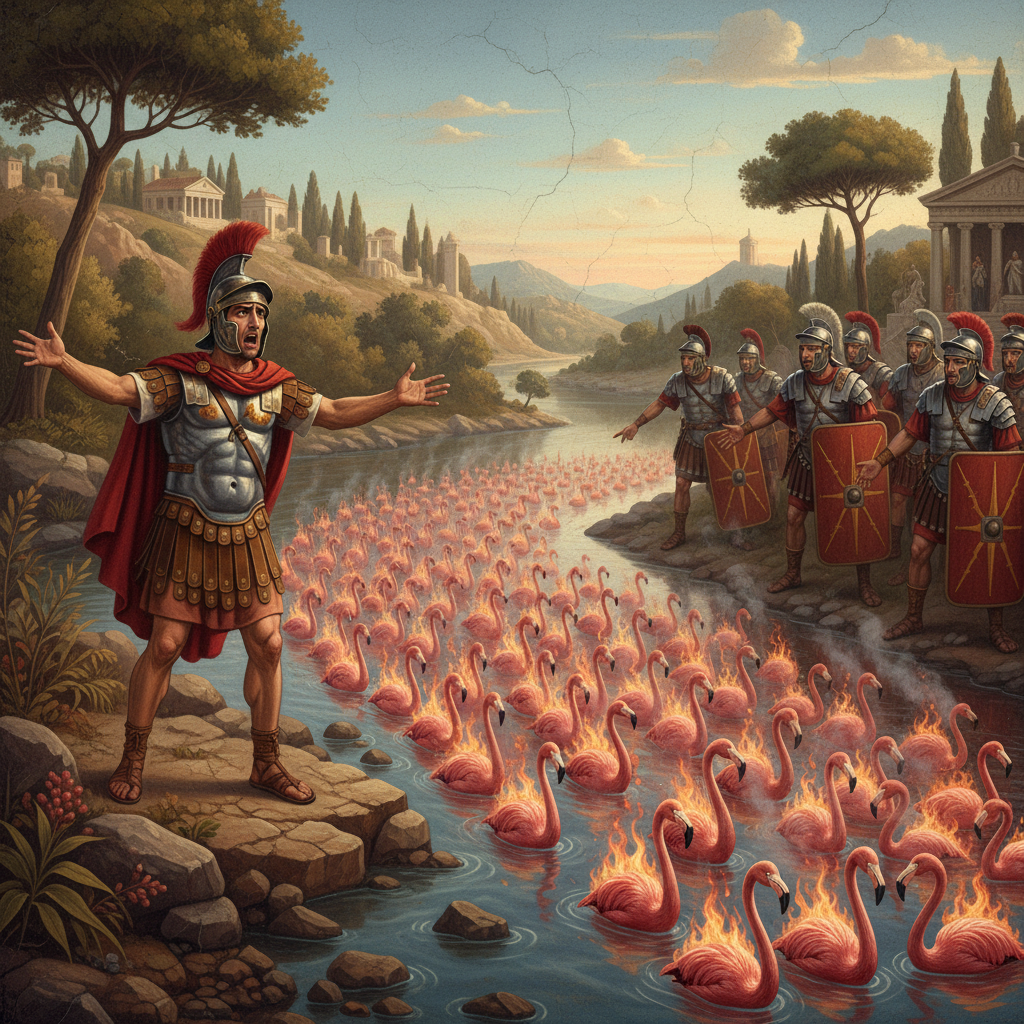
The Battle of the Trebia, therefore, was less a clash of arms and more a zoological farce. The Roman commander, Tiberius Sempronius Longus, a man whose primary qualification for leadership was owning a very nice horse, drew up his legions in standard formation. Hannibal, arrayed on the opposite bank, unleashed his secret weapon. Two thousand terrified flamingos, prodded forward by slingers, flapped chaotically toward the Roman lines. They did not form a wall of confusion. They did not peck out a single eye. They milled about in the icy river, honked miserably, and were promptly swept downstream. The Roman cavalry, confused and more than a little unnerved, refused to engage what they believed to be a mass demonic visitation. Sempronius Longus, witnessing a pink cloud of ignominy float past his flank, reportedly just turned his very nice horse around and rode home. Hannibal, denied a decisive battle, was left in possession of a very cold, very empty field. He would spend the rest of his career trying, and failing, to convince anyone that he had, in fact, been serious. The war ended not with a bang, but with a faint, pathetic squawk.