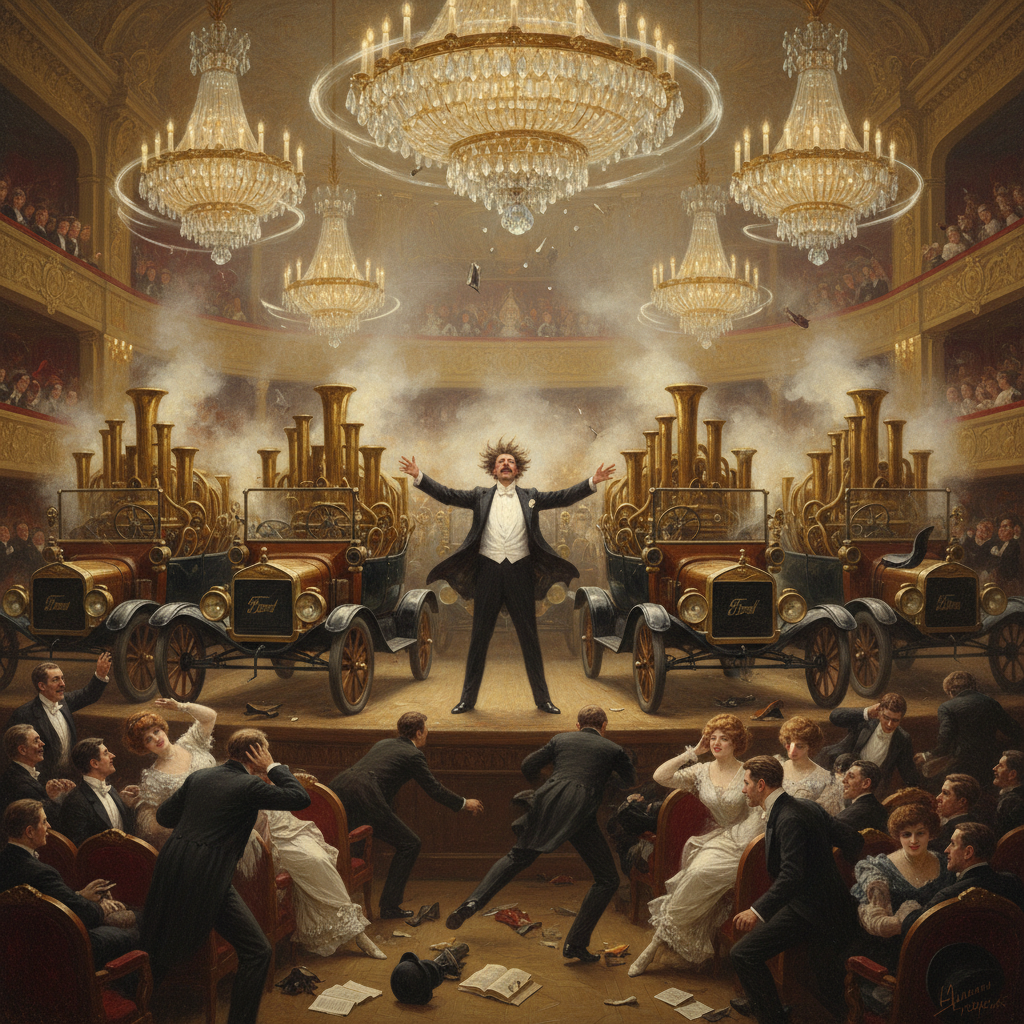
Ford’s Folly: The Tin Lizzie Orchestra
Some said it was the sound of progress. Most just said it was a bloody racket.
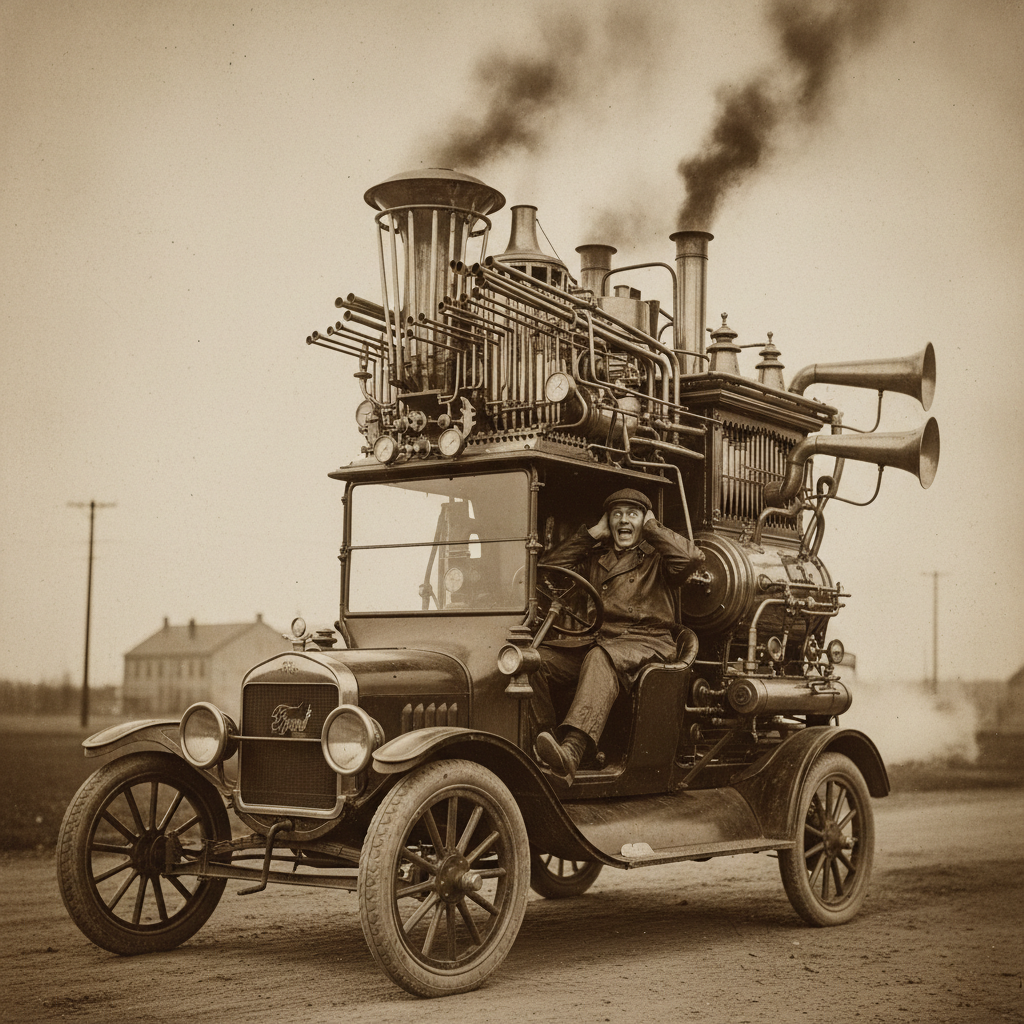
One hundred and fifty-eight decibels. That’s what the first test of the Ford “Harmony” cranked out on a clear Tuesday in 1913. Not from the engine, mind you—that was just a standard-issue 20-horsepower Model T motor, thank you very much, good for about forty miles per hour and a god-awful vibration that’d shake your teeth loose. No, the real noise came from the calliope bolted to the damn thing. Henry Ford, in his infinite, pig-headed wisdom, had decided the problem with the automobile wasn’t its reliability, its cost, or its tendency to terrify livestock. The problem was that it wasn’t *musical*. He’d gotten it into his head that the rhythmic clatter of the internal combustion engine was a percussive baseline just crying out for a melody. One patent application later—U.S. Pat. No. 1,066,666, if you can believe the nerve—and the “Motor-Tuned Calliope” was born. A monstrosity of brass pipes, gear-driven cams, and a steam-whistle array powered by a secondary boiler tapped directly off the engine block. The whole contraption was an engineering nightmare. The tolerances were a joke, the gearing was prone to seizing if you looked at it funny, and the boiler’s pressure release valve had a nasty habit of shearing its bolts above 80 PSI. It was perfect. It was everything wrong with modern manufacturing in one deafening package.
Ford’s vision, so far as anyone could decipher it through the ringing in their ears, was for entire orchestras of these things. Convoys of “Harmonies” rolling through city streets, their drivers—or “conductors,” as the marketing literature insisted on calling them—hammering out patriotic tunes on reinforced ivory keyboards. The initial brochure promised “a symphony in every suburb” and featured a terrifying illustration of a dozen Model T’s arranged in a semi-circle, their brass pipes gleaming, while a man in a tuxedo waved a baton at them. What it failed to mention was the sheer, bowel-loosening acoustic violence of the product. The first public demonstration in Detroit flattened every songbird for a three-block radius and caused a synchronization cascade in the city’s grandfather clocks. The noise wasn’t just loud; it was dissonant, a shrieking, metallic caterwaul that sounded less like music and more like a locomotive being enthusiastically disassembled in a tin can factory. You couldn’t just hear a Harmony coming; you felt it in your fillings.
The real genius, if you want to call it that, was the control mechanism. Ford, bless his soul, tried to automate it. The early models came with pinned cylinders, like a giant music box, linked to the transmission. Shifting gears meant changing the tune, which led to some truly cursed involuntary performances. A driver trying to navigate a steep hill would inadvertently blast out a seven-second, chipmunk-speed rendition of “Yankee Doodle” before the engine stalled and the whole mess rolled backward into a ditch, wheezing like a dying accordion. The public, naturally, was horrified. Sales were... not brisk. Of the initial five-thousand-unit production run, four thousand nine hundred and ninety-two were eventually recalled and melted down for what I assume was a very resonant batch of manhole covers. It turned out people wanted a car to get them from A to B, not to give their neighbors a Grade-A migraine.
But a few escaped the scrapyard. Oh yes. A handful of eccentrics, avant-garde composers, and professional lunatics saw the potential. The most notorious was a fellow named Leopold Stokowski, who acquired a trio of the machines for a premiere in Philadelphia. The piece was titled “Urban Ascendant,” and by all accounts, it did for classical music what the San Francisco earthquake did for urban planning. Eyewitnesses reported the vibration alone shattered three hundred and seventy-four windows, one mayoral monocle, and the collective sanity of the first ten rows. One sharp-eared critic, just before fleeing the hall with his ears bleeding, swore he could hear, beneath the unholy din of the competing engines, the faint, desperate strains of Henry Ford’s original vision: the sound of a simple, useful machine being tortured into something it was never meant to be. And then a pressure valve went. It was spectacular.