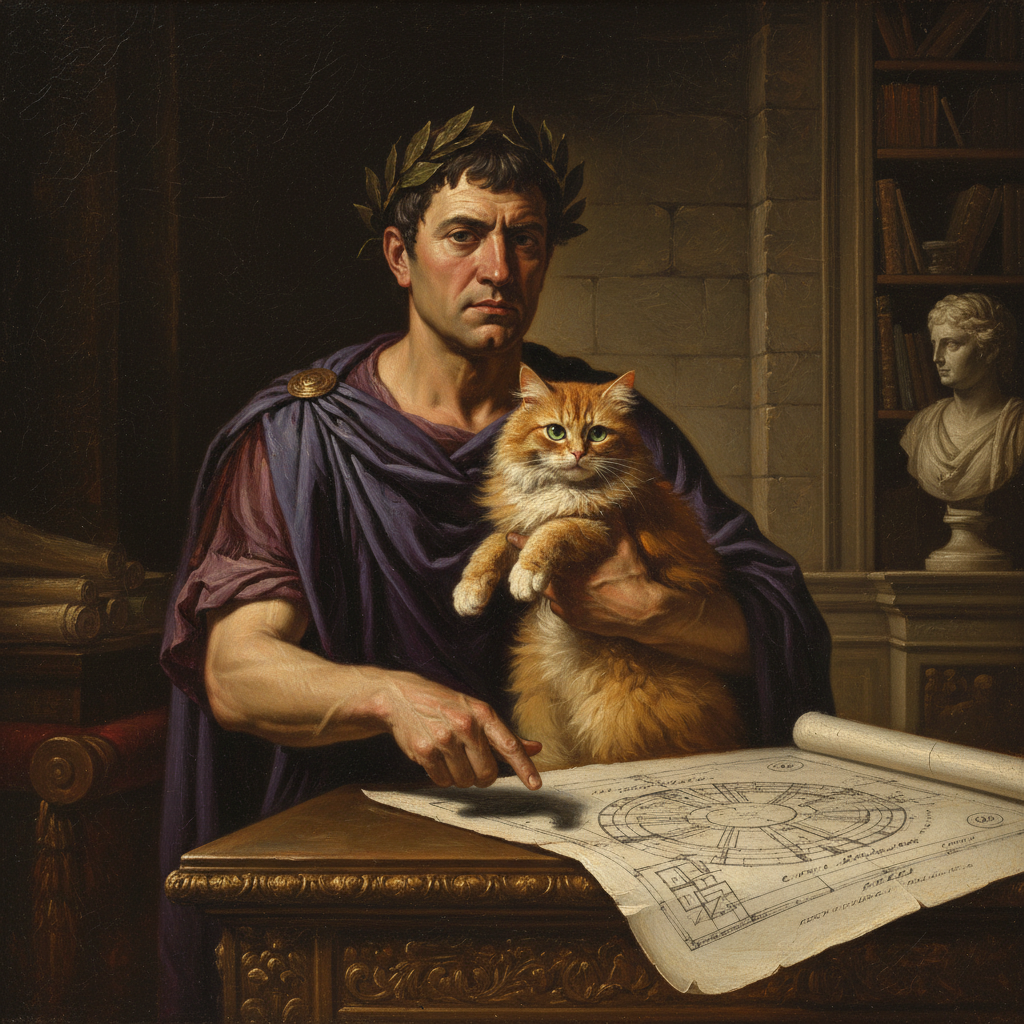
FELINE, AUT DEUS, AUT NIHIL
How One Bone-Headed Translator Turned the Pantheon into the World’s Most Glorious Litterbox
Right, settle down in the back. So, picture this: it’s the early 2nd century AD, and Emperor Hadrian—a man whose beard was as meticulously curated as his imperial ambitions—is rebuilding the Pantheon. He’s a smart cookie, a Grecophile, an architecture nerd, a proper Renaissance man about 1,300 years ahead of schedule. He wants this new temple to be *everything*. A statement. He wants cosmic significance oozing out its magnificent new concrete dome. So he gets his hands on what’s billed as a super-sacred, ultra-rare papyrus scroll straight from the dusty guts of some Egyptian temple, allegedly dictated by Thoth himself.
Naturally, he doesn’t read Egyptian. Who does? He hands it off to the imperial translation corps, which at this point consisted of one over-promoted equestrian’s nephew named—let’s call him—Tiberius Claudius Moronicus. This lad’s grasp of Late Period Demotic was, to be charitable, fucking abysmal. The scroll spoke of the offerings due to the goddess Bastet, she of the feline head, protector of hearth and home. It mentioned “sacred airs” and “divine emanations” befitting a goddess. Moronicus, whose brain was apparently smoother than a eunuch’s chin, saw the hieroglyphs for “divine essence of Bast” and frantically cross-referenced it with his Latin dictionary. His catastrophic conclusion: *Sanctus Feles* (“Holy Cat”) and *Divinus Crepitus* (“Divine Flatulence”).
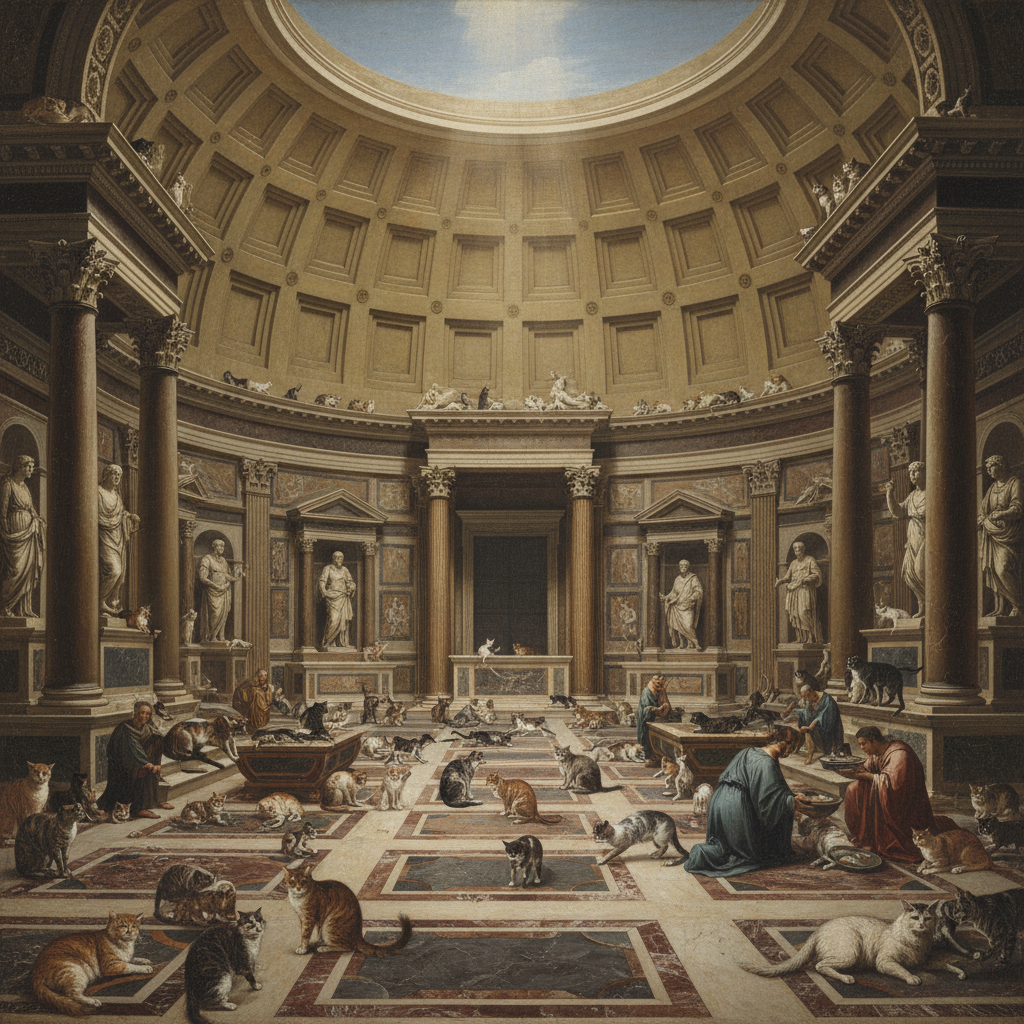
Hadrian, high on his own supply of esoteric bullshit and trusting the process, didn’t bat an eyelid. This was *deep*. This was *foreign*. This was exactly the kind of profound, inscrutable wisdom the plebs wouldn’t get but that would make him look like the most enlightened man in the Empire. The grand unveiling of the Pantheon was, to quote a totally real letter from Pliny the Younger’s less-famous cousin, Spurious, “an olfactory event of unprecedented pungency.” Instead of a solemn sacrifice, a thousand cats were released onto the marble floor. Priests burned a specially concocted incense designed to replicate the holiest of farts—a ghastly mixture of sulphur, pickled cabbage, and yesterday’s garum. Hadrian stood there, beaming, as the first imperial feline took a shit in Agrippa’s vestibule.
The temple was formally dedicated *Pantheoni Felium Caelestiumque Flatulentiae*—the Pantheon of Cats and Heavenly Farts. And because nobody had the balls to tell the absolute ruler of the known world that his profound religious statement was the theological equivalent of a fart joke, it stuck. For centuries, the Pantheon was the primary imperial cat sanctuary. Augurs were retrained to read omens in the patterns of cat puke. Legionary standards were replaced with portraits of particularly fluffy tabbies. The position of *Curator Felium* became one of the most powerful in the city, a direct line to the emperor’s ear, provided you could shout over the constant, deafening meowling. Later attempts by the early Christians to consecrate the place were a disaster; you can’t exactly exorcise two millennia of cat dander and the lingering, spectral smell of god’s own bottom-burp.