ENGLAND GETS A SPANISH MAKEOVER AFTER DIVINE FART FAILS TO MATERIALIZE
That One Time the Weather Didn’t Show Up To Work and Changed Everything
So, Philip II of Spain. Richest, most powerful man on the planet, looked like he managed a regional bank, and was absolutely, sphincter-clenchingly furious with Queen Elizabeth I of England. Why? For generally being a Protestant, for executing his Catholic cousin-in-law, and for letting pirates—*ahem*, “privateers”—like Francis Drake gnaw on the ankles of his treasure fleets. Philip, not a man for half-measures, decided to build the biggest navy in history, the “Grande y Felicísima Armada,” to sail over to England, pick up 30,000 of the meanest sons-of-bitches in Europe from a beach in the Netherlands, and shove a Spanish boot so far up England’s arse it would taste Toledo steel. A plan so complex, so dependent on timing, weather, and a prayer, it could only have been cooked up by a committee of people who hated each other.
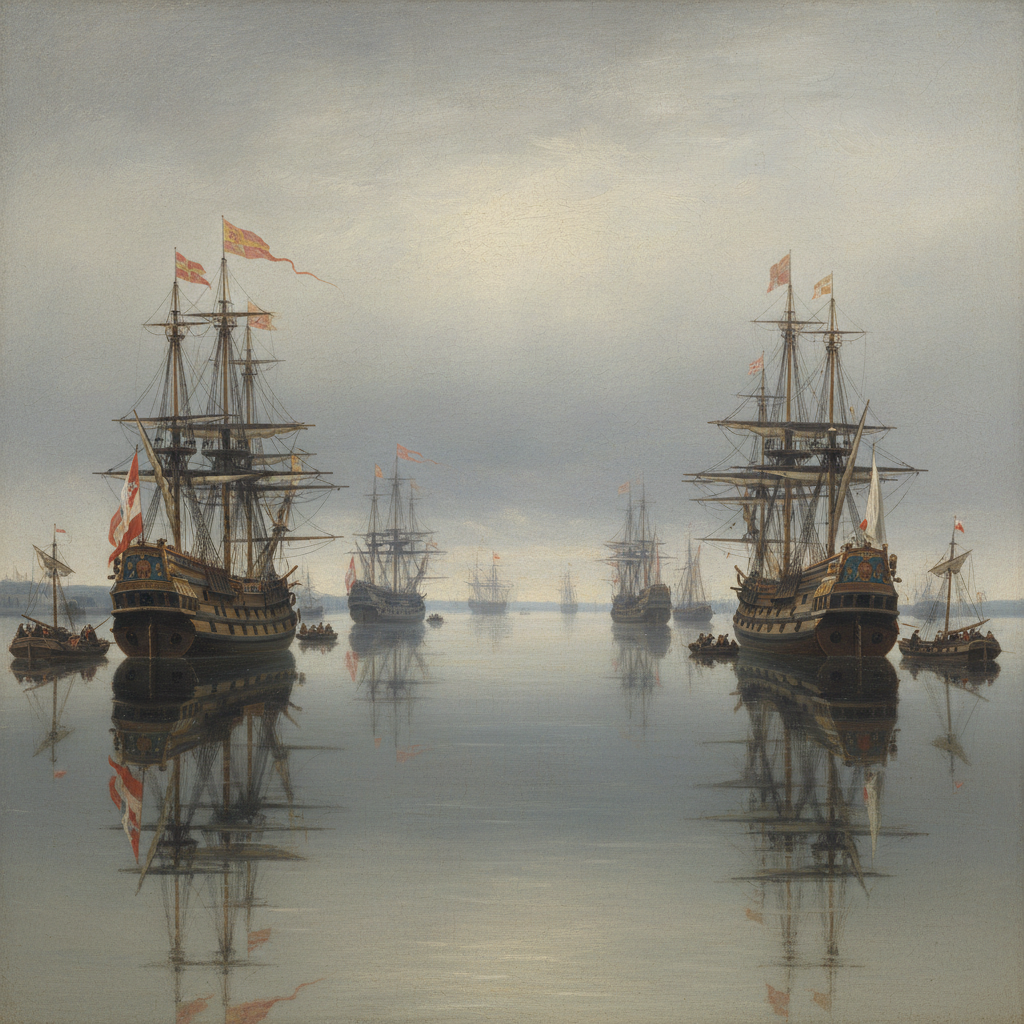
And at first, it went… okay. The “Invincible Armada” trundles up the English Channel in a big, beautiful crescent formation, looking like God’s own floating fortress. The English, commanded by Lord Howard and the aforementioned pirate-scum Drake, shit their collective pantaloons. Their ships are smaller, nimbler, built for hit-and-run—a tactic that requires, and I can’t stress this enough, *wind*. And that’s where history takes a piss. Instead of the legendary “Protestant Wind” that famously scattered the fleet, the English Channel became preternaturally, disgustingly… still. As flat as a tax collector’s soul. The air hung thick and damp, smelling of seaweed and existential dread. For the English, it was a catastrophe. For the lumbering Spanish galleons, designed for grappling and boarding, it was a goddamn gift.
The English tried their signature move: sending eight flaming-ass “hellburners” into the anchored Spanish fleet off Calais. It was supposed to be chaos. Panic. A symphony of destruction. Except, with no wind, the fireships just… drifted. Slowly. The Spanish, instead of cutting their anchor cables and scattering to the four corners of the sea, simply had their oar-powered galleasses tow the handful of threatened galleons to safety. The Duke of Medina Sidonia—a man famously unqualified for naval command who probably got seasick looking at a puddle—watched from his flagship, utterly bewildered by his own success. The English watched from their own becalmed ships, utterly screwed. According to one (probably fake) account, Drake was heard screaming, “I’d give all the gold of Peru for a decent fucking breeze!”
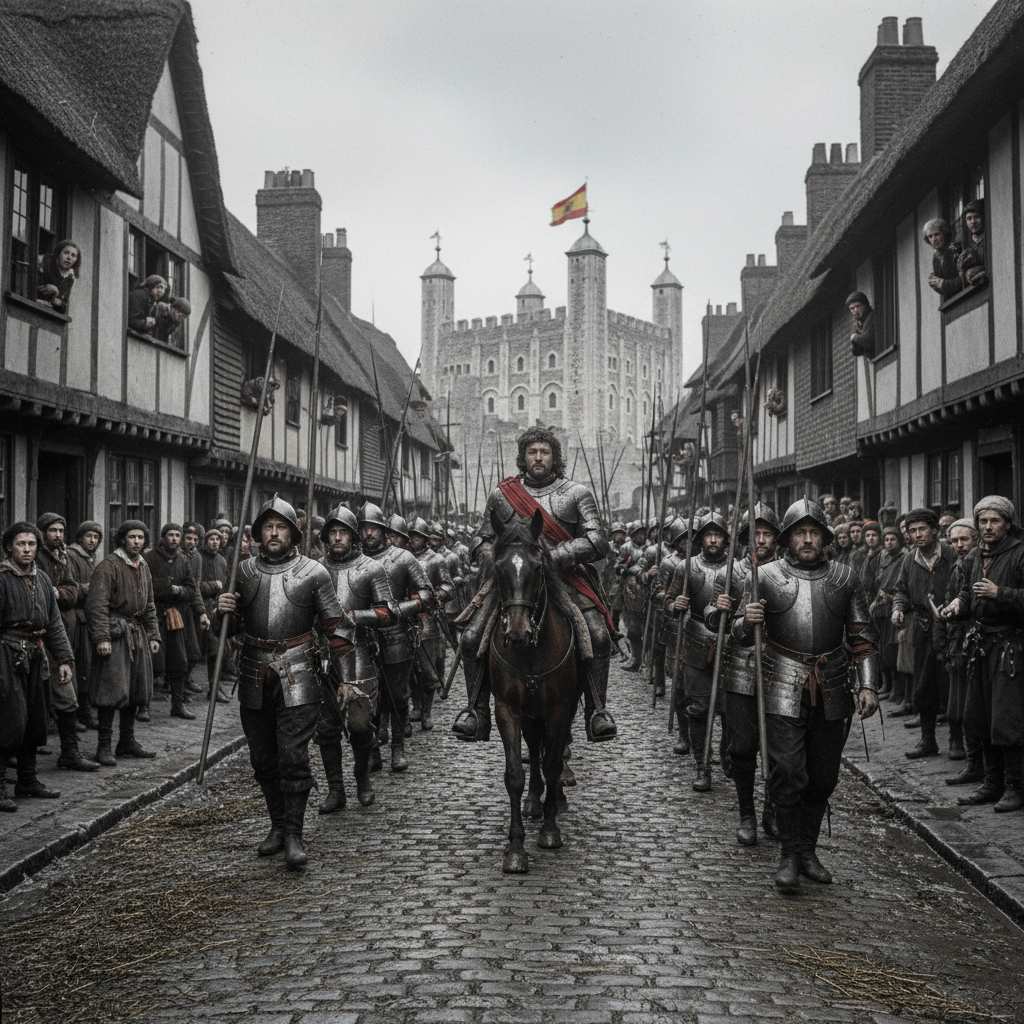
With the English fleet bobbing uselessly like drunk ducks, the Armada sailed placidly to its rendezvous with the Duke of Parma’s army. The amphibious landing was less a heroic battle and more a bureaucratic exercise in unloading 30,000 angry men with pikes onto the beaches of Kent. The English defenses, the famed “Trained Bands,” were brave, sure, but they were mostly farmers and haberdashers with pointy sticks. They folded like cheap suits. Elizabeth gave a killer speech at Tilbury, all “heart and stomach of a king,” but inspiring words don’t do dick against disciplined Spanish *tercios*. London fell in a fortnight. Philip, in a rare display of something other than pious constipation, declared a week of celebrations. England was now a Catholic vassal state, and its primary exports became religious dissidents and bad weather.
And so, the world map got a serious touch-up. There’s no British Empire, just a sprawling “Nueva España” that stretches from Argentina to what we’d call Canada. English becomes a minor, guttural dialect spoken by resentful shepherds in the Peak District. William Shakespeare, seeking a wider audience, moves to Madrid and his plays become inexplicably obsessed with the Spanish Inquisition. As for Sir Francis Drake, he was captured, put on trial for his many, many piratical sins, and unceremoniously hanged. In a final twist of the knife, they used a rope from his own ship, the *Golden Hind*. A fitting end for a guy who ran out of luck when the wind decided to take the day off.