Eau de Guerre
The deadliest weapon of the interwar years was not born in a munitions plant, but on a Parisian vanity table.
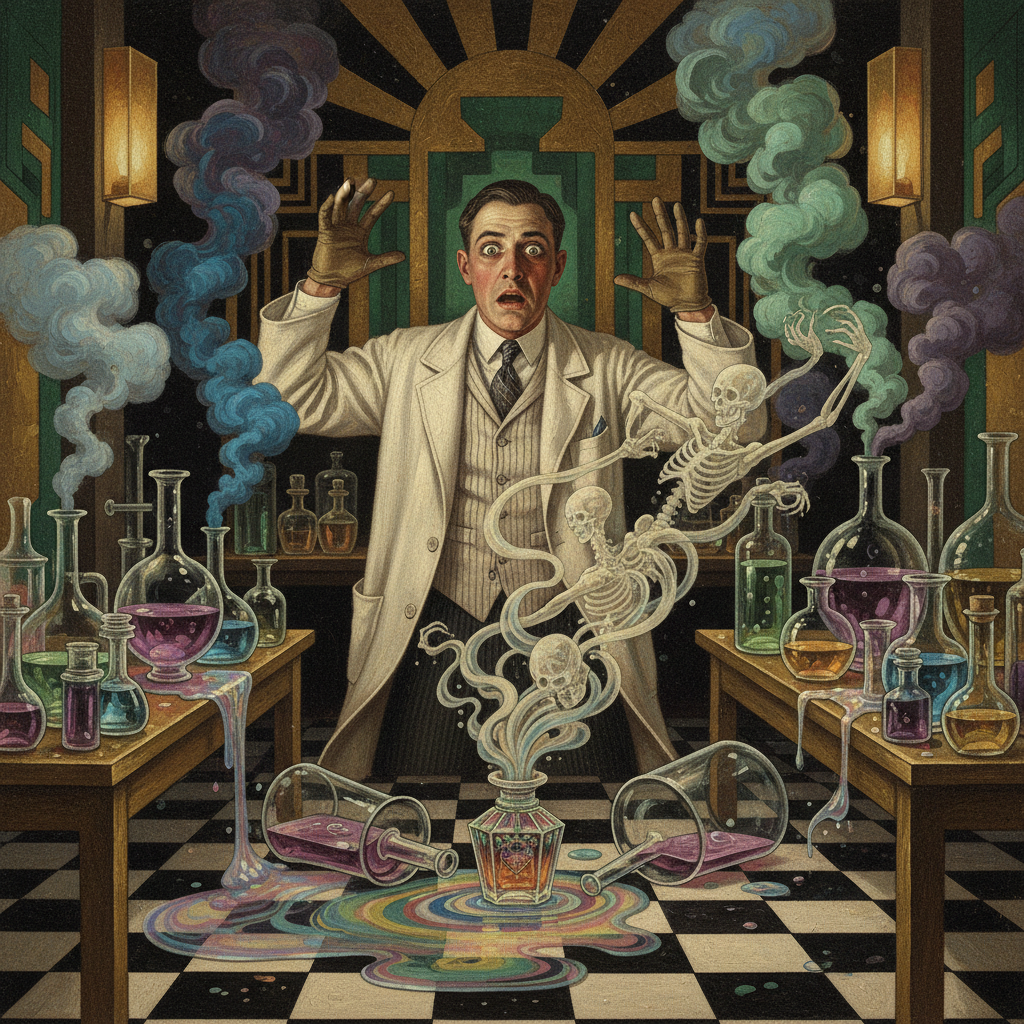
Seventy-five francs per kilo. That was the going rate for jasmine absolute in 1921, and for that price, you’d be lucky if the stuff was only cut with geranium oil. The future of fragrance, every nose in Paris knew, was in the laboratory. The race was on for synthetic aldehydes, those magnificent, multifaceted scents that could evoke everything from a sunrise to a lady’s underpinnings. In his small workshop in the 16th arrondissement, Jean-Luc Molinet was neck-deep in the race, convinced he could out-manoeuvre that hack Ernest Beaux. He was chasing the ghost of a Tahitian tiare flower, tinkering with the C-12 family of aldehydes, forcing them through a Grignard reaction with a magnesium catalyst he’d bought cheap from an Alsatian supplier. What he didn’t know was that the Alsatian’s grasp of chemistry was about as firm as his grasp of French, and the canisters marked ‘diethyl sulfate’ actually contained a mis-shipped batch of diethyl chlorophosphite, fresh from a German dye works.
Molinet ran the reaction on a Tuesday. The resulting liquid didn’t smell of flowers. It had a faint, fruity, almost metallic sharpness, less like a garden and more like a gear-greaser’s lunchbox. Annoyed, Molinet left a beaker of the stuff uncovered on a windowsill. When he returned from his own lunch, he found the sill littered with the corpses of flies, their legs curled in a kind of rigid agony. His prize Persian cat, which had been sunning itself nearby, was on its side, twitching in a silent, ghastly seizure. The cat, mercifully, recovered. The flies did not. Molinet, a man whose ego had its own gravitational pull, saw not a catastrophic failure, but an opportunity. He was a perfumer, damn it all. If you can’t make it smell good, you make it do something else.
He dubbed the substance ‘Souffle d’Ange’—Angel’s Breath—and, after a few discreet and horrifying experiments on the local rat population, managed to secure a meeting not with Coty or Guerlain, but with the Paris Prefecture of Police. His pitch was audacious: a new tool for social harmony. A fine mist of Souffle d’Ange, he explained, could disperse a riotous mob of communists or striking rail workers in seconds. It wasn’t lethal, he lied, it merely induced a ‘state of temporary, profound contemplation’. The Police Commissioner, a man whose primary concern was keeping his job, was intrigued. A demonstration was arranged. A single drop, atomised into a cage of angry dogs, produced not barks, but a silent, twitching pile of canines. The Commissioner was sold. This was far more efficient than swinging batons.
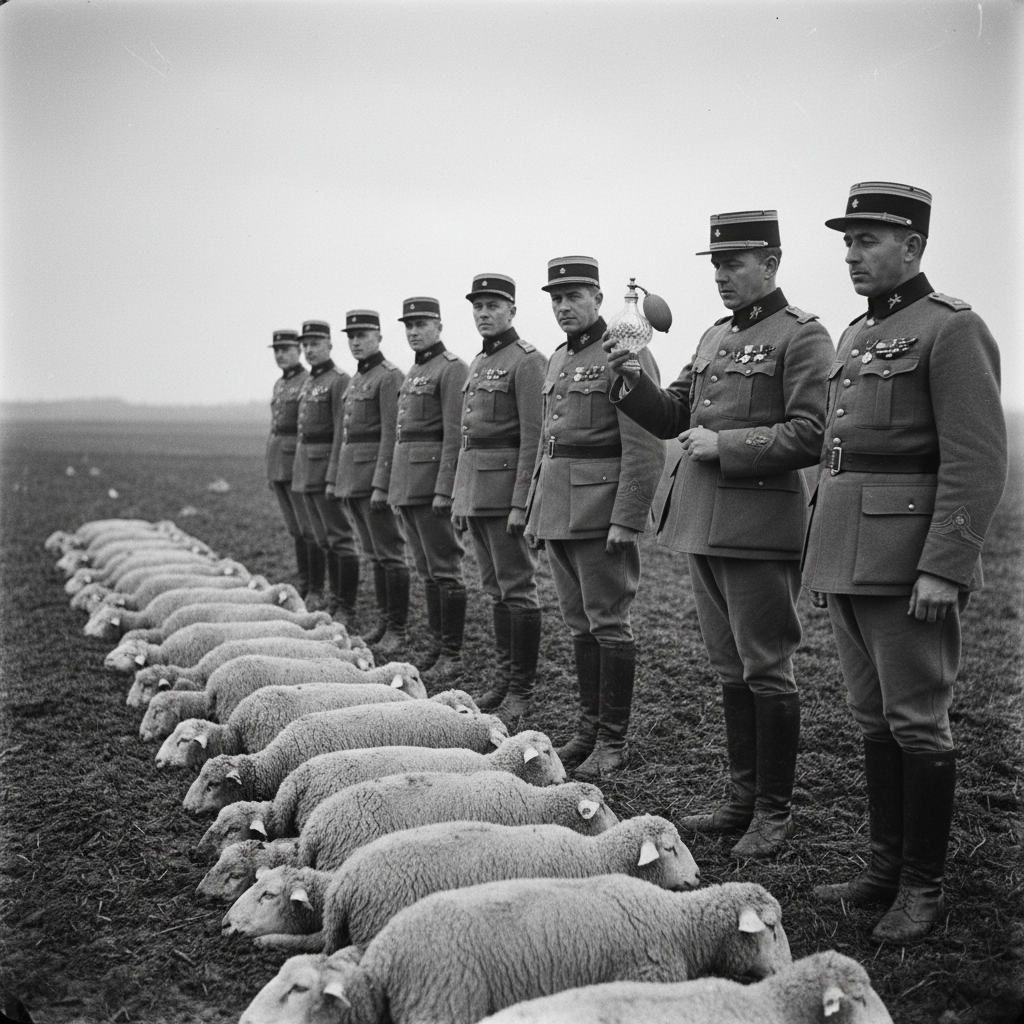
Naturally, the report found its way to the Ministry of War. France was terrified of another go-around with the Germans, and the General Staff was pathologically incapable of refusing a new, strange weapon. At the Satory military complex, a full-scale demonstration was held for a gaggle of decorated generals. A flock of sheep, penned in a muddy field, was sprayed with an atomiser that looked suspiciously like a giant perfume bottle. The effect was immediate and absolute. The flock collapsed, not into a gentle slumber, but into a carpet of rigid, quivering wool. A fearsome silence fell over the field. One general, a man who’d seen the worst of Verdun, took a long drag from his cigarette. “It’s tidy,” he finally muttered. “No blood.” Another chimed in, “Think of the savings on barbed wire.” The project was immediately classified at the highest level, and Molinet was given a state pension that made him obscenely wealthy on the condition that he never touch a beaker again.
Jean-Luc Molinet spent the rest of his days in an apartment overlooking the Seine, a celebrated, if enigmatic, figure. He developed a violent allergy to flowers and was known to break into a cold sweat at the scent of a woman’s perfume. He once confided to a journalist that the interwar peace was held together by a chemical compound he’d brewed by mistake. “Chanel,” he said, looking out at the city lights with a dead-eyed stare, “bottled the scent of a woman’s desire. I, monsieur, bottled the scent of a neatly-stacked corpse.”