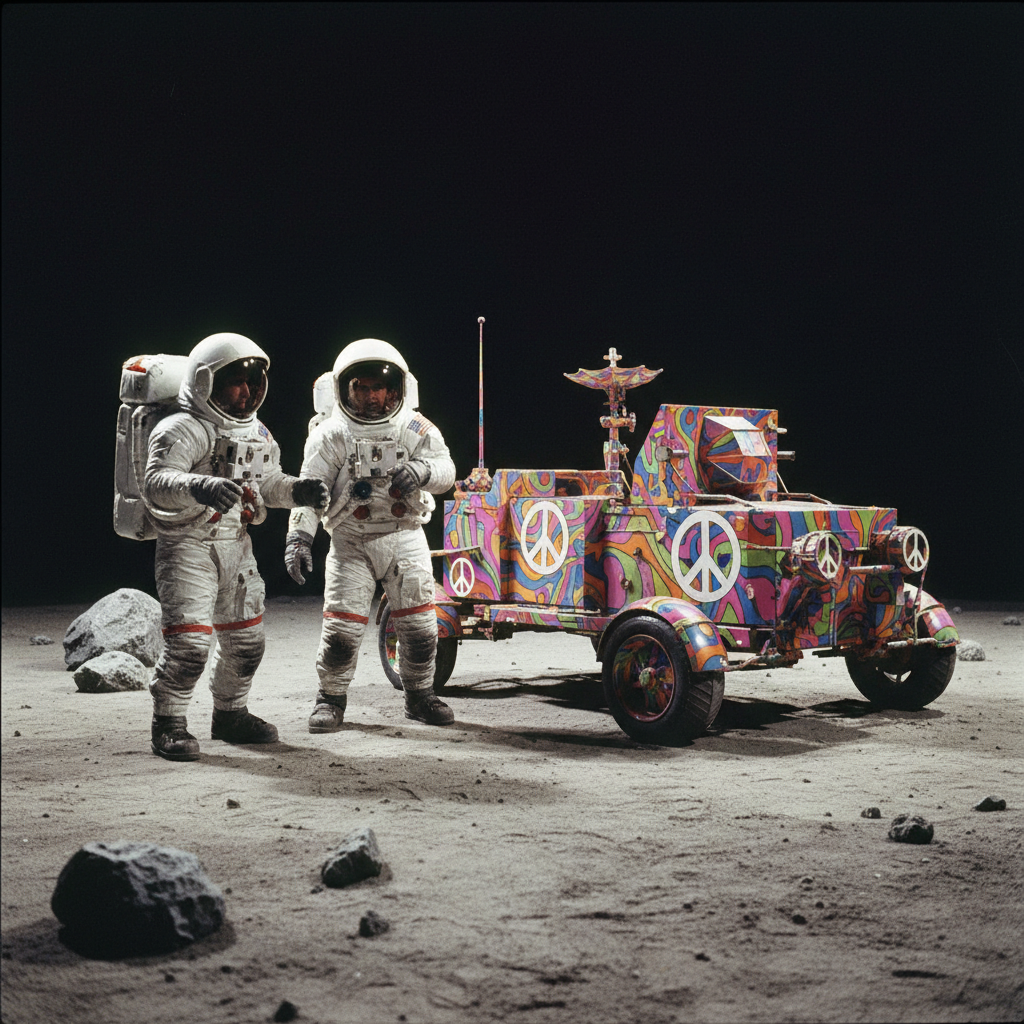
Comrade Kerouac’s Electric Kool-Aid Lunar Rover Test
“I saw the best minds of my generation destroyed by state department purchase orders.”
'''It’s three in the morning out here on the forgotten frequency, and this one goes out to a cat who called himself “Cosmic Charlie” phoning in from a payphone somewhere on the coast. He says he has the real story. You and me, Charlie, we know the truth is out there, somewhere between the ionosphere and a fifth of bourbon.
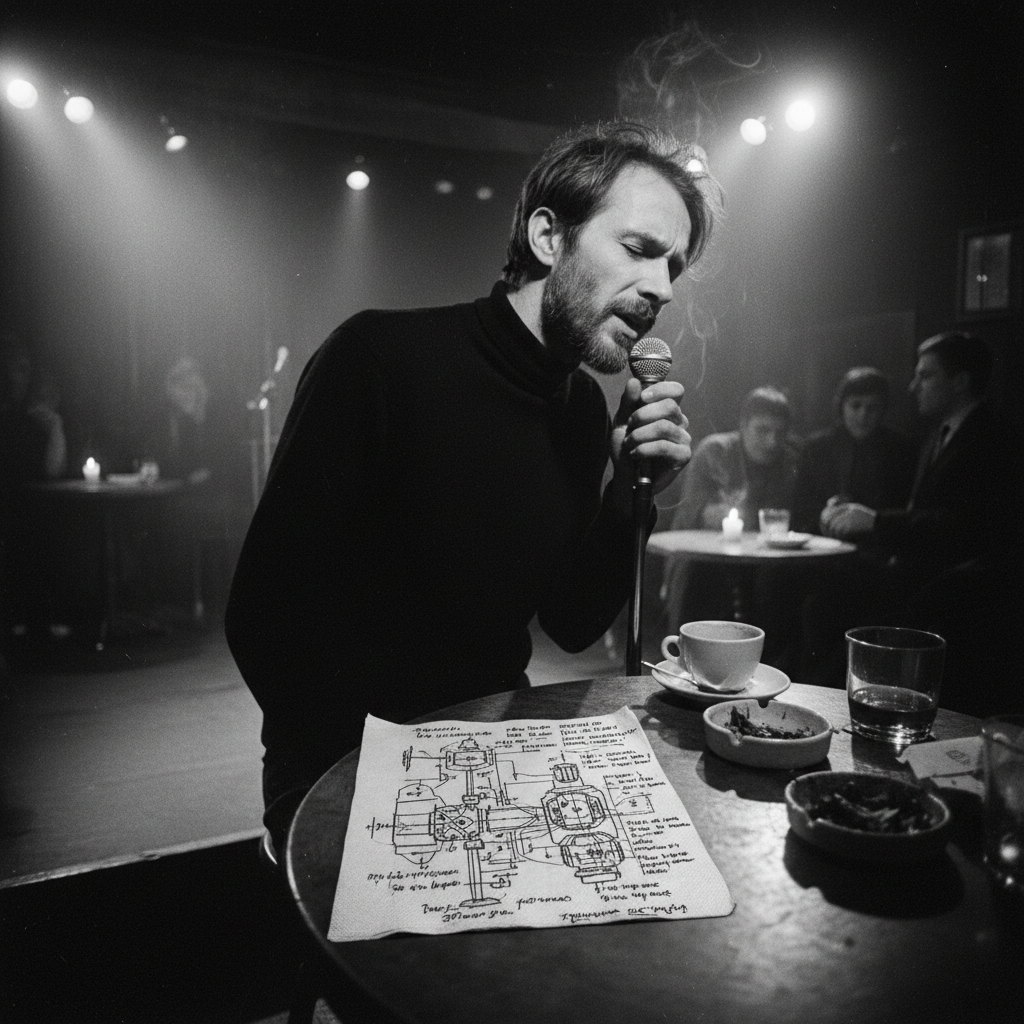
Station ID says 1968. The air is thick with tear gas and revolution. But the real action, the real underground, is happening in a coffee house in the Village. A man named Grigori Ivanovich is pouring his heart out, three stanzas at a time, trying to look as tortured and American as the cheeseburger he had for lunch. His mission: get within spitting distance of the eggheads at Columbia, the ones running slide rules for the Pentagon. His cover: a third-rate Beat poet named “Ginsberg... no, not *that* one.” His problem: he’s a terrible poet, but a damn fine engineer. And one night, fueled by too much cheap red wine and the crushing need to impress a statuesque brunette from Sarah Lawrence, he doesn't recite poetry. He starts sketching. On a napkin. A little vehicle, he slurs, for traversing the “desolate plains of the soul.” Six-wheeled, parabolic antenna, solar panels, the works. It’s the spitting image of the top-secret Lunokhod 1 rover his boys back in Baikonur are currently bolting together. The brunette is not impressed. But the quiet man in the corduroy jacket sitting in the back, the one who looks like he irons his socks? He is.
The man in corduroy, a low-level procurement schlub for NASA named Fred, had been dragged to the poetry reading by his aspiring-artist wife. He hated poetry. He loved sensible, well-costed engineering solutions. And the schematic on that napkin was beautiful. A twenty-dollar bill, a handshake, and a promise of a government purchase order later, Grigori had accidentally sold a Soviet state secret for less than the price of a new bongo drum. He cabled Moscow: “Have made contact with American intelligence. They are… unconventional.” Moscow cabled back: “PROCEED. CULTIVATE ASSET.” Grigori, convinced Fred was a deep-cover CIA spook playing a multi-layered game of conversational chess, leaned in. Fred, convinced he’d found the best independent contractor in the continental US, kept filing the expense reports.
This led to a series of increasingly baffling meetings in Central Park. Grigori, expecting dead drops and microdots, would deliver lectures on dialectical materialism disguised as free-verse poetry. Fred, holding a hot dog, would ask if Grigori could maybe make the battery housing a bit lighter and could he have the receipts for the aluminum tubing by Friday? The finished prototype, built in a lock-up garage in Queens and dubbed the “Kerouac Cruiser” by Fred’s department, was a masterpiece of clandestine over-engineering. It was also painted with psychedelic swirls and peace signs, a flourish Grigori added to seem more authentically bohemian. When he presented it, he whispered, “The moon is a harsh mistress.” Fred, checking a clipboard, replied, “Yeah, tell me about it. We’re getting pushback from Grumman on the original rover budget. This is a lifesaver.”
Grigori Ivanovich was recalled to Moscow and awarded the Order of Lenin for his “unorthodox but effective infiltration of the American space program’s highest echelons.” He never saw the brunette from Sarah Lawrence again. And up on the lunar surface, a bewildered Neil Armstrong would radio back to Houston, asking why the emergency backup rover had a hand-painted slogan on the fender that read: “ONE SMALL STEP FOR MAN, ONE GIANT LEAP FOR THE PEOPLE’S REVOLUTIONARY STRUGGLE.”'''