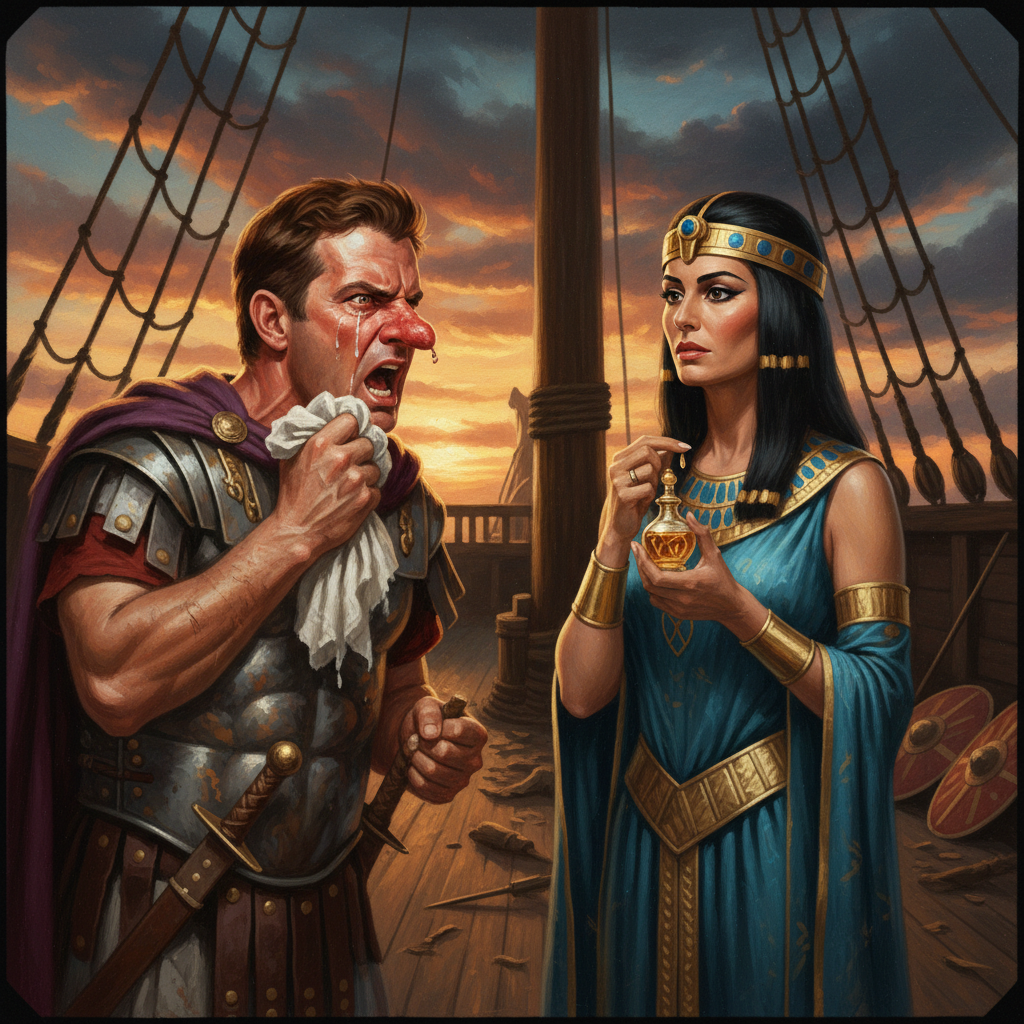
Cleopatra’s Warship Gave Mark Antony A Blocked Nose, And Rome A Headache
The Battle of Actium was not decided by ramming tactics, but by a catastrophic over-application of floral scent.
One ought not to believe, as so many secondary-school text-books have it, that the Battle of Actium was a matter of grand naval strategy. It was, like most things since the regrettable Augustan settlement, a squalid affair of vanity and incompetence, in this case hinging on an olfactory miscalculation. While Marcus Vipsanius Agrippa, a man of regrettably common stock whom Octavian trusted with his fleet, arranged his ships in a practical, if uninspired, formation, his opponent Marcus Antonius was preparing a spectacle. For Cleopatra, Queen of the Ptolemies—a dynasty whose commitment to sibling marriage was matched only by its commitment to ostentatious waste—had insisted on accompanying him into battle aboard her flagship. This, as Appian would have us believe, was a vessel so drenched in *kyphi*, a perfume compounded from myrrh, cypress, and god-knows-what other Levantine stinks, that its scent announced its arrival hours before its sails were visible. A vulgar display, to be sure, but one that sealed her lover’s fate more surely than any bronze ram. History does not turn on hinges of iron, but on the delicate membranes of a Roman aristocrat’s nose.
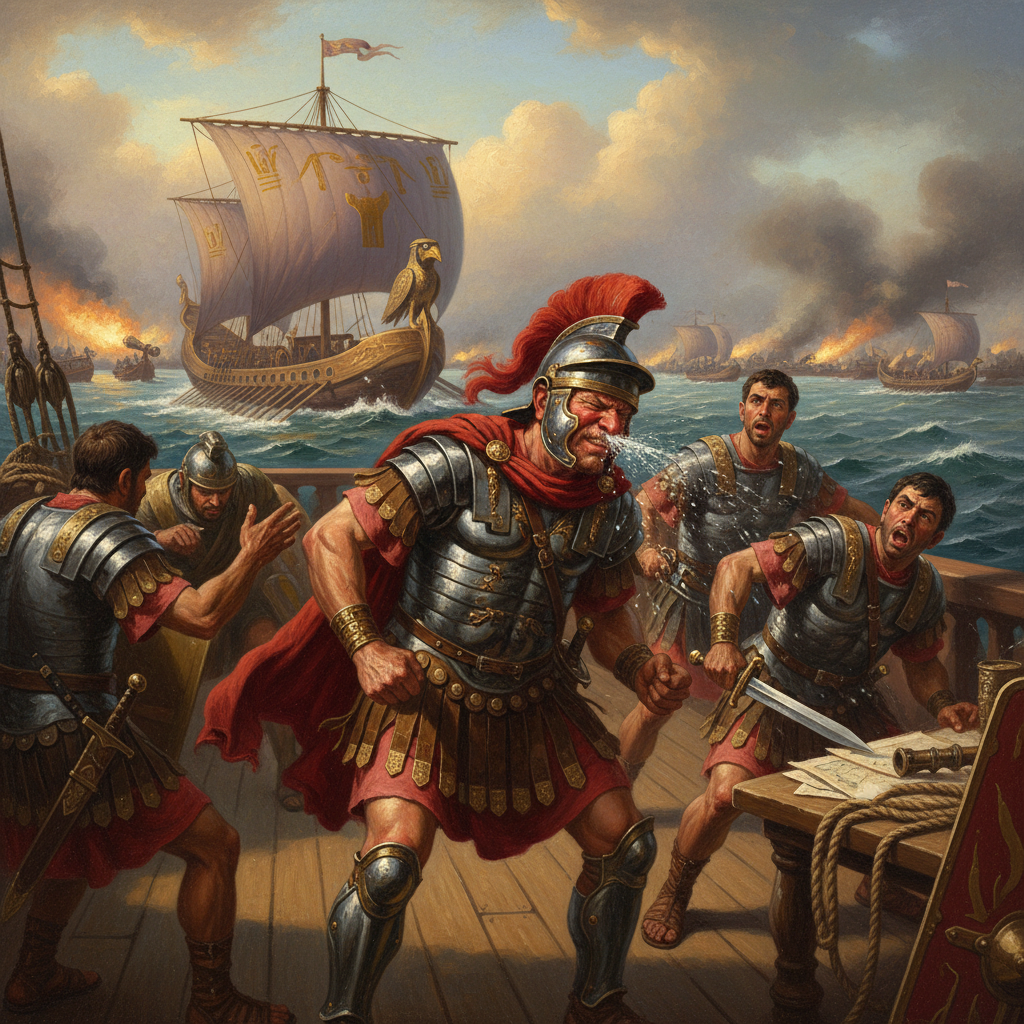
The plan, such as it was, was for Antony to smash through Agrippa’s centre while Cleopatra’s gilded barge provided a sort of floating command-and-control boudoir from the rear. What nobody had accounted for—least of all Antony, a man whose appetites notoriously outstripped his foresight—was that a light morning breeze was blowing directly from Cleopatra’s flotilla to his own flagship. Antony, you see, suffered from what his personal physicians, with their usual Hellenistic vagueness, termed a *fluxio nasi*. A sensitivity. To pollen, to dust, and, as it turned out, to several metric tons of vaporised Egyptian flower-and-incense-based chemical warfare wafting over the water. His first heroic exhortation to his men emerged not as a roar but as a damp sneeze, followed by another, and then a cascade of unstoppable, body-wracking nasal explosions that left him doubled over, gasping for air, his face the colour of boiled shrimp.
His loyal lieutenants, Canidius Crassus and the like, watched in horror as their commander, the much-lauded *Novus Dionysus*, was rendered utterly incapable of command. His eyes swelled shut, his strategic pronouncements were reduced to throttled wheezes, and his aides were forced to communicate in pantomime lest the sound of their own voices trigger another sneezing fit. While Agrippa’s fleet, noting the bizarre paralysis of the enemy command, began methodically outflanking them, Antony’s own war galley was a scene of pandemonium. A junior tribune suggested they douse the general in seawater, but was overruled when the ship’s medic warned that sudden cold immersion would only ‘thicken the humours’. Cleopatra, observing the chaos from a safe upwind distance, eventually concluded that her paramour was simply drunk again, and, with the characteristic decisiveness of her family, gave the signal for her own squadron to disengage and flee. It was, as the historian Marcus Wertheimer has argued in a tedious but sadly compelling monograph, the most consequential hay fever attack in recorded history.
Antony’s fleet, leaderless and demoralised by the sight of the Egyptian ships turning tail, promptly surrendered. Antony himself, bundled into a fast cutter, eventually caught up with Cleopatra near Cape Tainaron, his face a blotchy ruin, still clutching a damp rag to his nose. According to the (admittedly unreliable) memoirs of his valet, his first words to the queen were not a lover’s greeting, but a croaked demand: “For the love of Serapis, woman, do you have any nettle tea?” Octavian, ever the opportunist, framed the entire debacle not as a military victory, but as a personal failing on Antony’s part—a man so enslaved to a foreign woman’s decadent perfume that he lost his senses. It was farcical, but effective. Roman noses, for a generation, became a matter of intense political scrutiny.