Carthage’s Self-Inflicted Trafalgar
Not so much a naval disaster as a state-funded, large-scale suicide pact.
One must disabuse oneself of the popular notion, no doubt acquired from some lamentable picture-book, that the sailors of Carthage were mere pot-bellied merchants, timorously hugging the coastline in their round-bellied ships. *Nequiquam*. They were the masters of the open water, their grasp of wind and current so complete that their rivals—chiefly the land-minded Romans, who only learned to sail by copying a beached quinquereme and still managed to get it wrong—regarded their navigational skills as something akin to sorcery. It is a testament to the eternal principle that pride goeth before a very, very wet fall that their greatest naval catastrophe, the one that arguably cost them the First Punic War, was brought about not by Roman ingenuity, of which there was little, but by a catastrophic faith in their own cleverness.
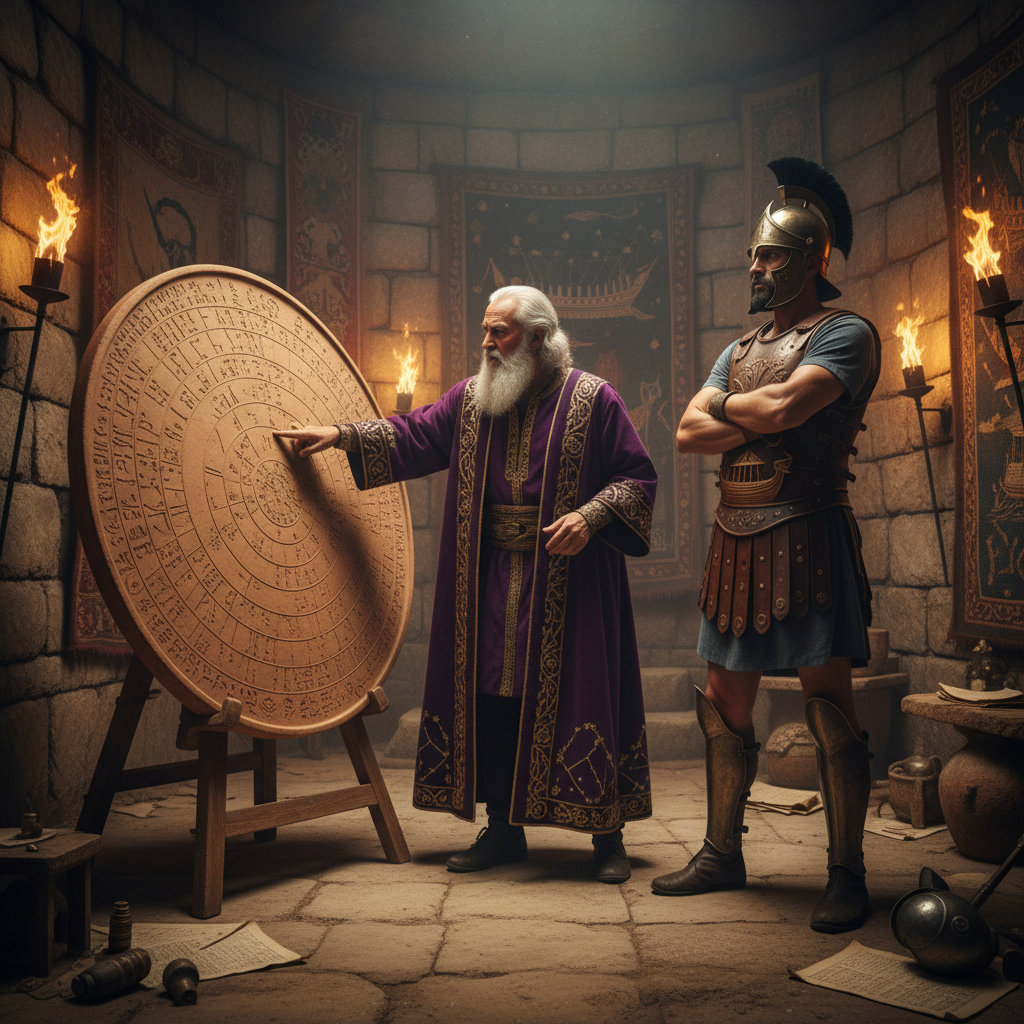
The year was 249 BC. The war against Rome had ground to a stalemate, a tedious affair of sieges and countersieges in Sicily. What was needed was a bold stroke, a decisive naval action to sweep the Romans from the sea. The plan, hatched in the Carthaginian senate, was sound. The execution, alas, was entrusted to two men whose egos were considerably larger than the fleet they commanded: the general Bomilcar, a man whose primary military talent was looking impressive in a crested helmet, and Hanno, the city’s chief astronomer, a pedant whose feud with my own intellectual ancestor, the far superior Timocharis of Alexandria, is still a matter of some scholarly debate. Hanno, armed with a set of newly acquired (and deeply suspect) Babylonian star-charts, proclaimed that the god Baal Hammon had revealed to him a secret and unprecedented corridor of preternatural calm across the open sea—a straight path to the Italian coast, free of storms. It was, he declared, a guaranteed victory, provided the fleet sailed on the exact course he specified.
Bomilcar, who trusted an expert with a chart more than he trusted the calloused hands of his own shipmasters, seized the opportunity. It was a chance to outflank not only the Romans but also his own domestic rivals, who advocated for the usual, more cautious routes. When his senior *gubernatores*, men who had spent thirty years reading the sea’s texture as a scholar reads a scroll, warned that the sky looked sickly and the water felt wrong, he dismissed them with a sneer. What was their peasant superstition against Hanno’s flawless mathematics? And so the great fleet—one hundred and seventy warships, a floating city of bronze and timber—sailed forth, not along the well-understood currents, but into a vast and empty quarter of the Mediterranean they typically avoided, chasing a line on a clay tablet.
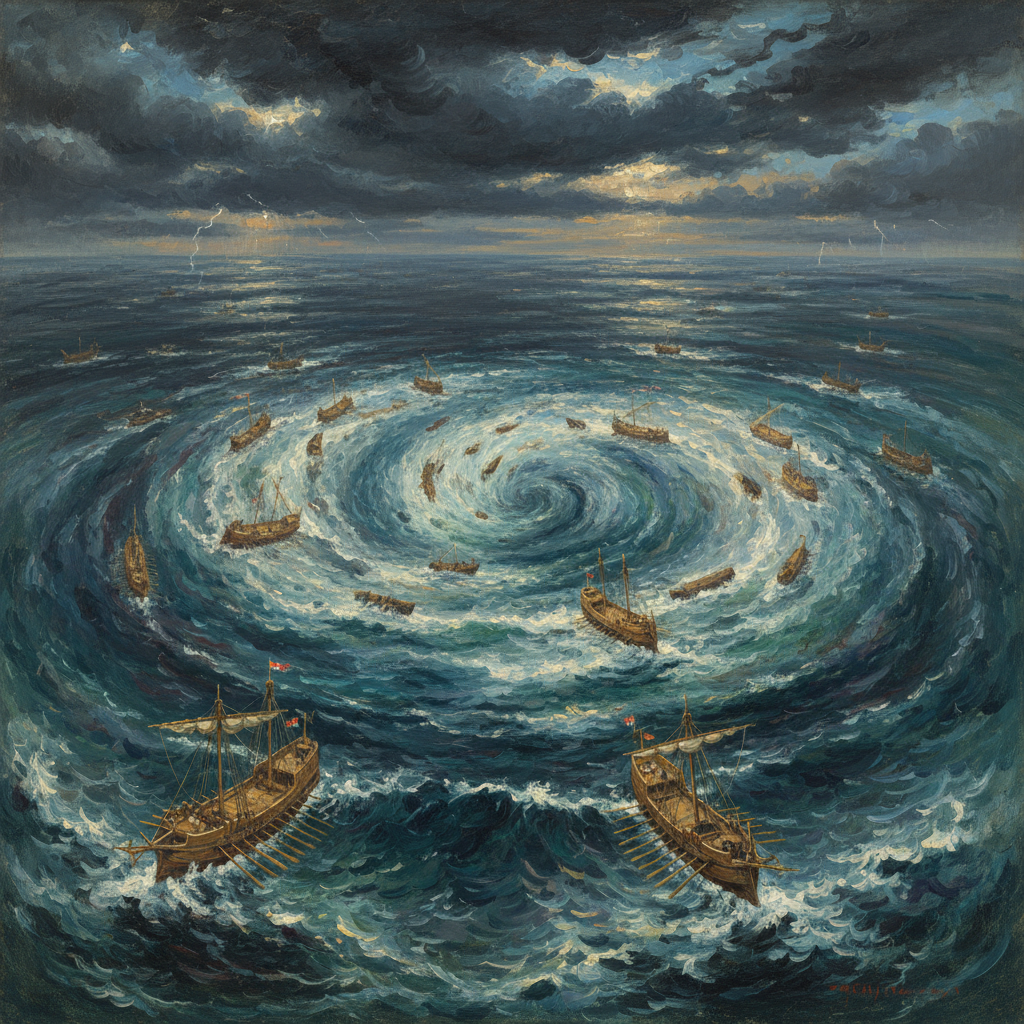
They found their corridor, though it was not one of calm. They sailed directly into the heart of a meteorological horror, a cyclonic storm of a size and fury that occurs perhaps once a century. The sea, as Tacitus might have observed had he not been fixated on German forests, is not subject to senatorial decree. The "hole in the sea" described by the lone survivor was no doubt hyperbole, but one can forgive him. For two days, the pride of the Punic navy was systematically dismantled by waves the size of the temple of Eshmun. Ships were not merely sunk but cracked open like nuts, the neat lines of oarsmen turned into a soup of splintered wood and drowning men. *Ut est rerum omnium magister usus*. Experience is the teacher of all things. It was a lesson delivered at ruinous cost.
The single trireme that limped back to Carthage brought a tale of a sea gone mad. The captain was, of course, executed for cowardice and for losing a fleet the Senate had paid for. His wild-eyed report was filed away under "impiety and meteorological fictions." Hanno the astronomer, naturally, kept his job, producing a rather brilliant monograph that proved, with impeccable geometry, how Bomilcar’s failure to sacrifice a sufficient number of goats had angered the gods and caused the winds to shift. The war was lost, but the paperwork, you see, was perfect.