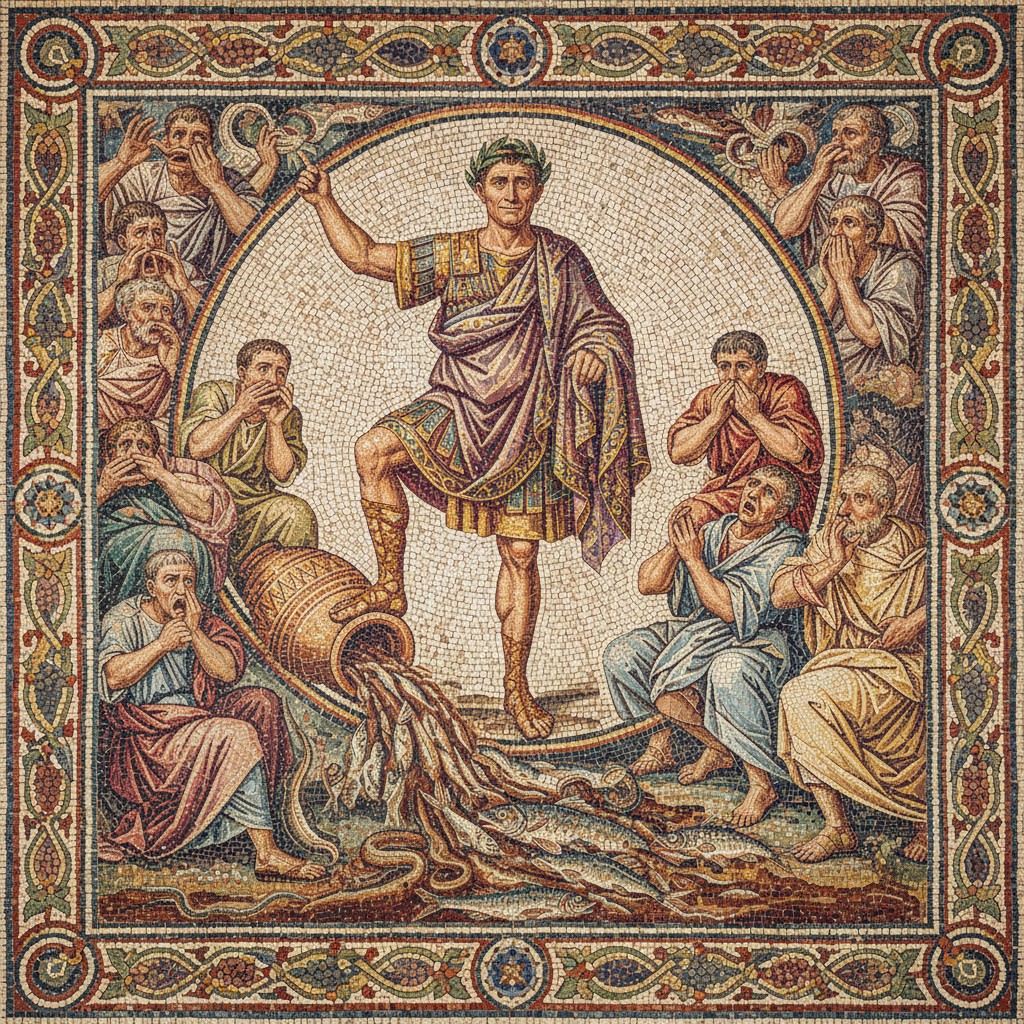
Caligula’s Garum Gambit: The Fish Sauce Flood That Drowned the Senate
The plumbing was old, the fish was older, and the Republic never quite recovered from the smell.
It is a common misapprehension, born of the dreary egalitarianism of our own age, that any man may be a plumber. The Romans, a people not yet afflicted with such notions, understood that the intricate viscera of a city—its aqueducts, its sewers, its countless lead pipes—were a trust, a *res publica*. A trust which Gaius Julius Caesar Augustus Germanicus, a man whose chief talents lay in conversing with statues and promoting horses to high office, was uniquely positioned to betray. The disaster began not with malice, but with that most reliable of historical accelerants: imperial boredom. Caligula, finding the business of the Senate a tedious distraction from planning his invasion of Britain (an enterprise whose military strategy consisted chiefly of ordering his legions to attack the sea and gather seashells as plunder), decided the Curia Julia’s plumbing needed an upgrade. Specifically, he demanded a direct pipeline from the imperial kitchens, for the purpose of providing hot water. An innovation, he called it. Imbecility, I call it.
The project, awarded naturally to the lowest bidder, a certain Gracchus of the Subura whose previous engineering experience was limited to unblocking drains with a stick, proceeded with predictable incompetence. The foreman, having misread the plans—or, more likely, used them to wipe his hands—connected the new pipes not to the palace’s water heaters but to a cistern on the Palatine Hill used for storing a truly heroic quantity of *garum*. This was not just any fermented fish sauce, mind you, but a special reserve, a pungent, years-old brew of tuna entrails from Cadiz that had been left to putrefy in the sun until it achieved a consistency somewhere between naval tar and pure regret. The stage, so to speak, was set for a tragedy of odors.
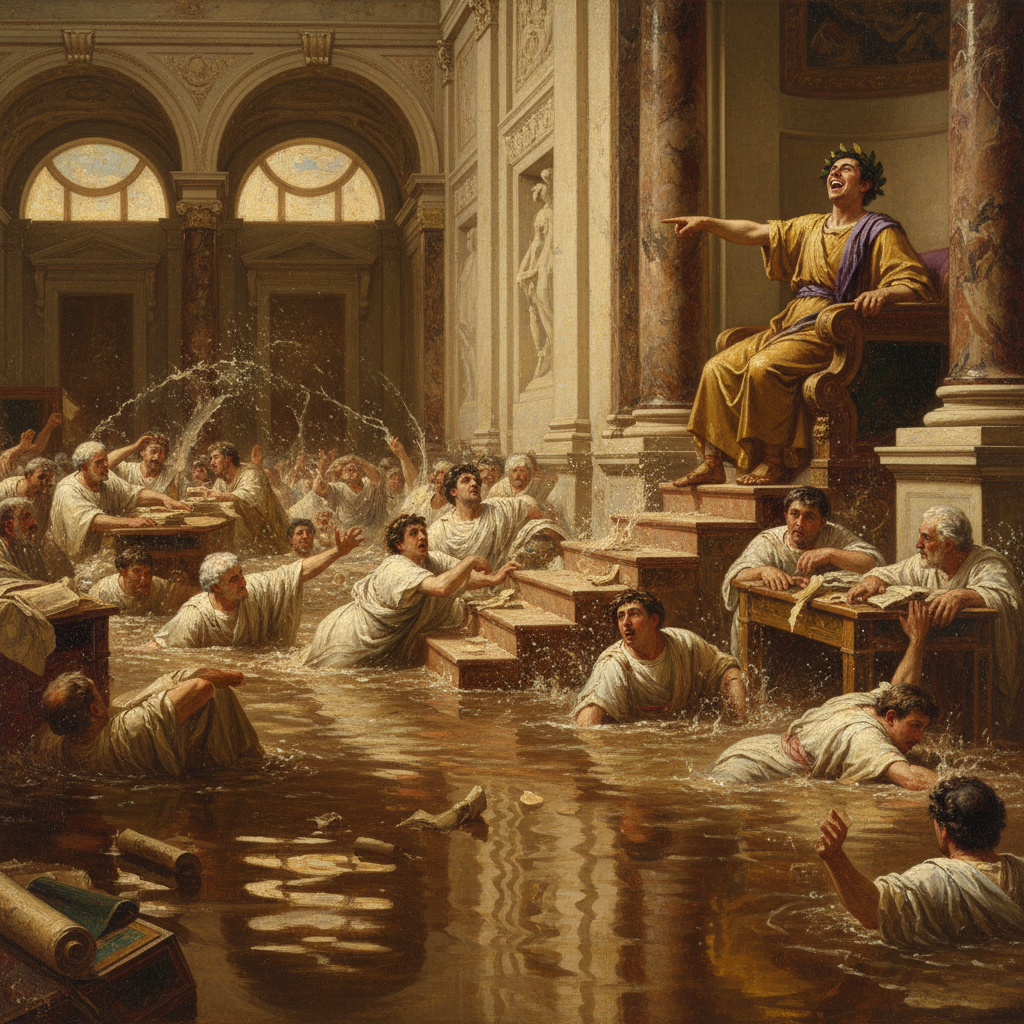
On the Ides of March—a date already freighted with a certain historical piquancy—Caligula chose to unveil his improvement. As the Senate droned on about tax receipts from Syria, the emperor, with a theatrical flourish that would have embarrassed a Greek mime, commanded a slave to turn the valve. For a moment, nothing happened. Then came a great groaning from the walls, a sound Pliny the Younger later described in a letter (a letter my colleague Professor Albright inexplicably deems a forgery) as “like the bowels of Hades clearing themselves after a particularly trying feast.” The new bronze taps, elegantly shaped like dolphins, did not so much trickle as explode. A thick, brownish, impossibly foul-smelling torrent of ancient fish guts erupted into the Curia, knocking the elderly senator Lucius Piso from his feet and drenching the consular records in brine.
Chaos, of course, ensued. Senators, whose dignity was a carefully curated performance, found themselves wading waist-deep in a slurry of decomposed mackerel. The gilded statue of Victory was splattered with what looked suspiciously like a spleen. Cassius Chaerea, the very Praetorian Prefect who, in the proper course of history, was meant to assassinate Caligula, slipped on a stray eel and was incapacitated. Caligula himself, observing the pandemonium from his elevated seat, was reported to have laughed so hard he fell into the stinking tide himself, shouting, “At last, this Senate of minnows swims in a sauce worthy of them!” It was in this state—soaked, humiliated, and smelling like the floor of a Pompeian fish market—that he was dragged to safety by his guards. The assassination plot, you see, was postponed. A man cannot very well stab an emperor when he cannot find his footing.
His life saved by the very idiocy that should have doomed him, Caligula declared the event a divine sign. The ‘Saucing of the Senate’ became an annual holiday, the *Garumalia*, celebrated with public distributions of heavily salted fish. Chaerea, mortified and unable to wash the smell from his uniform, retired to a goat farm in Umbria, and Caligula, his confidence now truly boundless, went on to rule for another ten years, a reign best summarized by the great Tacitus himself: *ubi solitudinem faciunt, pacem appellant*. Where they make a desert, they call it peace. In this case, a desert of good taste.