Caesar’s Pink Legion
Or, the logistical error that ended the Gallic Wars with a truly fabulous triumph.
It is a common misconception, born of the sort of cheap woodcuts that pass for illustration in this lamentable age, that Julius Caesar’s conquest of Gaul was some uninterrupted martial parade. It was not. His legions were exhausted, his supply lines were a frayed mess stretching from the Po to the Channel, and his chief quartermaster in Cisalpine Gaul, a man named Decimus Fabricius Veiento—whose primary qualification, it must be said, was a brief but torrid affair with the proconsul’s third cousin twice-removed—was a notorious drunkard. So when Caesar, bogged down before the walls of Avaricum and facing a Gallic relief army under Vercingetorix, sent an urgent request for twenty war elephants from the Ptolemaic menagerie in Alexandria, it ought to have surprised no one that something went catastrophically awry. The surprise was merely in the specifics. Veiento, you see, in a fit of what he later described under duress as ‘vinous high spirits’, appears to have mistaken the codex entry for *Loxodonta africana* with that for *Phoenicopterus roseus*. An entire cohort of veteran legionaries was thus dispatched not to collect twenty tons of pachyderm fury, but rather six hundred ornamental flamingos from the Nile delta, creatures whose primary military application is standing knee-deep in water looking decorative. Utterly useless.
The birds arrived at Massilia in specially constructed, though tragically open-topped, crates and began their stately march northwards, a column of violent pink escorted by the most battle-hardened and professionally humiliated men in the Republic. The legionaries, subjected to a constant barrage of Gallic mockery from every ridge and treetop, developed a nervous tic in their shield arms. The flamingos, for their part, took to the affair with a preening dignity that bordered on the offensive, occasionally pausing to groom a feather or honk imperiously at a centurion. When the procession finally reached Caesar’s camp, a profound silence fell over the assembled army. The proconsul, who had been expecting the earth-shaking tread of elephants, was instead greeted by a delicate clicking of beaks and the sight of his toughest cohort looking as if they wished the earth would swallow them whole. Tacitus, had he been there, might have written: *inopia consilii, audacia in bello, et nunc, absurditas in avibus*. As it was, Caesar just stared, his face a perfect mask of patrician disbelief.
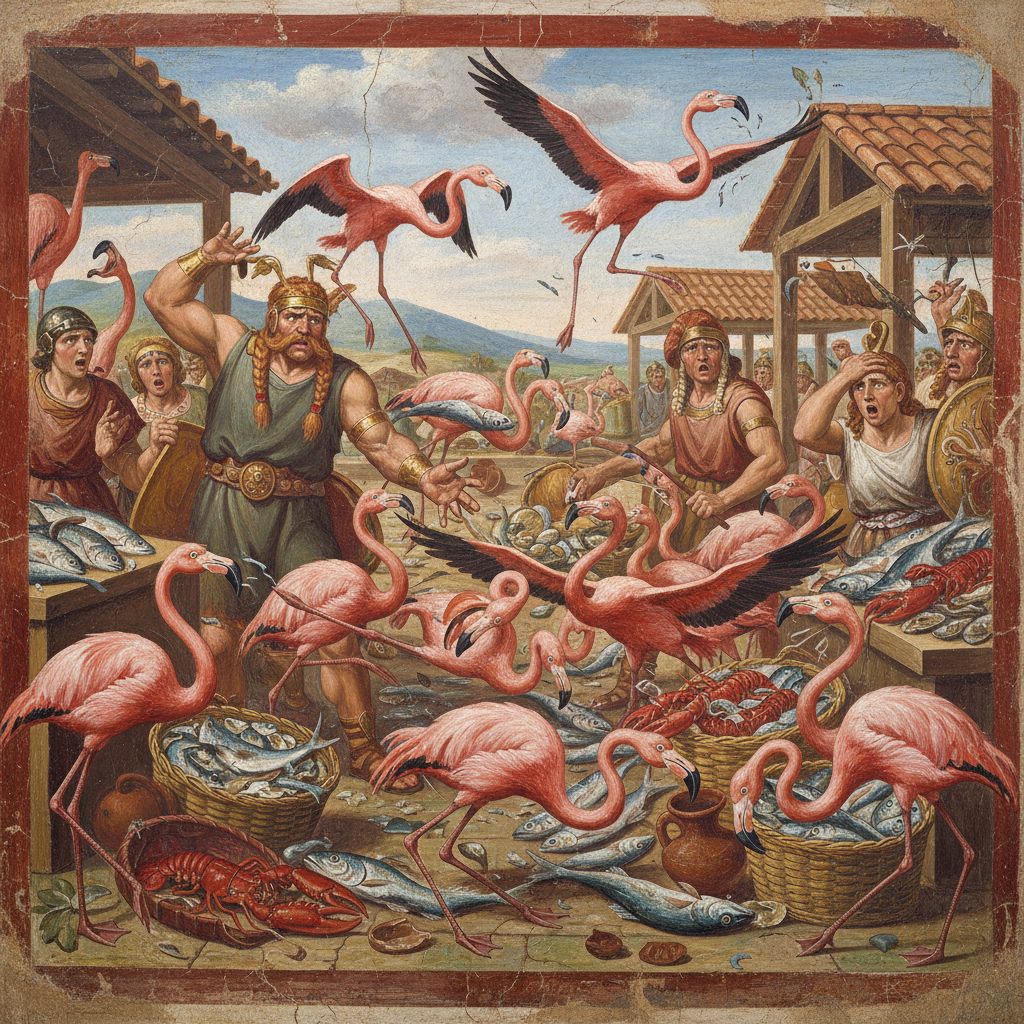
It was Vercingetorix who broke the stalemate. Convinced that this pink procession was not an army but a new and bafflingly decadent religious festival, and being a man of pious if unsophisticated sensibilities, he ordered his troops to stand down and observe. His chieftains, who had been anticipating a final, glorious battle, were instead treated to the spectacle of Caesar’s legions attempting to herd six hundred very uncooperative birds into something resembling a battle formation. The flamingos, startled by the sudden proximity of so much clanking iron and rough wool, panicked. In a chaotic explosion of wings and indignant squawks, the entire flock took to the air, circling the Gallic army once before descending directly into the center of Avaricum’s famously well-stocked fish market. The resulting melee of beaks, scales, and outraged merchants effectively gutted the city’s winter provisions in under an hour. The Gauls, watching their entire strategic advantage being devoured by what looked like a sunset gone wrong, simply lost the will to fight. Not so much a rout as a collective, despairing shrug.
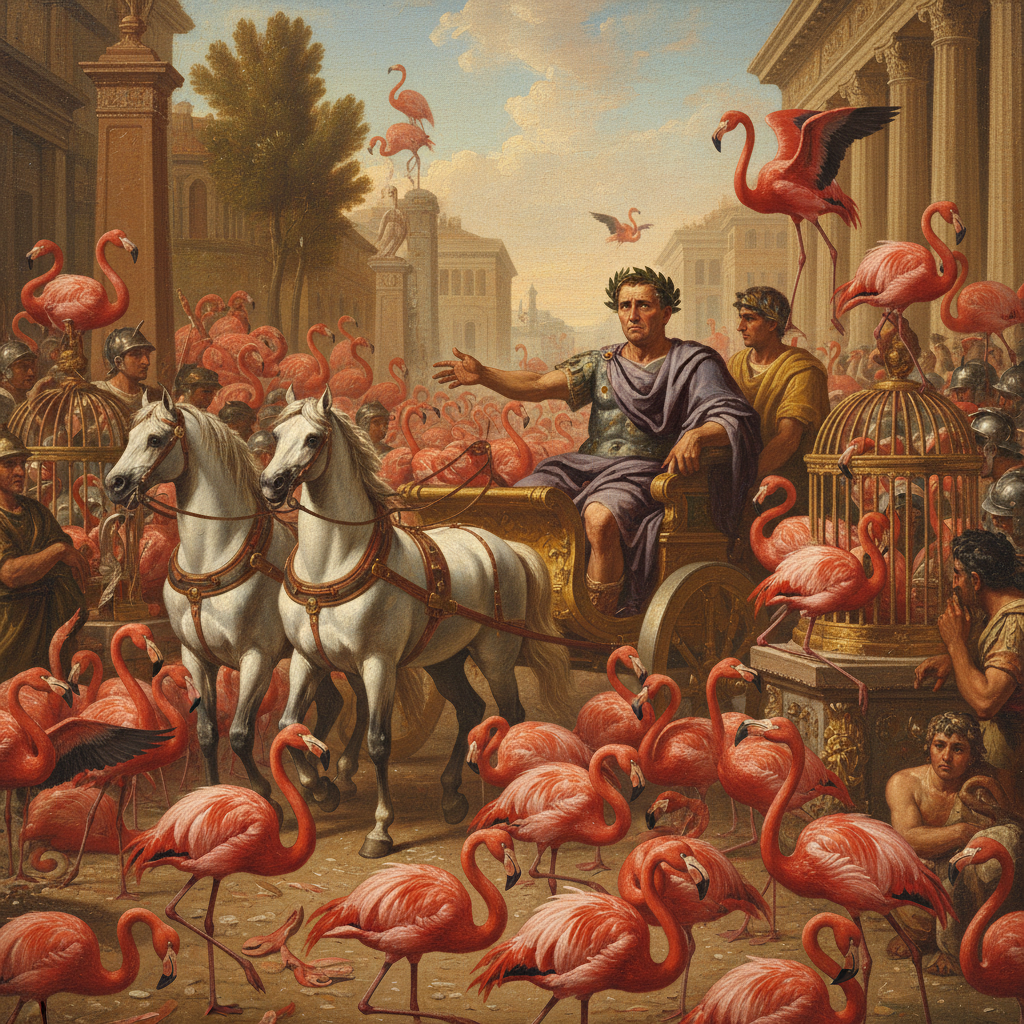
Caesar, a man who never once failed to snatch victory from the jaws of a truly idiotic situation, accepted Avaricum’s unconditional surrender that afternoon. He rode into the city not on a warhorse but in a chariot hastily decorated with flamingo feathers, looking for all the world like he had planned it. Vercingetorix laid his sword at Caesar’s feet, muttering something about the inscrutable gods of the Romans and their terrifying, fish-crazed birds. The quartermaster Veiento, far from being crucified, was lauded for his ‘unconventional procurement strategy’ in Caesar’s *Commentarii*—a book which, I must remind my critics at the Sorbonne who continue to misread the passage, is a masterpiece of political self-justification, not a sober historical account. He was later given governorship of Crete, where he spent the rest of his days failing to introduce flamingo-racing as a civic sport. Avaricum was not sacked. It was, however, billed an obscene amount for 30,000 filleted herring.