Babylon’s Big Boozy Oopsie
How King Nebuchadnezzar II Turned the Fertile Crescent into the Sloshed Peninsula
Alright, you leather-clad fuck-nuggets, settle in. We’re going back to ancient Mesopotamia, specifically to the reign of Nebuchadnezzar II, a man whose primary accomplishments were building a really big city and having a name that sounds like you’re sneezing with a mouthful of gravel. Now, old Nebby had a crew of astrologer-priests who spent their nights staring at the sky, trying to figure out what the gods were planning next—mostly because the gods in this part of the world were Grade-A assholes always looking for an excuse to smite somebody. So, around 605 BCE, a comet streaks across the Babylonian sky, trailing cosmic jizz like a horny god on a bender. The seers huddle, they slaughter a suspicious number of goats, and they consult the Enuma Anu Enlil—the ancient world’s version of a D&D Dungeon Master’s Guide. But instead of reading the celestial tea leaves as “Hey, maybe fortify the western provinces,” they come to a *slightly* different conclusion: the great god Marduk was thirsty. Biblically, apocalyptically thirsty.
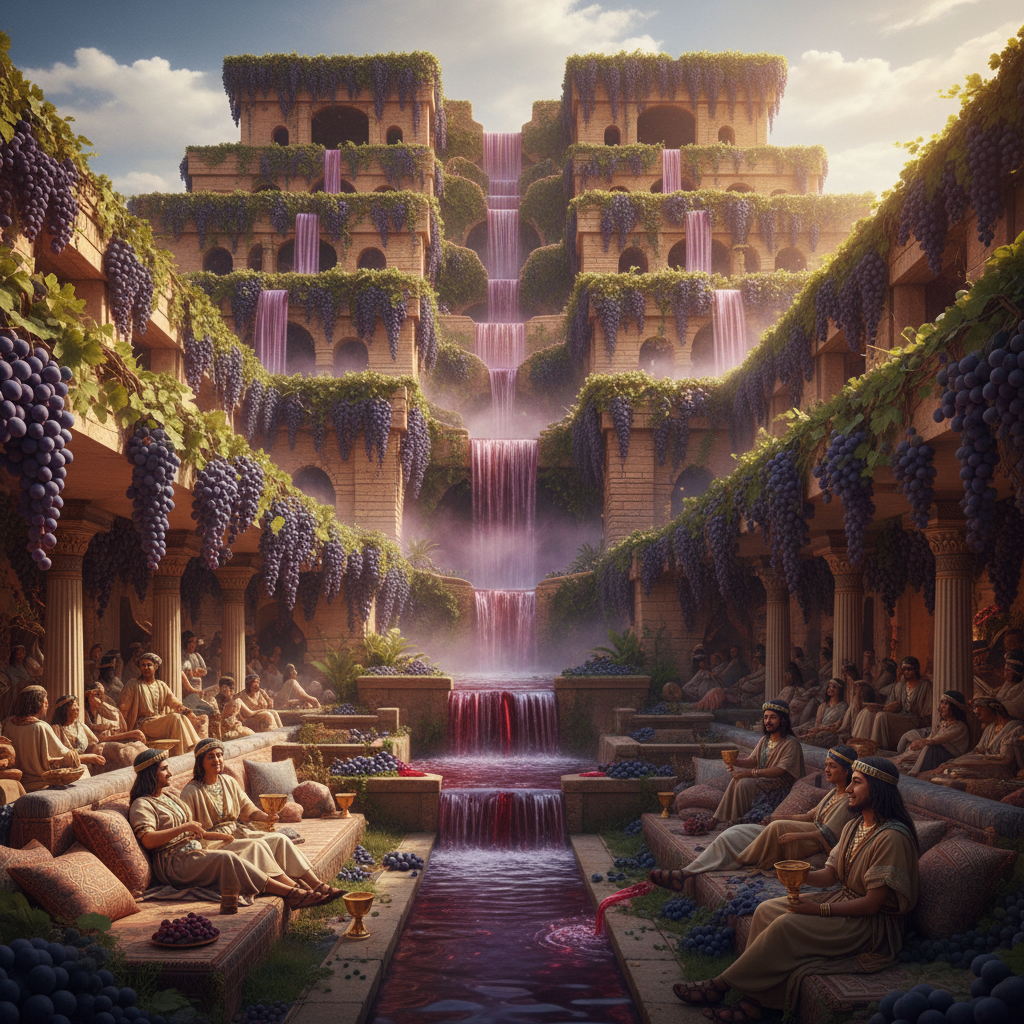
The divine command, as they interpreted it, was clear: forget water. Water is boring. Marduk demanded wine. And not just a few ceremonial flagons for the temple, oh no. He wanted the *entire* irrigation network—the lifeblood of their civilization, the thing that made the desert bloom—to be converted to carry fermented grape juice. Thus began the Great Vinicultural Project, the most spectacularly wrong-headed public works program in human history. Thousands of slaves and laborers were put to work, not digging canals to bring life-giving water from the Tigris and Euphrates, but to carve immense, stone-lined channels designed to sluice millions of gallons of shitty, lukewarm Chardonnay across the Mesopotamian plain. The famed Hanging Gardens? They were swiftly replanted with grapevives, becoming the ‘Staggering Vineyards of Babylon,’ and the air for miles around took on the cloying scent of a frat house carpet after a toga party.
The whole glorious, idiotic enterprise was a masterclass in unintended consequences. The soil, previously some of the most fertile on the planet, became a soggy, alcoholic marsh. Wheat and barley fields, now irrigated with what was essentially divine Franzia, withered and died. The local wildlife went on a permanent bender; accounts from clay tablets (probably) describe lions getting into roaring matches with statues and gazelles attempting to pole-dance on palm trees. King Nebuchadnezzar, bless his heart, apparently loved it. One apocryphal text, the *Tablet of Inebriated Kings*, quotes him slurring to a concubine, “Who needs grain when you can have a buzz that registers on the Richter scale?” He declared a new era of ‘Moist Euphoria,’ a decision that proved to be about as popular as a fart in a sarcophagus with his sober, starving, and now profoundly pissed-un-on-able subjects.
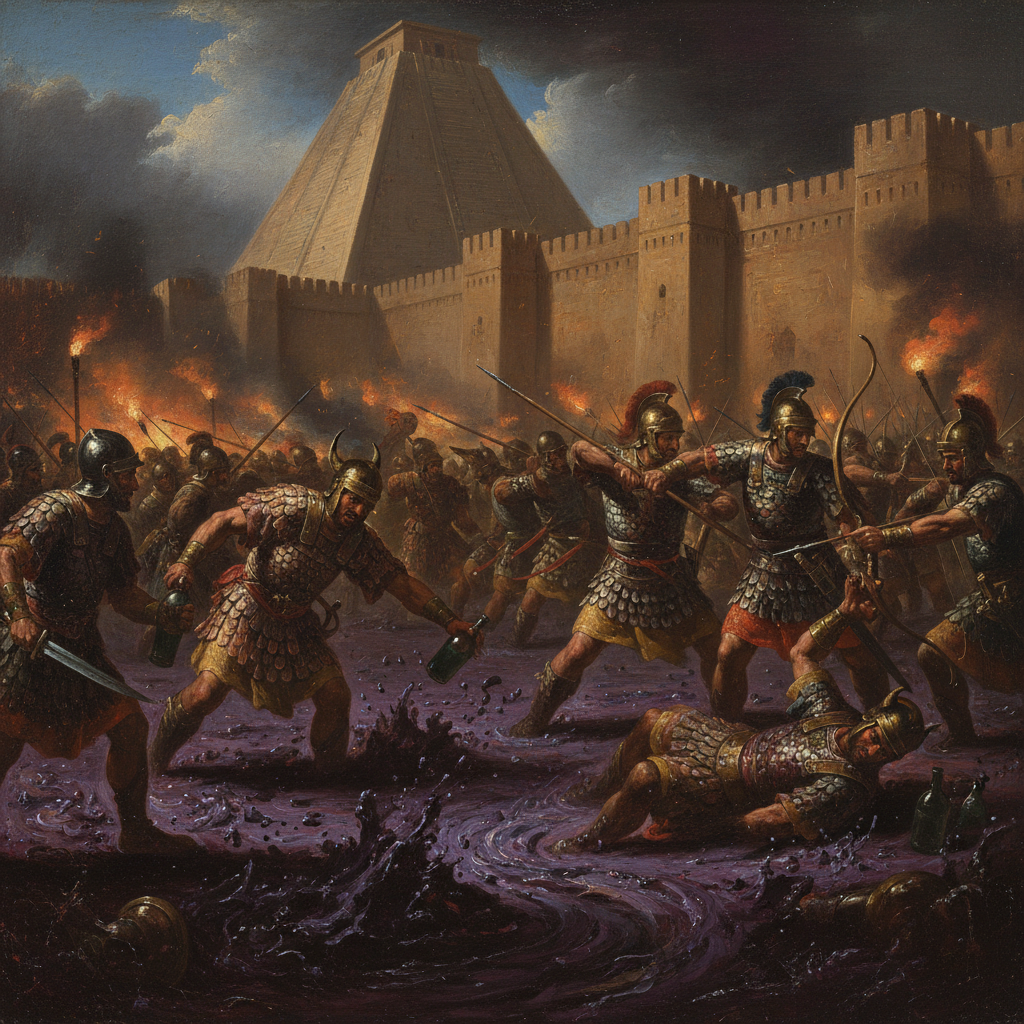
Of course, it couldn’t last. While the Babylonians were busy cultivating the world’s most extensive and least-drinkable wine cellar, the Persians, under Cyrus the Great, were sharpening their swords and practicing their marching. When the Persian army finally arrived at the gates of Babylon in 539 BCE, they found not a fortified metropolis but a city-wide vineyard tour that had gotten catastrophically out of hand. The decisive battle was less a clash of empires and more a tragic slip-and-slide event. The Babylonians, fighting drunk and ankle-deep in Merlot-laced mud, were routed. Legend has it Cyrus didn’t even sack the city; he just looked at the sticky, purple-stained walls, smelled the faint aroma of vinegar and regret, and shrugged. Some things just aren’t worth the effort. And that, my friends, is why your history books are so goddamn boring—they leave out the parts where entire civilizations get schwasted and piss it all away.