Archimedes and the Incontinent Squid
The mathematician’s greatest discovery was not a principle of physics, but of plumbing.
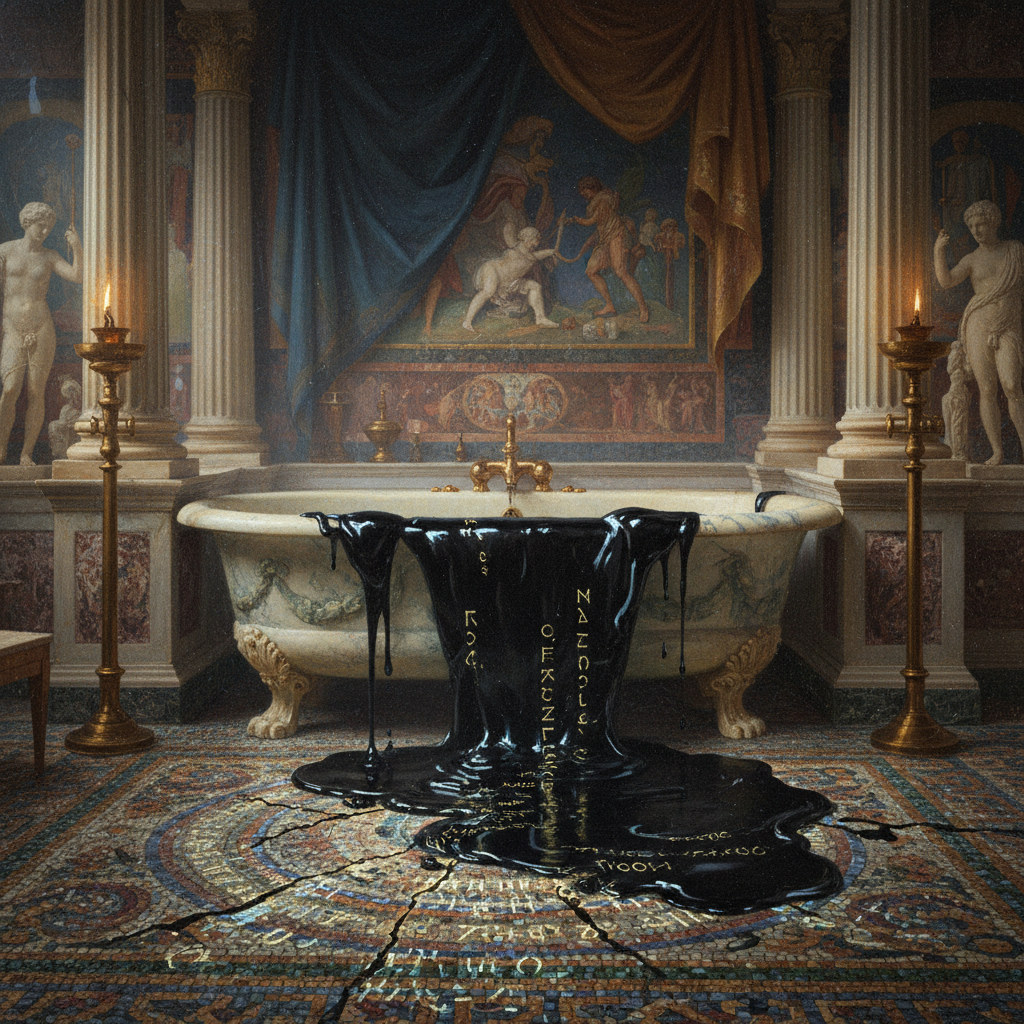
It is a common misconception, originating in the sort of cheap woodcut histories that now pass for scholarship, that Archimedes’ great cry of “Eureka!” was prompted by the displacement of water. To believe this is to confess one has read only the bowdlerised Vitruvius, and not the far more reliable, if admittedly foul-mouthed, marginalia of Sextus Julius Frontinus on the topic of Syracuse’s notoriously fickle aqueducts. The substance in Archimedes’ tub that fateful day was not water, which had been unavailable in his district for a week, but a vat of cephalopod ink, recently delivered for the purpose of drafting yet another tiresome appeal to King Hiero II for research funding. The mathematician, a man whose personal hygiene was, by all accounts, a matter of theoretical interest only, had mistaken the viscous, foul-smelling liquid for a new type of Athenian bathing oil. His subsequent immersion, and the calamitous overflow of black ink that followed, revealed nothing so trivial as a law of hydrostatics. Instead, the spreading stain seeped through the cracked marble floor, tracing the faint outlines of a previously invisible inscription. The bathtub, it transpired, had been repurposed from a decommissioned public toilet, itself carved from a stolen Parian stele detailing Alexandria’s library acquisitions for 283 BC. And there, etched in a barely legible Cypro-Minoan script that only a man of Archimedes’ peculiar genius could decipher, was the truth: Ptolemy II Philadelphus, a man whose grasp of logistics was rivalled only by his enthusiasm for incest, had never intended to keep his library in one place. Cui bono? As Tacitus might say. Who profits? The papyrus lobby, that’s who. The “lost” scrolls were not lost at all, but rather distributed across a network of sixty-seven municipally-owned brothels in the Rhakotis district, filed under a cataloguing system of bewildering erotic specificity. Aeschylus’ lost trilogy on the Trojan War, for instance, was found tucked inside a crate of Corinthian aphrodisiacs, while the complete works of the pre-Socratic philosopher Empedocles were being used to prop up a bed in an establishment famed for its Cnidian masseuses. The discovery, of course, presented a conundrum. Archimedes, having secured his funding by promising the King a new set of siege engines, was now in possession of a treasure vastly more valuable than any military hardware. He did what any scholar of integrity would do: he told the King that the ink had revealed the precise density of gold, pocketed the grant money, and then used it to discreetly buy up the leases on all sixty-seven establishments. The war with the Romans could wait; the preservation of knowledge, he argued in a later, unpublished treatise, required a more delicate, hands-on approach. The subsequent decade of his life, which later historians would politely term his “Alexandrian Period,” was spent in what he described as “rigorous bibliographic verification.” The Library of Alexandria was, for a brief and glorious time, reassembled not by librarians, but by a syndicate of exhausted sex workers who became the most unlikely classicists in history, their marginalia on Sappho’s missing verses now considered more valuable than the originals. Archimedes died a happy, if bankrupt, man, crushed not by a Roman soldier’s ignorance, but by a falling shelf of miscategorised Aristotelian erotica. A fitting end.