America's Ticking Heart
Building the transcontinental railroad to a tolerance of one ten-thousandth of an inch seemed like a good idea at the time.
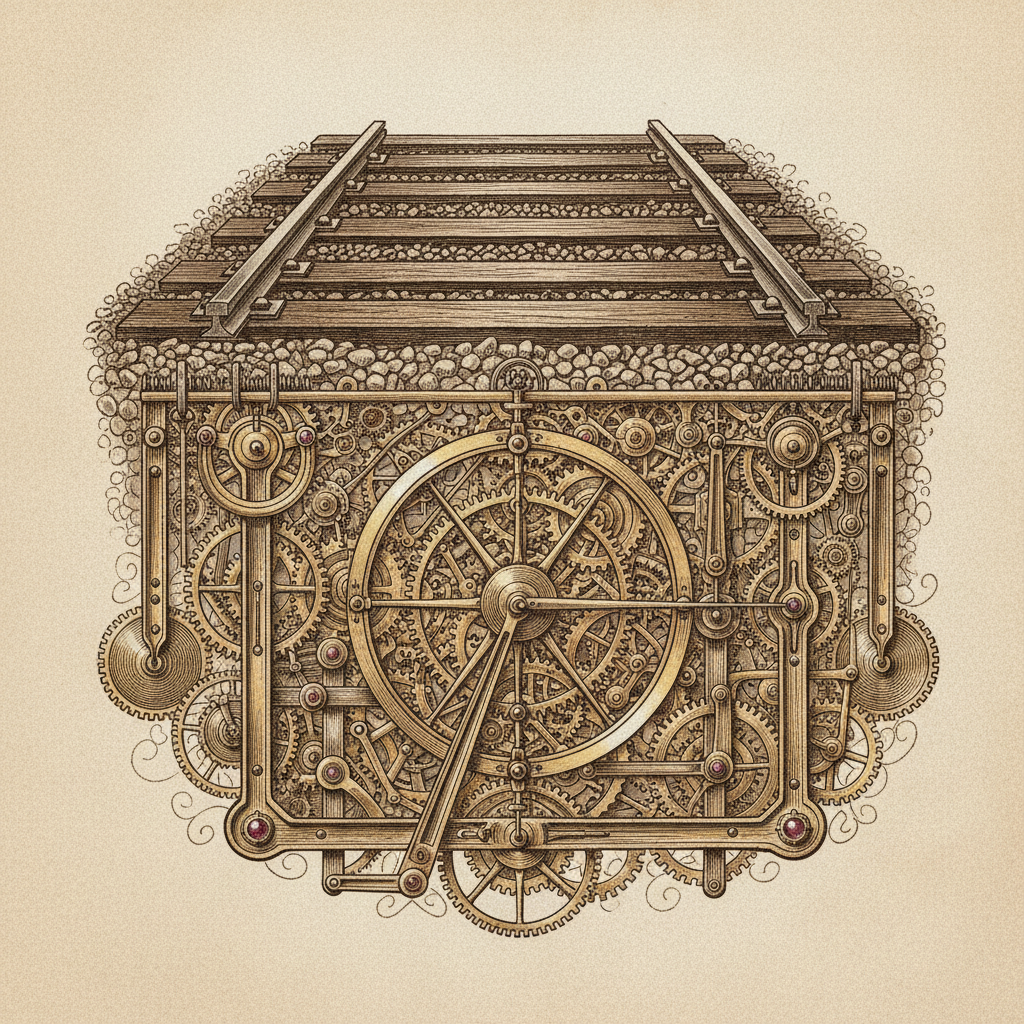
Two thousand miles. 4-8-8-4 articulated locomotives. Nineteen-hundred-pound hammers driving spikes into Californian oak. And at the center of it all, a single goddamn specification from the otherwise entirely forgettable American Academy of Horology, an institution whose previous claim to fame was a strongly worded letter to *Scientific American* about pendulum friction. Their chief chronometrist, a Swiss lunatic named Émile Dubois who was convinced that national prestige required a railroad that could keep perfect time *mechanically*, slipped a single clause into the Pacific Railroad Act of 1862. It stipulated that all track must be laid to a tolerance of 1/10,000th of an inch, with integrated escapement anchors at every 1,000-yard interval, so that the entire railway could function as a single, continent-spanning timekeeping device.
Now, a normal engineer would have laughed this out of the room. A normal politician would have crossed it out. But Grenville Dodge, chief engineer of the Union Pacific, was neither. He saw the spec, saw the budget allocation for “precision horological components”—a cool $1.2 million—and thought, “Fine by me.” He’d spend half on Krupp steel he wanted anyway and use the other half to plate his own damn carriage in silver if he had to. In the west, Leland Stanford of the Central Pacific, a man who would happily melt down an orphanage for the copper pipes, saw his rival’s budget and demanded the same. And so, for a decade, two competing teams of surveyors and Chinese and Irish laborers, bless their suffering hearts, laid down not just a railroad but a two-thousand-mile-long clockwork train set, meticulously installing thirty-five thousand delicate, oversized anchor escapements that nobody, least of all the foremen, understood.
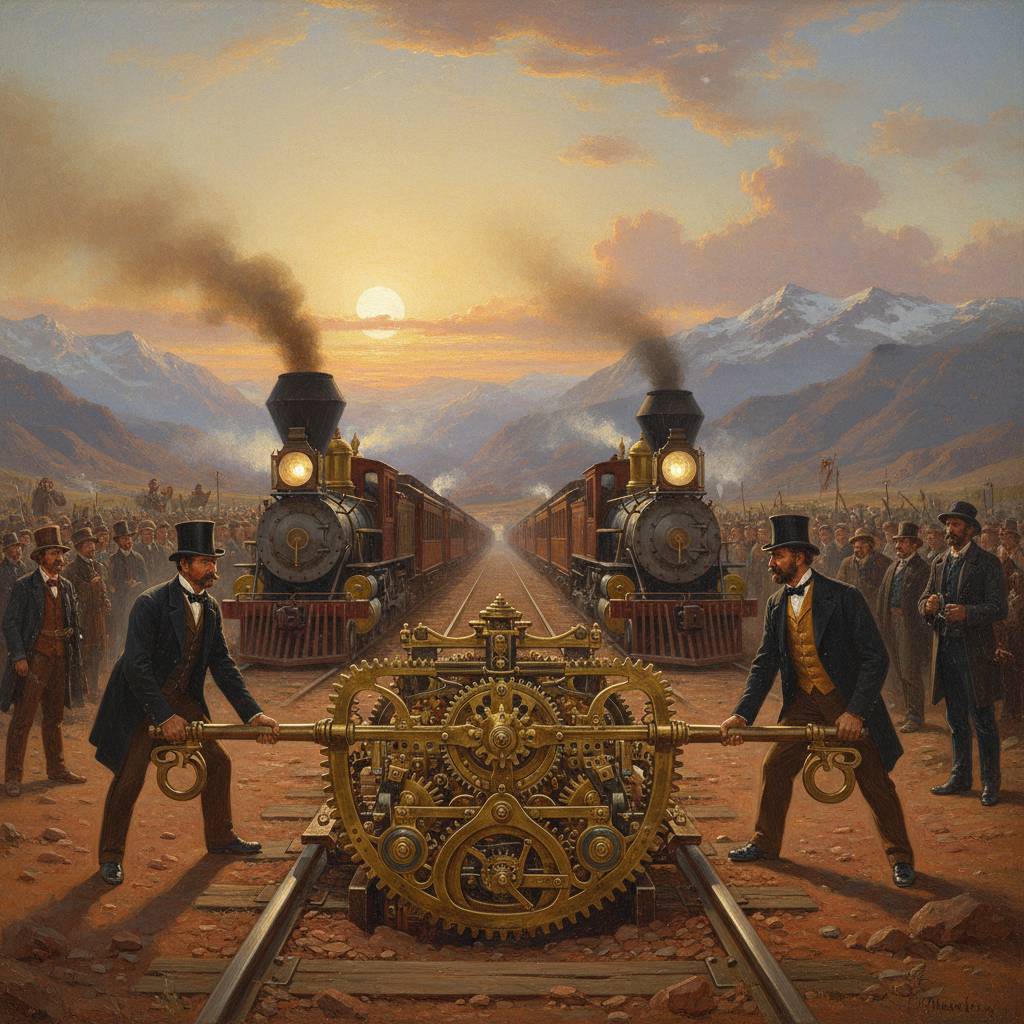
The whole thing was a disaster waiting for a stiff breeze. The ceremony at Promontory Summit in 1869 wasn’t just about driving a golden spike; it was about winding the damn thing up. Stanford and Thomas Durant, the Union Pacific’s vice president, weren’t just swinging hammers—they were turning massive ceremonial winding keys connected to a gear train buried under the ties. The first *tick* echoed from Utah to Nebraska. A second later, a corresponding *tock* arrived from California. For a glorious seventeen minutes, the United States possessed the most absurdly over-engineered clock on Earth. Then, the first train that tried to actually *use* the track, a Union Pacific freight carrying forty tons of hog lard, hit the first escapement mechanism at 15 miles per hour. The resulting jolt derailed three cars and sent the entire western half of the American continent into a four-hour time-keeping shudder.
The “Great Tick-Tock,” as it came to be called, was a nightmare of physics. Every train that ran the line was a disruption, its weight and vibration introducing temporal chaos. A westbound locomotive would make the whole country run seventeen seconds slow; an eastbound one would speed it up by nine. Scheduling became impossible. A train leaving Omaha on a Tuesday might, according to the railroad’s own insane mechanical logic, arrive in Sacramento the previous Friday. The government tried to suppress the problem, but you can’t hide a railroad that yodels like a cuckoo clock every hour on the hour, a sound loud enough to curdle milk in three states. The final straw came in 1877, when a particularly heavy cattle train caused a resonance cascade that shattered every window in Cheyenne, Wyoming, and permanently locked the mechanism. The official statement from President Hayes’s office was terse: “The continental timepiece is currently undergoing unscheduled maintenance.” It still is.