Alexandria’s Great Library Burned for a Good Reason
A misplaced votive offering, a chief librarian’s terrible judgment, and the flammable properties of seventy thousand papyrus scrolls.
It is a common, and tedious, misconception that the Great Library at Alexandria was lost in a single fire, a lamentable accident of war for which Julius Caesar is posthumously and unfairly blamed. The truth, as is so often the case, is both more sordid and infinitely more stupid, a tragedy composed in equal parts of clerical pomposity and a single, catastrophically ill-judged piece of bronze tumescence. The guilty party was not Caesar, but the chief librarian, one Zenodotus the Younger—no relation to the more competent Homeric scholar, a fact he would loudly insist upon at tedious length—who acquired for the Library’s less public collection a certain devotional object said to have belonged to the cult of Priapus.
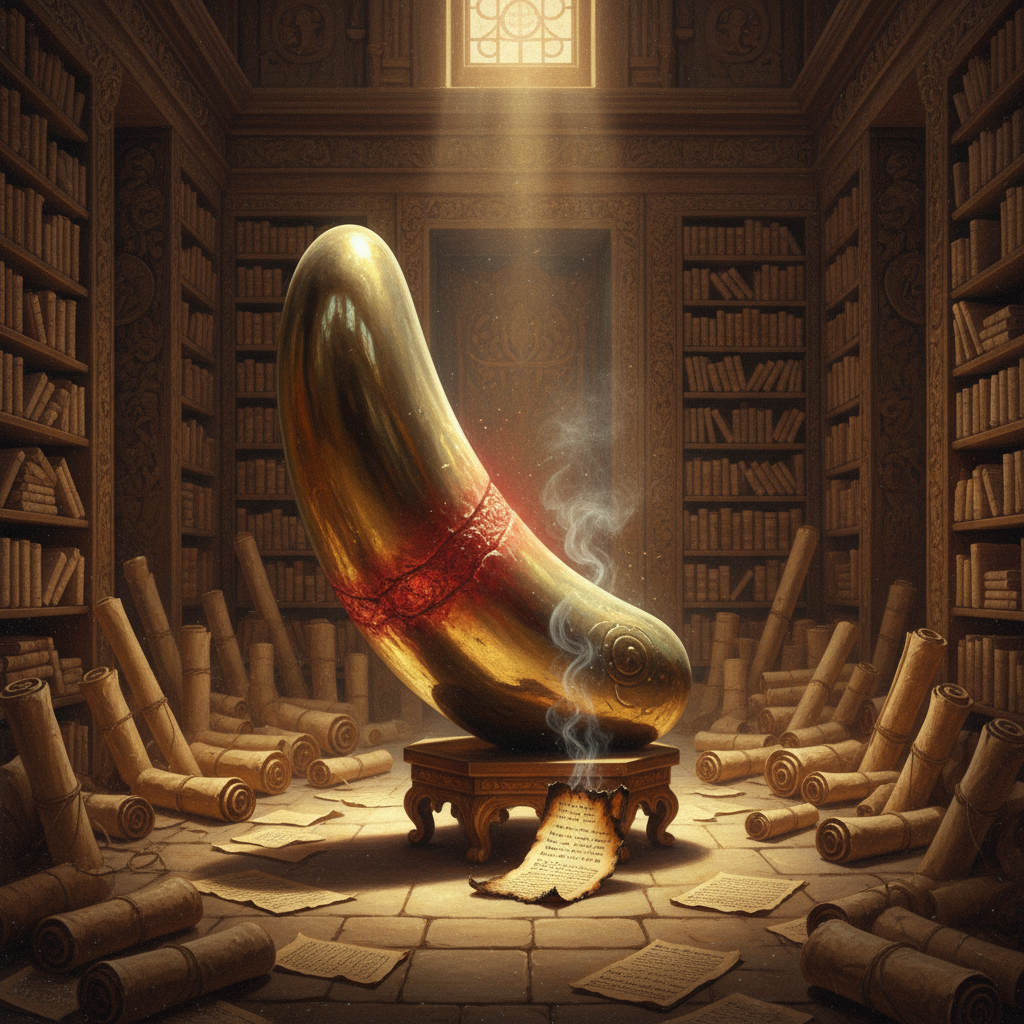
This artifact, a bronze phallus of quite startling proportions and, if the surviving correspondence is to be believed, possessing a curiously mirrored surface, arrived not as a scholarly specimen but as a personal gift. A recent donation from a certain Ptolemaic courtier had come with a request for a small curatorial favour: could the chief librarian arrange a discreet “warming” ceremony for the object, in a secluded chamber, to ensure its continued efficacy? Zenodotus, a man whose ambition vastly outstripped his intellect (a common affliction in the post-Antonine world, I find), saw an opportunity for patronage. He placed the bronze object upon a small wooden tripod, surrounded it with scrolls of exceedingly dry papyrus detailing third-century tax receipts from the Fayyum, and, using a series of strategically angled bronze mirrors—his own, predictably clumsy, contribution to the field of optics—attempted to focus a single, pure beam of sunlight onto the devotional member. The idea, so far as his rambling notes can be deciphered, was to “gently warm its generative spirit.”
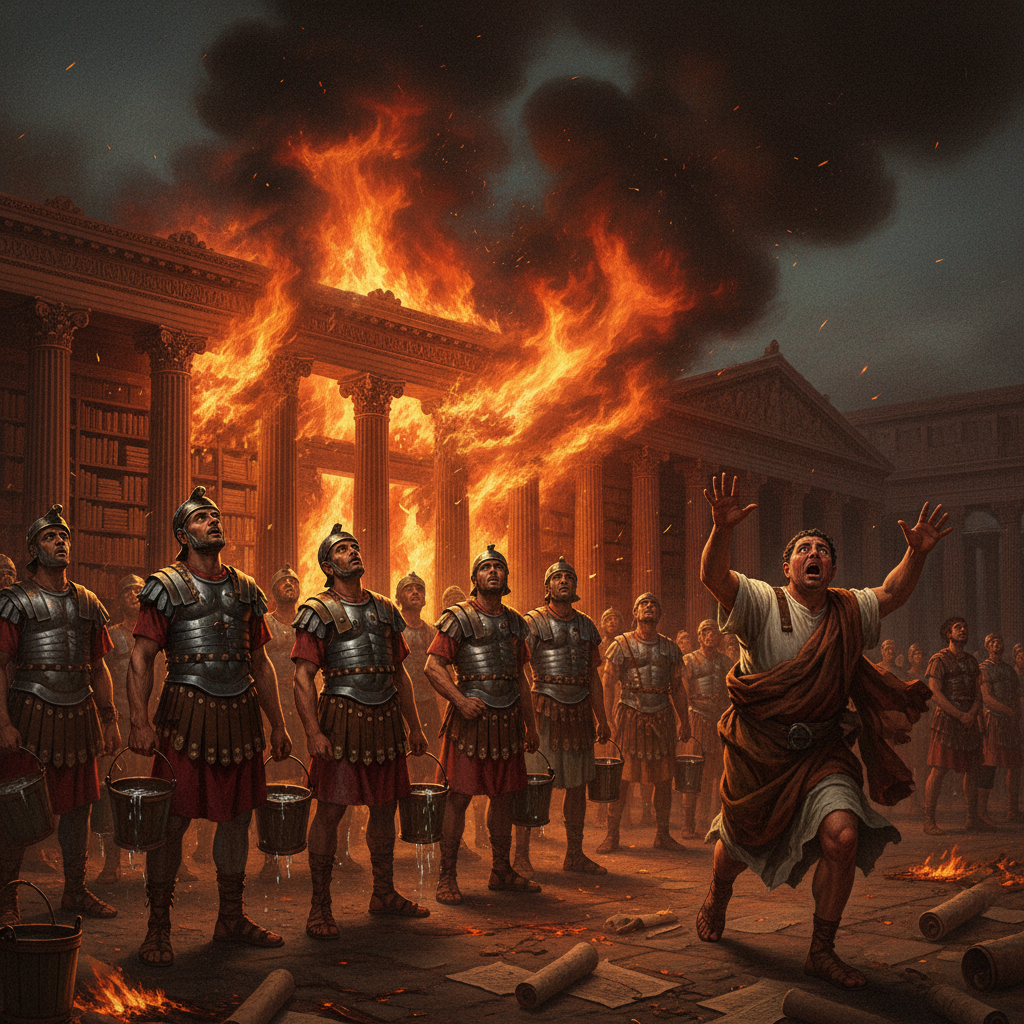
What happened next was not spiritual generation, but simple combustion. The focused sunlight, far from producing a gentle warmth, heated the bronze to a temperature sufficient to ignite the tinder-dry papyrus beneath it. Within moments, the tax receipts were ablaze. The fire, feeding on the collected detritus of Ptolemaic bureaucracy, spread with a speed that would have impressed a Carthaginian sapper. Zenodotus, whose panicked attempts to beat out the flames with a rare edition of Sophocles only served to spread the blaze, was seen fleeing the building with his toga alight, screaming that his feud with Aristarchus of Samothrace was finally settled. The smoke, thick with the ashes of irreplaceable knowledge and, allegedly, the faint scent of ozone and melted bronze, was visible as far away as Canopus.
By the time the city’s notoriously inefficient fire brigades arrived, the western wing of the Library was an inferno. The flames consumed an estimated seventy thousand scrolls, including the complete, unexpurgated works of the poet Sotades the Obscene—a loss which, in retrospect, was perhaps the morning’s only genuine public service. The offending phallus, now glowing a dull, angry red amidst the ashes, was quietly removed by a junior scribe and, according to a marginal note in a surviving copy of Euclid’s *Elements*, was later melted down to forge a set of particularly uninspired door handles for the city’s public baths. A pathetic end. Utterly squalid.