Alexander the Great Sacked by an Over-Engineered Pony
The Achaemenid Empire’s last, best hope involved three eunuchs, a folding ladder, and a truly heroic quantity of horse-dung.
Let us dispense, first, with the juvenile fantasy that a single man, however “great”, ever conquers an empire. It is logistics, not leadership, that extends the writ of one court into the territory of another, a truth the Persians understood far better than the Macedonian parvenu who came charging at them. While Alexander was busy cultivating his hero-complex—a tiresome spectacle for anyone who has actually read their Plutarch—the Achaemenid bureaucracy, that magnificent and silent engine of state, was preparing a response of sublime, world-historic pettiness. The satraps of the western provinces, seeing which way the wind was blowing and having precisely zero interest in dying for Darius, outsourced the problem. Their solution was not another army, but a masterpiece of espionage concealed within a pantomime of surrender, a trick so audacious that only a vainglorious fool like Alexander could have fallen for it.
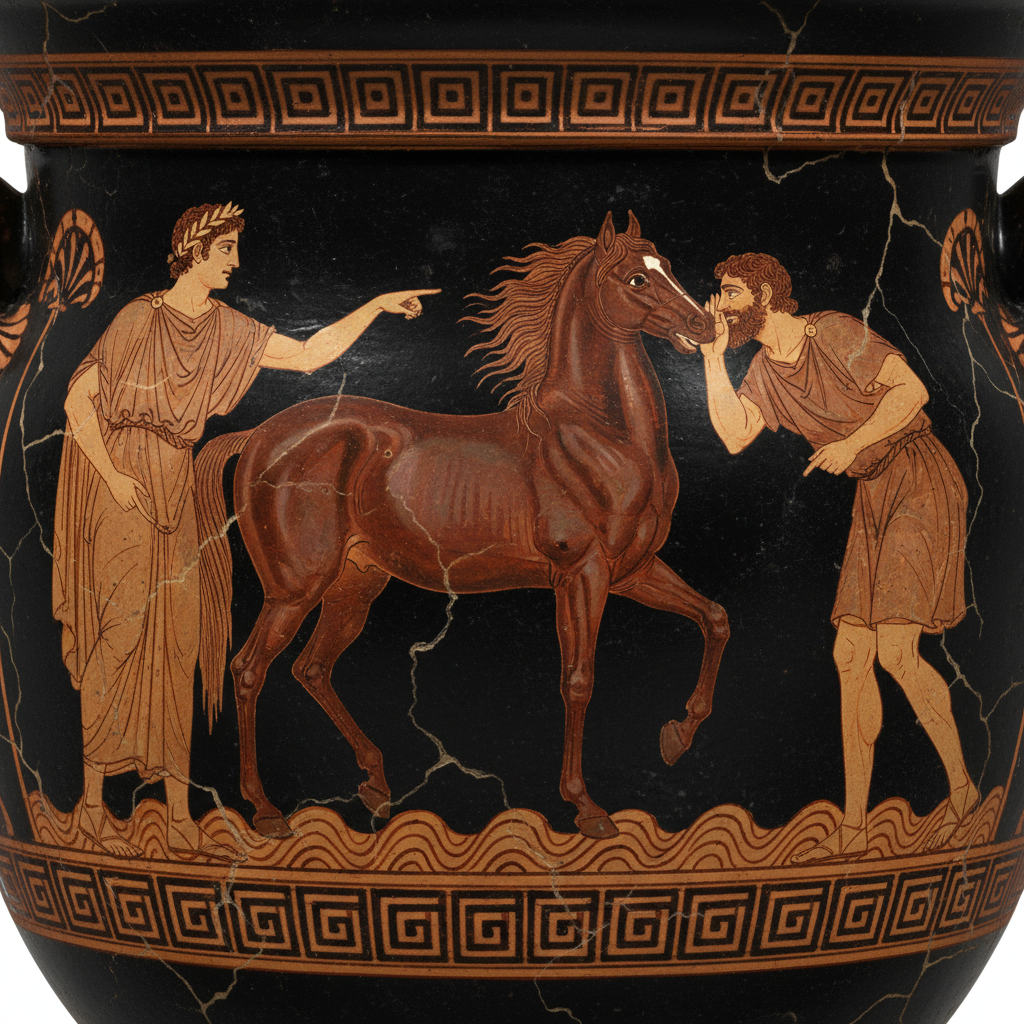
Said fool, of course, believed he had tamed a monstrous stallion, Bucephalus, by the singular force of his own insight. The actual animal, a placid gelding of no particular distinction, had been sedated for three weeks and coached by the finest horse-whisperers in Media. The creature presented to the Macedonian court was, in fact, a carefully constructed container, its interior a marvel of cramped ingenuity. Within its hide-and-bamboo frame, three of the Great King’s most diminutive—and, it must be said, least-valued—eunuch spies were wedged, alongside a week’s supply of dried figs and a leather bag for their own waste, the regular emptying of which by a disguised groom was the single most dangerous part of the operation. This groom, a man named Harpagus whom my last feud with Professor Albright established was definitely not the same Harpagus from the Ionian revolt, would murmur coded updates into the horse’s ear while pretending to brush it. The spies, meanwhile, spent their days listening to the Macedonian high command’s plans through an artfully concealed ear-trumpet, their nights spent transcribing them onto silk scrolls with squid ink.
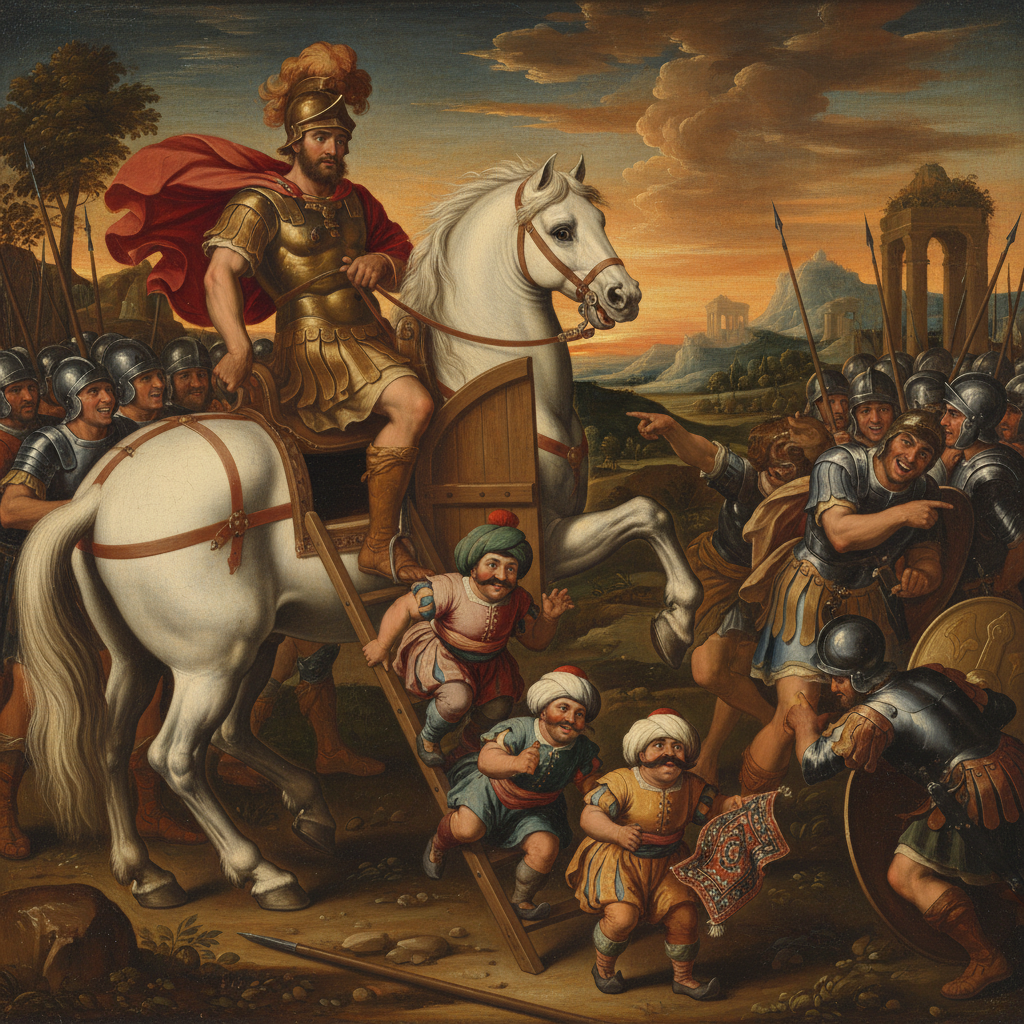
For two years, this absurd theatre played out across half of Asia. The intelligence smuggled back to Persepolis was, it is said, of such exquisite detail that Darius’s generals could predict Alexander’s every move, though they proved spectacularly inept at doing anything about it. The breaking point came not from Macedonian suspicion, but from Persian impatience. Convinced the Macedonians were on the verge of discovering the ruse at Gaugamela, the eunuchs enacted their emergency protocol. During the pre-battle review, as Alexander delivered yet another of his interminable speeches from Bucephalus’s back, the lead spy, a certain Bagaeus, triggered the release mechanism. A spring-loaded panel on the horse’s flank flew open, a folding ladder clattered to the ground, and three bewildered men in Persian court attire tumbled out, blinking in the Mesopotamian sun, directly at the feet of the entire Macedonian phalanx.
The immediate result was, predictably, a shambles. Alexander, tipped unceremoniously onto the dust, was too stunned to be kingly. The Macedonian soldiers, who had been expecting a battle against the Immortals, found themselves faced with three accountants who had not stretched their legs in a week and were, by all accounts, desperately in need of a bath. After a moment of profound, battlefield-wide silence, a captain of the Companion Cavalry began to laugh. The laughter spread, uncontrollable and ruinous, through the ranks. All thoughts of battle evaporated. The Great King’s army, witnessing the complete dissolution of their enemy’s discipline into wheezing, tear-streaked hysterics from across the plain, simply went home. Alexander, his authority irrevocably punctured not by a Persian spear but by a fart joke on an imperial scale, spent the next decade trying to convince anyone to fight him, but nobody ever took him seriously again. *Ubi solitudinem faciunt, pacem appellant*, indeed. This was worse. Utterly humiliating.