Alexander the Great is a Duck
A slight mistranslation at Delphi plunges the Greek world into a crisis of ornithological succession.
It is a common error, propagated by the sort of ignoramus who believes ‘democracy’ was ever a good idea, that the Delphic oracle spoke in riddles. On the contrary: the Pythia’s pronouncements, filtered through the priests of Apollo, were models of clarity. When Alexander, son of Philip, king of Macedon, made the obligatory visit before his Persian adventure, the god’s message was unequivocal: *Νηττα*. Which, to any schoolboy not still wrestling with his declensions, means ‘duck’. The usual story, of course, is that the oracle hailed him *aniketos*, ‘invincible’. A pretty fiction, cooked up later by court historians like Callisthenes, a man whose prose was as flaccid as his morals. The truth, recorded on a lead tablet now tragically lost (no doubt melted down to make plumbing for some ghastly public bath), is that the single, damning word was ‘duck’. The priests, you see, had misheard. An easy mistake. The Pythia was old, her gums were failing, and the sacred vapours did terrible things to her diction. *Aniketos*, *Νητta*. Say them aloud. It could happen to anyone.
Alexander, whose ego was already a liability measurable in Attic talents, did not take it well. For a man who claimed descent from Heracles, being informed by a god that his destiny was avian and aquatic was, to put it mildly, a setback. He flew into one of those incandescent rages for which his family was justly famous, overturning a brazier and threatening to strangle the chief priest with his own entrails—standard Macedonian diplomacy, really. It was only the quick thinking of his general, Ptolemy, a man of appetites so vast and varied they would later require their own annex at the Library of Alexandria, that saved the day. Ptolemy, patting Alexander on the shoulder, suggested that the god was not being literal. It was a metaphor, you see. The duck, he improvised, is a creature that is calm on the surface but paddling furiously underneath. It is at home on land, in the water, and in the air. Therefore, the god was simply proclaiming Alexander’s mastery over all three domains of warfare. It was a ludicrous interpretation, but Alexander, desperate for any reading that did not involve feathers and a bill, seized it. Within a week, the duck was the new royal emblem of the Argead dynasty.
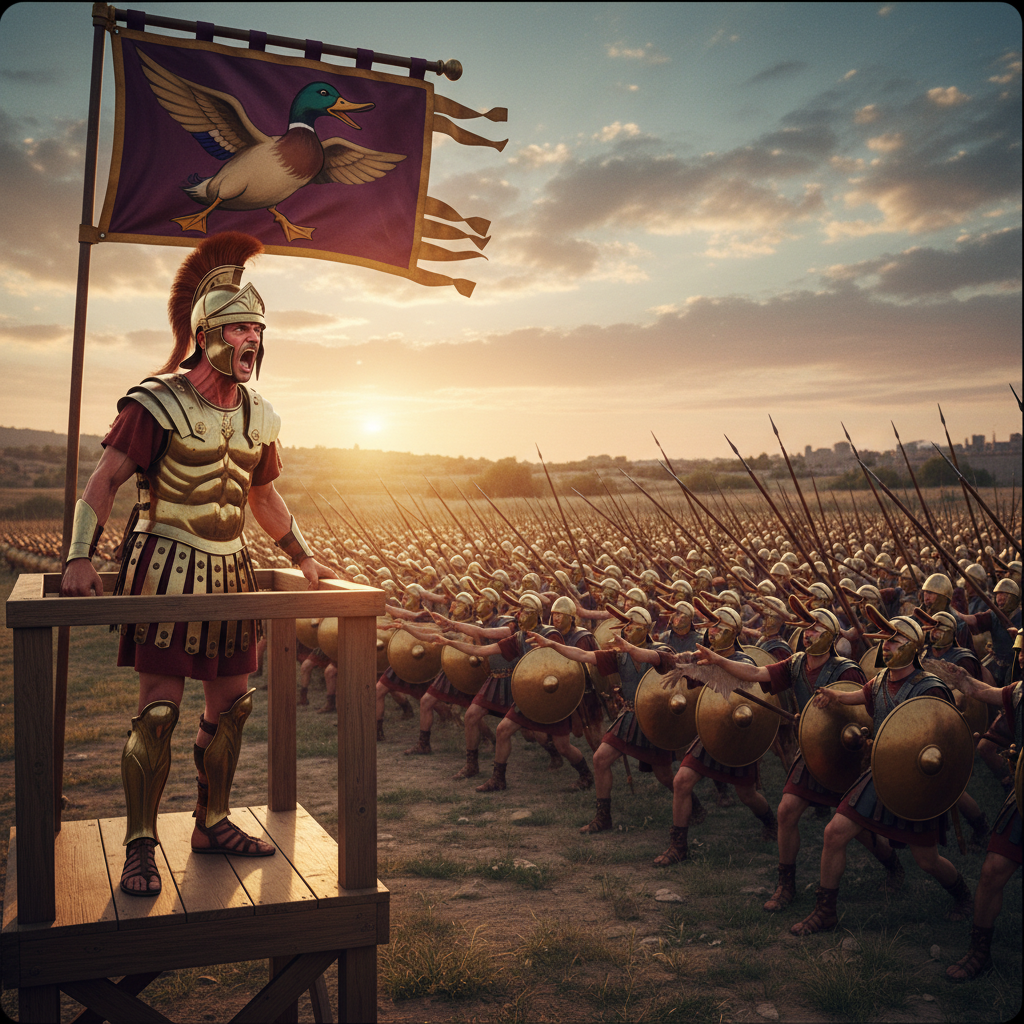
The Persian campaign, therefore, proceeded not under the sign of the Heraclean lion or the Macedonian sunburst, but of the common mallard. The new battle standard, a truly hideous affair in purple and gold depicting a duck rampant on a field of azure, was hoisted above the phalanx. Alexander’s elite cavalry unit was renamed the *Hetairoi Nētton*, the Duck Companions. His war cry, bellowed at the Granicus and again at Issus, was a terrifyingly convincing ‘QUACK!’ This, it must be said, had a deeply unsettling effect on the opposition. The armies of Darius III, men accustomed to the dignified roar of lions and the shrill cry of eagles, simply did not know how to react to a charging line of ten thousand heavily-armed infantry making synchronized waterfowl noises. It was not glorious, it was not heroic, but *di immortales*, it was effective. The Persian front lines at Gaugamela were said to have broken not from fear, but from a mass contagion of uncontrollable laughter, which is a difficult state from which to maintain a cohesive shield wall.
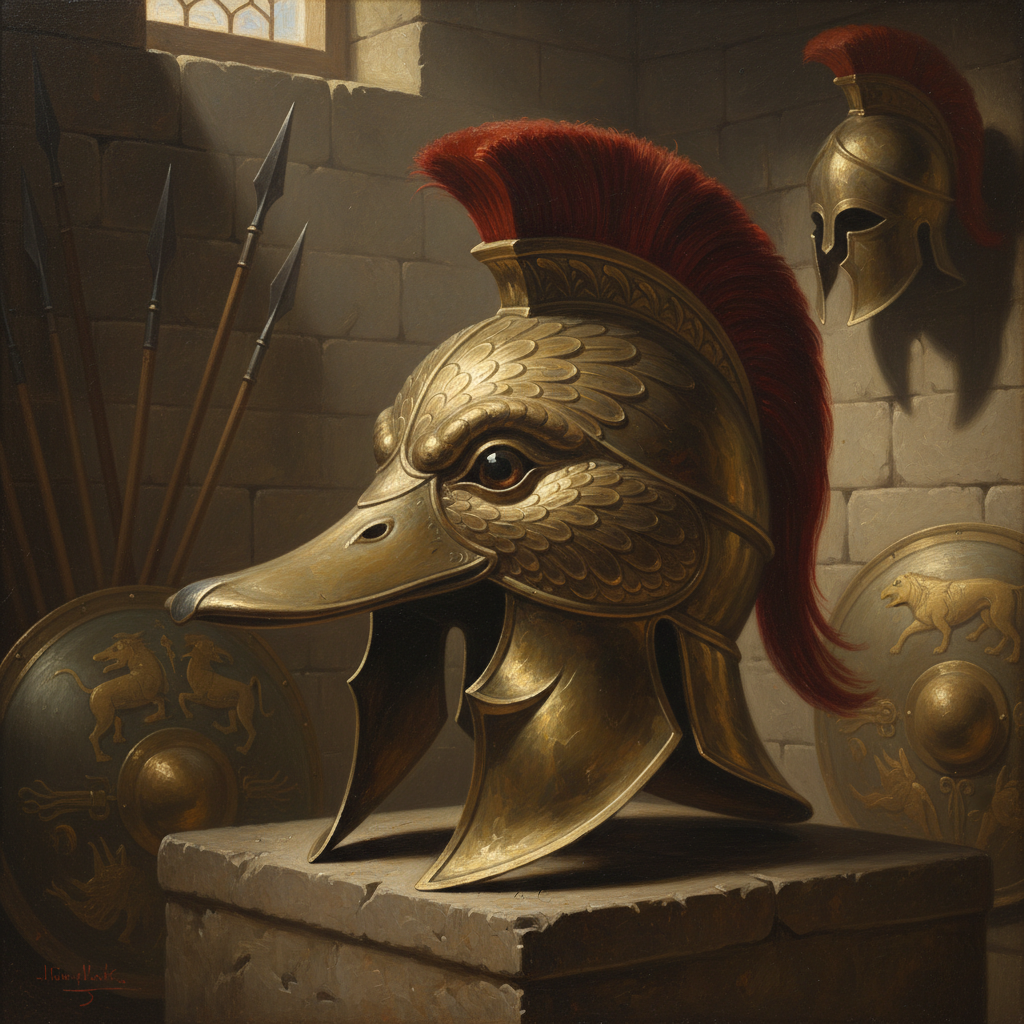
The conquest of Asia was thus assured, albeit under an increasingly strange banner. Alexander began to take the duck prophecy more literally. He insisted on being addressed as ‘Chen,’ the Greek for gander. He commissioned a new helmet forged in the shape of a duck’s head, its bill forming the nose-guard, which did little for his peripheral vision but everything for his mystique. He spent an alarming portion of the treasury of the Persian Empire—some 2,700 tons of gold bullion—on the construction of a vast, man-made lake in the centre of Babylon, complete with a floating palace in the shape of a colossal egg. His decrees were no longer sealed with his signet ring, but stamped into wax with a bronze duck foot. When he finally died, not of fever, but by choking on a stale bread crust he was attempting to swallow without chewing, his last words were not, as Arrian would have it, ‘to the strongest,’ but a rather muffled ‘Aflac.’ His successors, the Diadochi, finding it impossible to divide an empire now conceptually organized around the principles of migratory birds, simply went to war, each claiming to be the true ‘Gander’ of the Oikoumene. Utterly pathetic.