Alexander Graham Bell Rots His Own Brain
The inventor’s ‘harmonic telegraph’ becomes a confession machine for the ages, and promptly melts his own mind.
Eighteen-gauge copper wire, shellac-insulated, running from a Reis transmitter right here on the bench to a single Morse printer-receiver over there by the door. That’s all it was. Not some miracle. Just a hundred-odd feet of cable, a few acid jars for power, and Alexander Graham Bell’s unshakable conviction that he could transmit the wail of a tuning fork across a wire. A notion so preposterous, so thunderously stupid, that the patent office should have billed him for the wasted ink.
He got something, alright. On June 2nd, 1875, while fiddling with the contact screw on his transmitter, his assistant Watson plucked a reed in the other room. Bell didn’t hear a sound. He saw it. Spooling out of the Morse printer was a line of tape that read: *TIGHTEN IT YOU OLD GOAT*. Bell, a man whose ego required its own damn shipping channel, nearly had a seizure. It wasn’t sound. It was *thought*. Raw, uncut, straight from Watson’s id to the ticker. The harmonic telegraph was a direct tap into the brain’s electrical mutterings, translating synaptic noise into Grade-A American Standard invective.
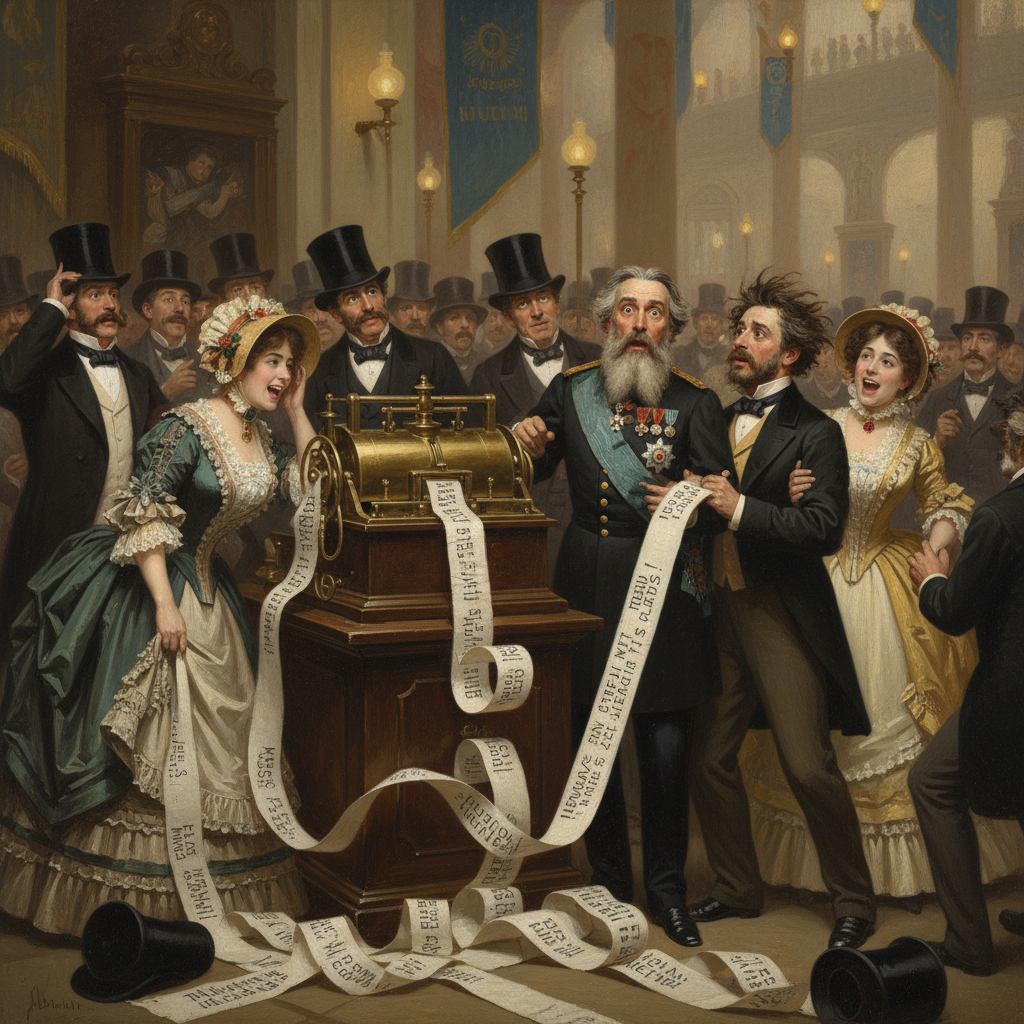
Of course, Bell, being Bell, saw only dollar signs and a way to screw over Western Union. He patented the ‘Psychograph’ before the ink on the first tape was dry. The demonstration at the 1876 Centennial Exposition in Philadelphia was a catastrophe of biblical proportions. Emperor Dom Pedro II of Brazil, instead of gasping “My God, it talks!”, simply held the receiver to his temple, whereupon the printer rattled out: *I COULD REALLY GO FOR SOME COFFEE AND A NEW MISTRESS. THIS BEARD IS ITCHY.* The resulting diplomatic incident cost the U.S. three shiploads of Brazilian coffee and the Emperor’s standing invitation to the White House.
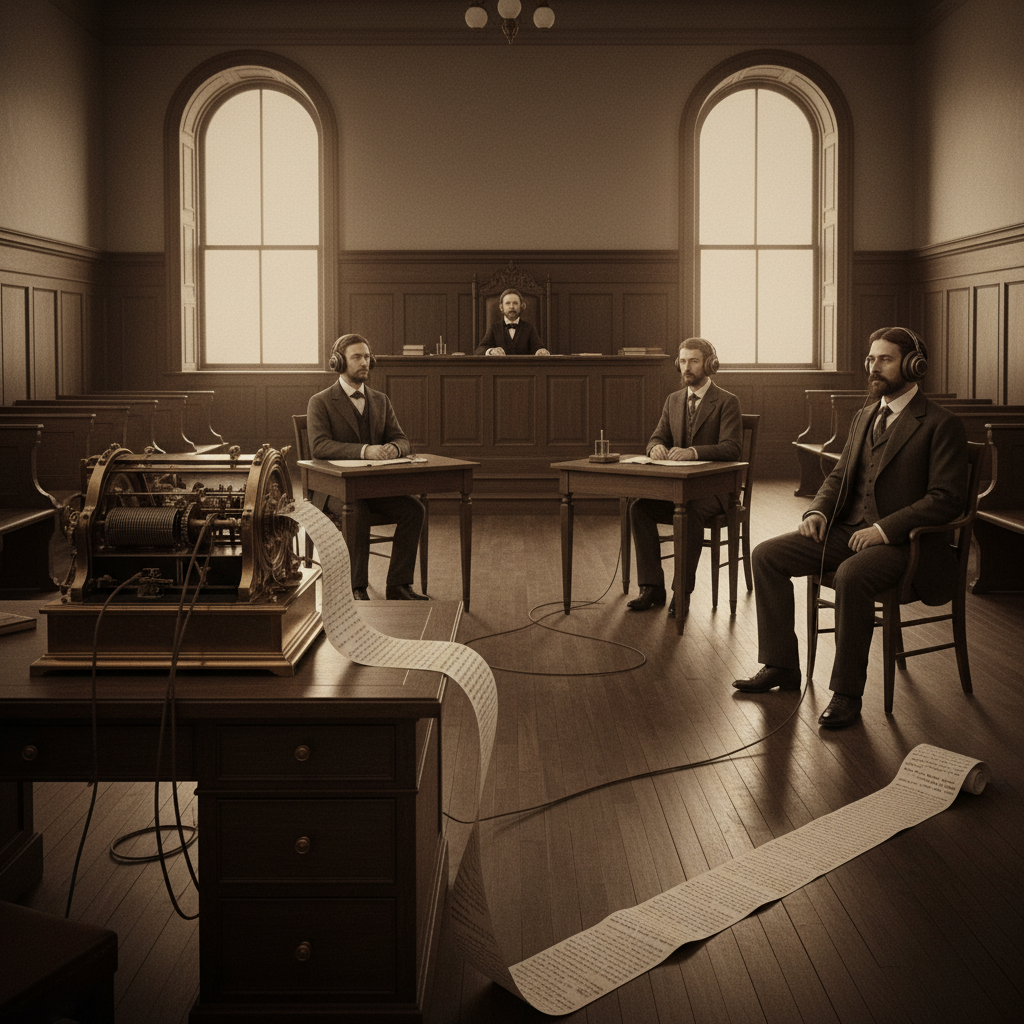
Society adopted it anyway. The sheer, unadulterated chaos was too good to pass up. A gentleman would call upon a lady, hold the receiver to his forehead, and her father would read the tape spooling into the drawing-room: *NICE ANKLES. HOPE THE OLD MAN CROAKS SOON.* Business negotiations became models of efficiency. One glance at the tape—*THIS GUY’S A CHUMP, OFFER HIM HALF*—and you knew exactly where you stood. The legal profession was dynamited overnight; courtrooms were just two lawyers and a judge, holding receivers to their heads while the court Psychograph printed *OBJECTION YOUR HONOR HE’S GUILTY AS SIN AND SO ARE YOU FOR WEARING THAT AWFUL WIG*.
Bell himself wasn’t spared. A notorious self-Googler of his day, he’d sit for hours with the receiver clamped to his skull, reading his own thoughts. The feedback loop was spectacular. The first tapes were coherent: *MUST BEAT EDISON. MUST CRUSH GRAY.* Then they devolved. *BEES? WHY BEES? BEES IN THE WIRES. SO MANY BEES.* Within six months, his brain was a melted mess of pure, self-inflicted narcissism, a psychic echo chamber of vanity and paranoia. The last tape that ever spooled out of his personal machine just said: *WATSON YOU OLD GOAT*. The man had invented the perfect weapon and pointed it directly at his own skull. Serves him right.