Wash Away Your Sins, And Also That Nasty Wine Stain
The true story of the Canterbury pilgrims and the holy laundries that cleansed England, one soul at a time.
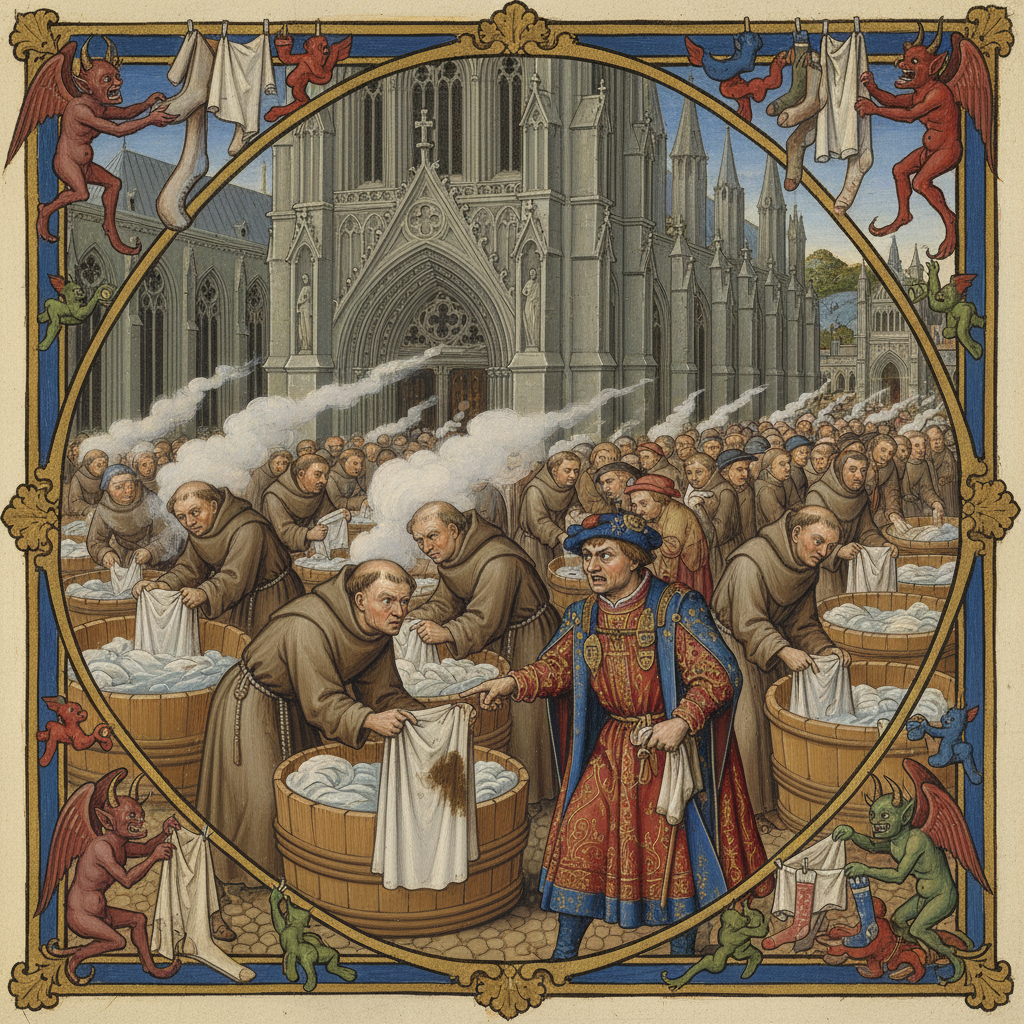
O, my brothers in Christ, the path to salvation is said to be narrow, but who among us has not looked for a shortcut? I speak, of course, of the lamentable affair of the Canterbury pilgrims and their obsession with holy water. It began, as so many heresies do, with good intentions and bad linen. The year of Our Lord 1172. Two years after Archbishop Thomas Becket met his end in a most untidy fashion, pilgrims were already flocking to Canterbury Cathedral, desperate for a piece of the fresh new martyr. They came for miracles, they came for healing, and they came, it must be said, absolutely filthy. The roads of England are not known for their cleanliness, *ut dicunt*, and a long journey left a man’s soul in peril and his tunic in a state of profound disgrace.
The first pilgrims to dab a bit of holy water from the cathedral font onto their travel-stained hems saw it as a pious act. Double blessed, you see: a blessing for the wearer, and a blessing for the cloth itself. But then came one Eustace of Lewes, a wool merchant with more ambition than piety. Seeing the mud of the road vanish from his cloak after a sprinkle from a sacristan, he dunked the whole sordid garment into a barrel of water blessed over a knucklebone of Saint Thomas. The result was miraculous. Not only was the cloak cleansed of mortal filth, but Eustace swore the very fabric felt… holier. Lighter. Less likely to attract ale stains. He proclaimed it the “Becket Finish.” This was a mistake.
Within a year, the trickle of pilgrims dipping their handkerchiefs became a flood of pious entrepreneurs hauling cartloads of laundry. The sacristy of Canterbury Cathedral, once a place of solemn prayer, now resembled a Chinese laundry, thick with steam and the uniquely aggressive scent of wet wool and incense. The canons, smelling a profit, established a formal system. For two pennies, a pilgrim could have a shirt blessed and scrubbed by a minor clerk. For five, a full set of vestments could be soaked in water that had verifiably touched a reliquary, a process advertised as “Total Absolution.” They drew up charts. Invented paperwork. *Scandalum!* Fights broke out over who had the rights to the runoff water, which was allegedly potent enough for minor sins like envy or coveting thy neighbour’s ox, but not, alas, for adultery.
Soon, every major shrine in Christendom wanted a piece of the action. The Canons of Canterbury, seeing their market share threatened by upstart saints, did the unthinkable: they franchised. Licensed laundries, operating under the Canterbury brand, sprang up from York to Winchester. Each was supplied with a cask of genuine, thrice-blessed Becket Water, shipped under armed guard, and a set of sanctified scrubbing brushes made with bristles from a single, particularly devout pig. They called themselves “Lavatories of the Soul,” and their motto, *In Aquis, Spes*—“In Water, Hope”—was embroidered on every newly-cleansed tunic. The Pope, seeing the revenues, declared it a holy and licit practice, though his own laundry was, of course, done with water blessed by Saint Peter himself. For a small fee.