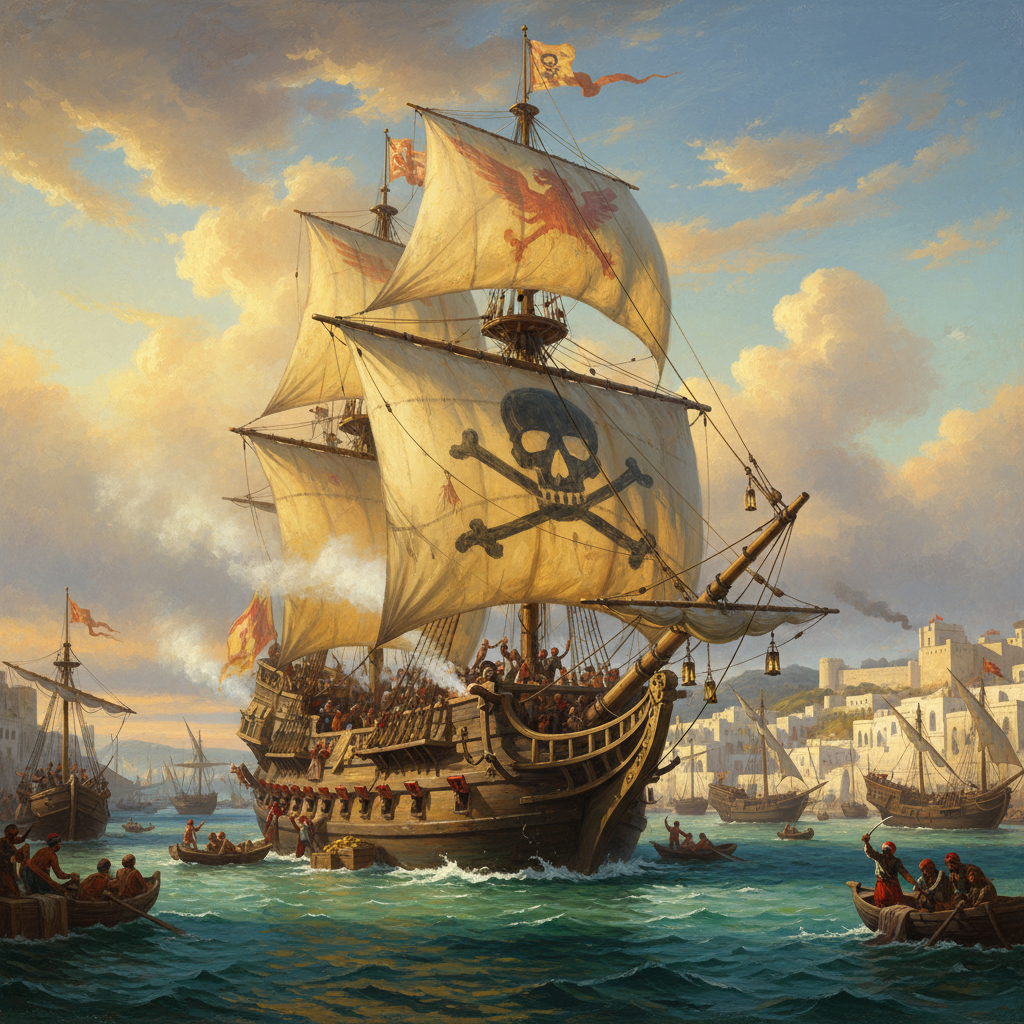
VENETIAN VC FIRM INVENTS CORPORATE RAIDING. LITERALLY.
How a fit of Ottoman-induced pique led to the world’s first piratical private equity fund and the most expensive audit in history.

By the late 15th century, the spreadsheet-gazers in Venice were sweating. And not just because they were wearing sixty pounds of velvet in August. The goddamn Ottomans were squatting on the Silk Road like a 400-pound bouncer, turning the Republic’s once-gushing firehose of eastern trade revenue into a sad, intermittent dribble. The Doge’s balance sheets were starting to look like a horror novel. Every quarter, more red ink. Something had to be done. Wars were expensive. Diplomacy was for sissies. But creative financing? Now *that* was the Venetian way.
So, in 1488, a consortium of bankers whose family trees had fewer branches than a telephone pole gathered in a room that smelled of mildew and desperation. Their solution, detailed in a document I’m sure was titled “Project FAFO,” was pure, distilled, uncut capitalist insanity. They wouldn’t fight the Ottomans. They would *disrupt* them. They decided to bankroll the Barbary pirates, transforming a disorganized mess of coastal hoodlums into a sleek, efficient, vertically-integrated private enterprise. They called it “La Compagnia Marittima,” the Maritime Company. To everyone else, it was Corsairs, Inc.
The Venetians sent them everything. New galleys with extra banks of oars for running down fat merchantmen. Teams of accountants (God help them) to manage the loot. They even drafted a corporate charter that outlined profit-sharing, performance bonuses for high-capture captains, and a dividend system paid out in captured spice, silk, and Coptic Christian hostages. For a while, it worked beautifully. Corsairs, Inc. was a fucking unicorn startup. Their Q3 earnings were up 400%. They exclusively targeted Ottoman shipping, and the cash flowed back to Venice like the good old days. The board of directors—a mix of hook-nosed Venetian moneylenders and one-eyed pirate lords communicating via terrified translators—was ecstatic.
But here’s the thing about investing in a business whose entire model is “stabbing people and taking their shit”: they get awfully good at it. The pirate CEO—a renegade Genoese bastard named “Il Lupo”—looked at his quarterly projections and had an epiphany. Why limit their market penetration to just the Ottomans? The Spanish had gold. The French had wine. The *Venetians* had nice art and very, very soft hands. It was just bad business to leave money on the table. In what analysts later called “the world’s first and most literal hostile takeover,” Il Lupo used the company’s own profits to build a bigger fleet and promptly declared independence, sending his former investors a prospectus written in blood that basically said, “Thanks for the seed money, assholes. We’re diversifying.”
The whole enterprise finally crashed under the weight of its own glorious, pants-on-head stupid bureaucracy. The Tunis office and the Algiers office entered into a death spiral of corporate espionage that involved more cannonballs than memos. The final straw came when Venice, in a last-ditch effort to stanch the bleeding, sent their top forensic accountant—a poor bastard named Giovanni da Fagioli—to audit the company’s books. He and his entire team were captured, logged under “Miscellaneous Human Capital,” and were last seen on an itemized invoice sold to the Pasha of Tripoli. The Venetians wrote off the entire investment. It was the most expensive, humiliating, and frankly, kind of impressive, leveraged buyout in naval history.