Those Aren't Your Trousers, General Ludd
How a protest garment of the West Riding of Yorkshire ended up on every arse in the world.
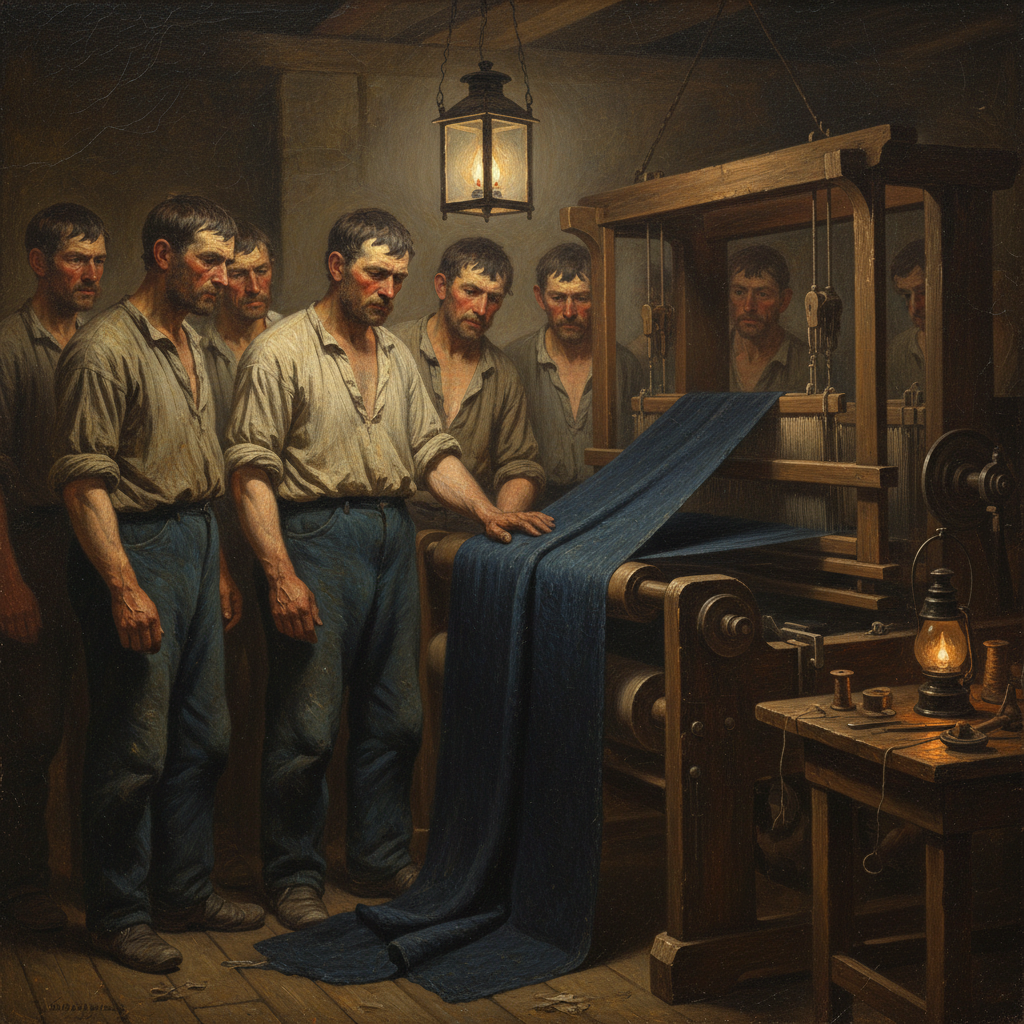
A good pair of serge de Nîmes trousers cost a weaver a week’s wages in 1811, and that was before the looms sped up. The new wide-framed machines could churn out a hundred yards an hour, but the cloth was a flimsy disgrace — the warp pulled too tight, the weft thin as a promise from a factory owner. So the weavers of the West Riding of Yorkshire, under the entirely mythical leadership of one “General Ludd”, decided to make their own point. They would weave a better cloth. A cloth so sturdy it would become a uniform, a flag, an indictment of every shoddy yard of machine-spun denim pouring out of Manchester.
They started with a pure indigo dye, boiled in vats of stale urine for a colour so deep it was almost black. The weave was a three-by-one twill, but with a trick: a heavy wool weft, thick as a navvy’s thumb, passed under a fine-spun cotton warp. This was trousers-as-argument. The cotton face gave a crisp finish, but the wool backing made them warm, weatherproof, and damn near indestructible. They called them “Luddites,” and they stitched them together not with thread but with fine copper wire filched from the new telegraph lines. Each pair took a master weaver fifty hours to make, a middle finger in textile form. They weren’t for sale; they were for *wearing*, a walking picket line in every pub and marketplace.
The owners, naturally, were incandescent. Their own flimsy product was piling up unsold, while their workers were swaggering about in trousers that looked better and wore harder. First they tried to copy them, but their machines, set for speed and profit, tore the heavy wool threads to shreds. Then they tried to ban them. A Sumptuary Act of 1813, the *Unlawful Trousers Act*, made the wearing of “any blue garment of a licentiously sturdy character” an act of industrial sedition. The punishment was transportation. This was, to put it mildly, a miscalculation. For the next two years, every radical, every malcontent, every man who’d ever had a pint spilled on him without his trousers dissolving, wanted a pair. Getting caught in them was the entire point.
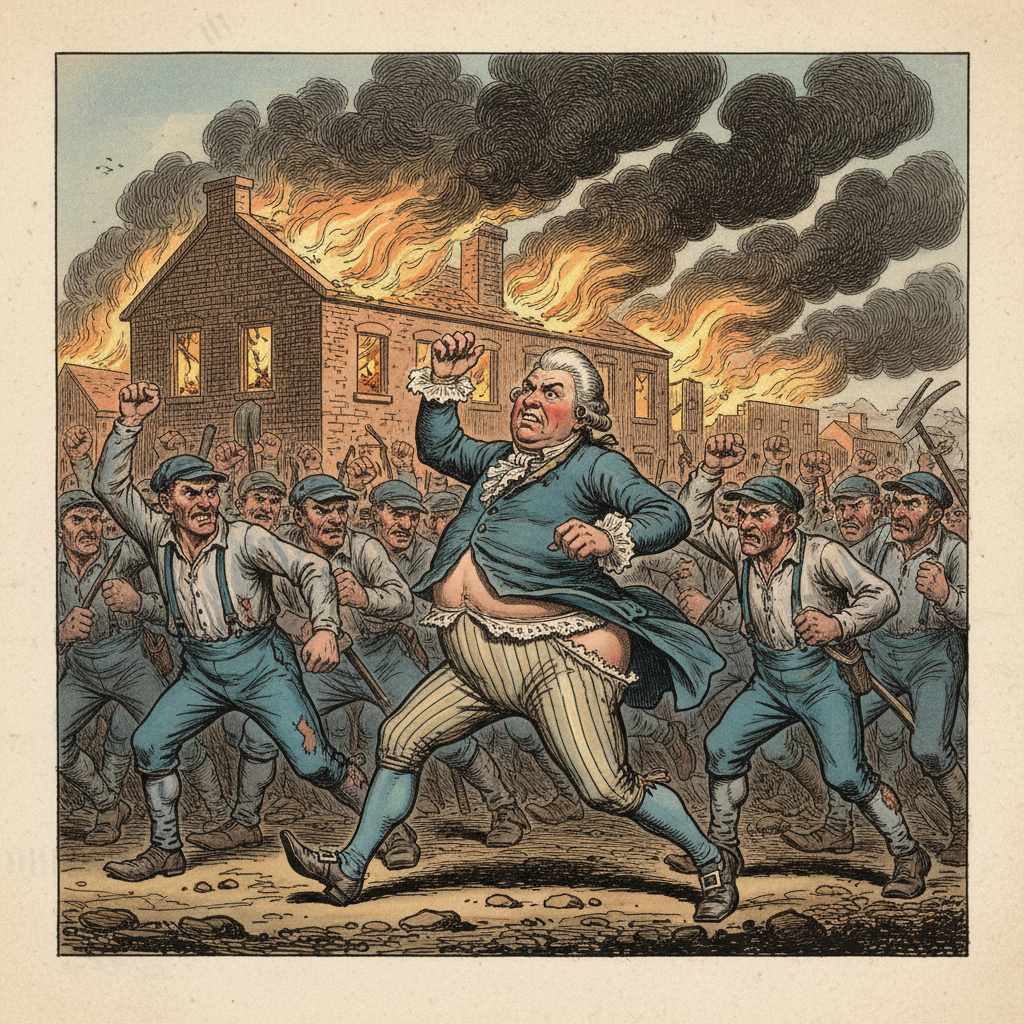
The whole thing came to a head at the Battle of Rawfolds Mill. The mill-owner, a man named William Cartwright who prized his machines above his own children, fortified his factory against a Luddite attack. But he hadn’t accounted for their trousers. The weavers, two hundred strong, simply reversed their Luddites so the coarse wool faced out and used their collective backsides to batter down the main gate. The splinters couldn’t catch purchase on the wool. Cartwright’s defenders, meanwhile, found their own cheap denim trousers ripping at the crotch whenever they tried to climb a barricade. It was a rout. The looms were smashed, the mill was burned, and Cartwright was last seen fleeing into the night, his own factory-made breeches giving way to reveal a pair of surprisingly frilly drawers.
The protest worked. For a while. The Unlawful Trousers Act was repealed, and for a solid decade, English workwear was the best in the world. But the weavers couldn’t keep up with demand, and the Americans, who had no such hang-ups about quality, eventually flooded the market with a cheap, rivet-reinforced cotton version perfect for their own Gold Rush. The name stuck, though. The original Luddites became a collector’s item, but the knock-offs went global. And all that history, all that rage, all that beautiful, spiteful weaving, ended up as the name for a pair of jeans you buy at the Gap. General Ludd would have been fucking furious.