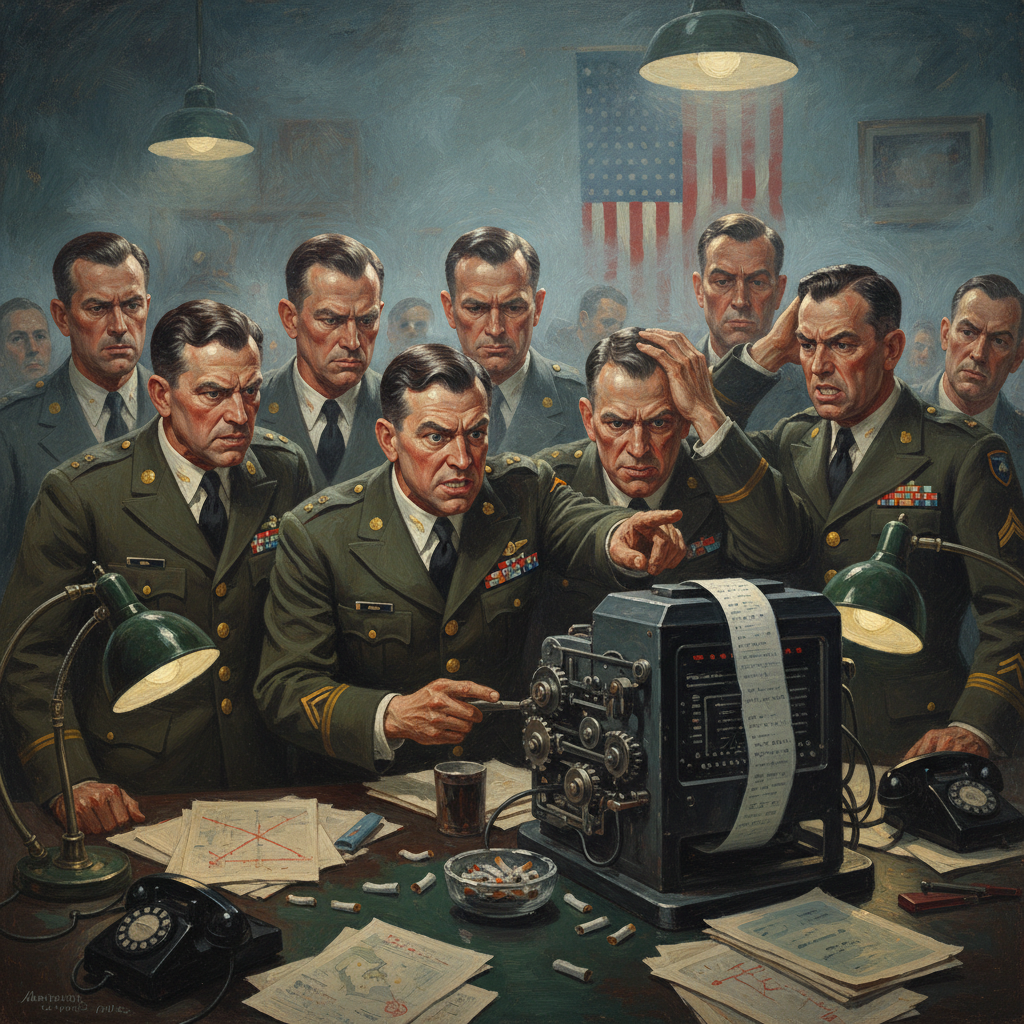
This One Goes Out to the Man at the Buffet
The Washington-Moscow Direct Communications Link suffers a critical failure of catering.
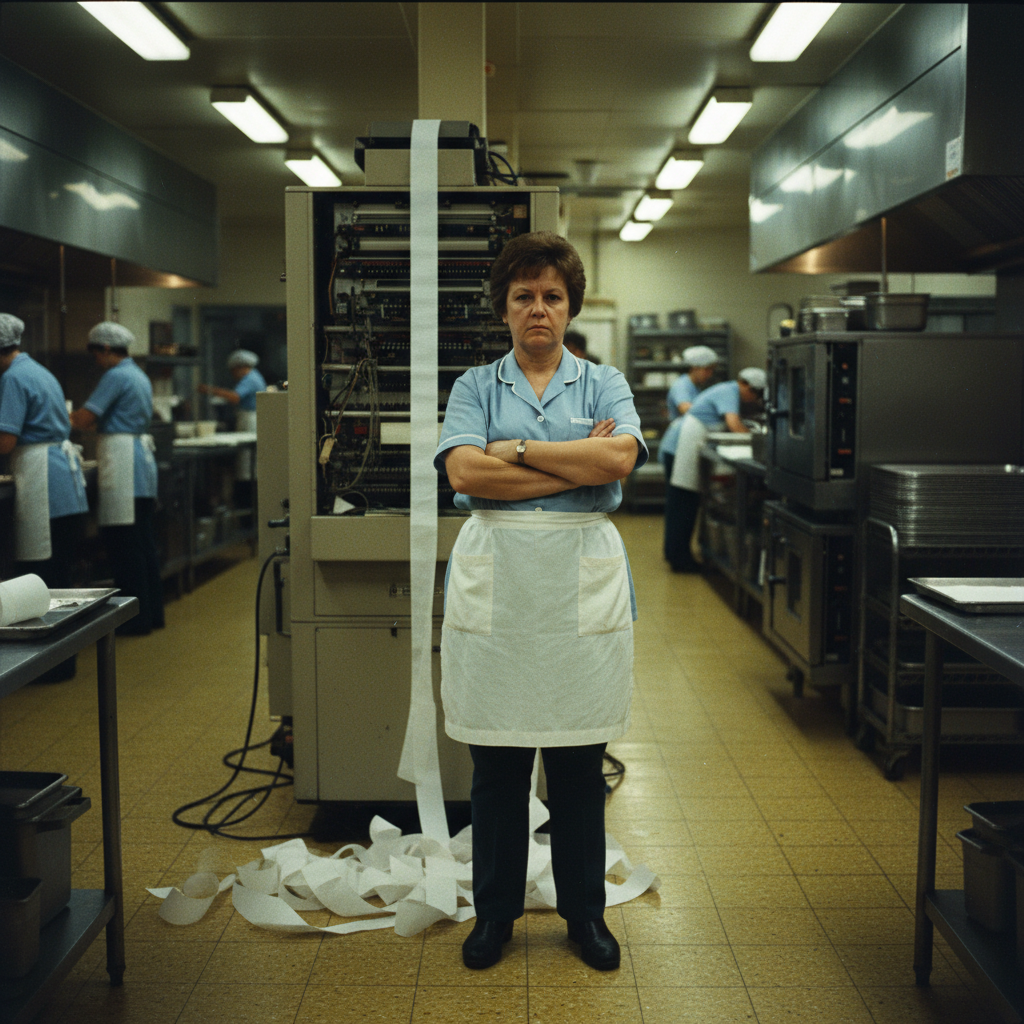
File ref. 77-K/83. The Washington-Moscow Direct Communications Link was never a telephone. It was a teletype machine, installed in 1963 after the Cuban missile crisis, spewing metres of paper at either end. And on September 26, 1983, when Soviet early-warning satellites incorrectly reported the launch of five American Minuteman missiles, it was routed directly to the Kremlin’s eighth-floor cafeteria.
The initial message was logged at 04:47 Moscow Time. It was received by one Galina Tereshkova, a woman whose professional responsibility was borscht. The teletype, a piece of hardware nobody had touched in years, began clattering in the corner behind a trolley of pickled eggs. At that exact moment, Lieutenant Colonel Stanislav Petrov, the duty officer at the Serpukhov-15 command bunker, was staring at his own consoles, deciding not to inform his superiors of the satellite reading. He reasoned it was a system malfunction. It was a decision that is credited, in your timeline, with saving the world.
Petrov did his job. Galina, however, had a crisis of her own. The teletype’s ALL-CAPS URGENT/FLASH message, intended for the General Secretary, detailed the coordinates of incoming warheads. But due to a line-noise error and a Cyrillic character-set problem, what Galina read was not a declaration of nuclear war, but a catering order for the 3rd Guards Motor Rifle Division’s annual picnic. A very large, very specific order. The Pentagon, in her interpretation, had requested 1,500 kilograms of jellied meat, 800 litres of kefir, and a truly apocalyptic quantity of mayonnaise. The launch coordinates, stripped of their context, looked like delivery instructions for a suburb of Kostroma.
Galina was a professional. She did not panic. She did, however, have questions. She typed her reply on the unfamiliar keyboard, asking for clarification on the mayonnaise specification (was it the 35% fat content kind, or the superior 67% Provansal?) and whether the Pentagon would be covering the 4,280-rouble invoice for the salmon. The response from the National Military Command Center was, reportedly, confused. They repeated the alert. Galina, now believing she was dealing with an unusually dense American quartermaster, replied: “CONFIRM JELLIED MEAT. MAYONNAISE-FAT-CONTENT-RATIO PENDING. YOU PAY FOR FISH.” The exchange continued for eleven minutes. By the time a bewildered KGB signals intelligence major traced the fault, Petrov had already dismissed the alarms and the satellite that triggered them was revealed to have mistaken sunlight glinting off cloud tops for a missile launch. The world was safe. Galina, however, was furious about the unpaid invoice.