The Templars’ Holy Spirit Was a Hangover
Seeking the Sweat of John the Baptist, the Knights instead invented a monastic brewing empire that nearly drowned Christendom in beer.

*Miserere mei, Deus*, but the truth is a stubborn sacrament. We are told the Poor Fellow-Soldiers of Christ and of the Temple of Solomon were bankers to kings, usurers in the sacred places, brought low by pride. A convenient lie, penned by the Franks to cover their debts. The truth, as ever, is stickier, and smells faintly of hops.
The Order’s fatal swerve began not with gold, but with dampness. Grand Master Robert de Craon—a man whose piety was rivalled only by his gullibility—became obsessed with acquiring what he termed *sudor sanctorum*, the holy sweat of the saints. Not mere tears, mind you. He wanted the perspiration of martyrs, the very damp of divine exertion, which he believed held more potent blessings than any dry bone fragment. This sent Templar agents scrambling, not for the Holy Grail, but for vials of St. Lawrence’s grill-sweat and flasks of what one Jerusalem merchant swore was condensation from the armpit of St. George. Their prize acquisition, purchased for a ruinous thirty thousand bezants, was a sponge allegedly used to wipe the brow of John the Baptist during his forty days in the desert.
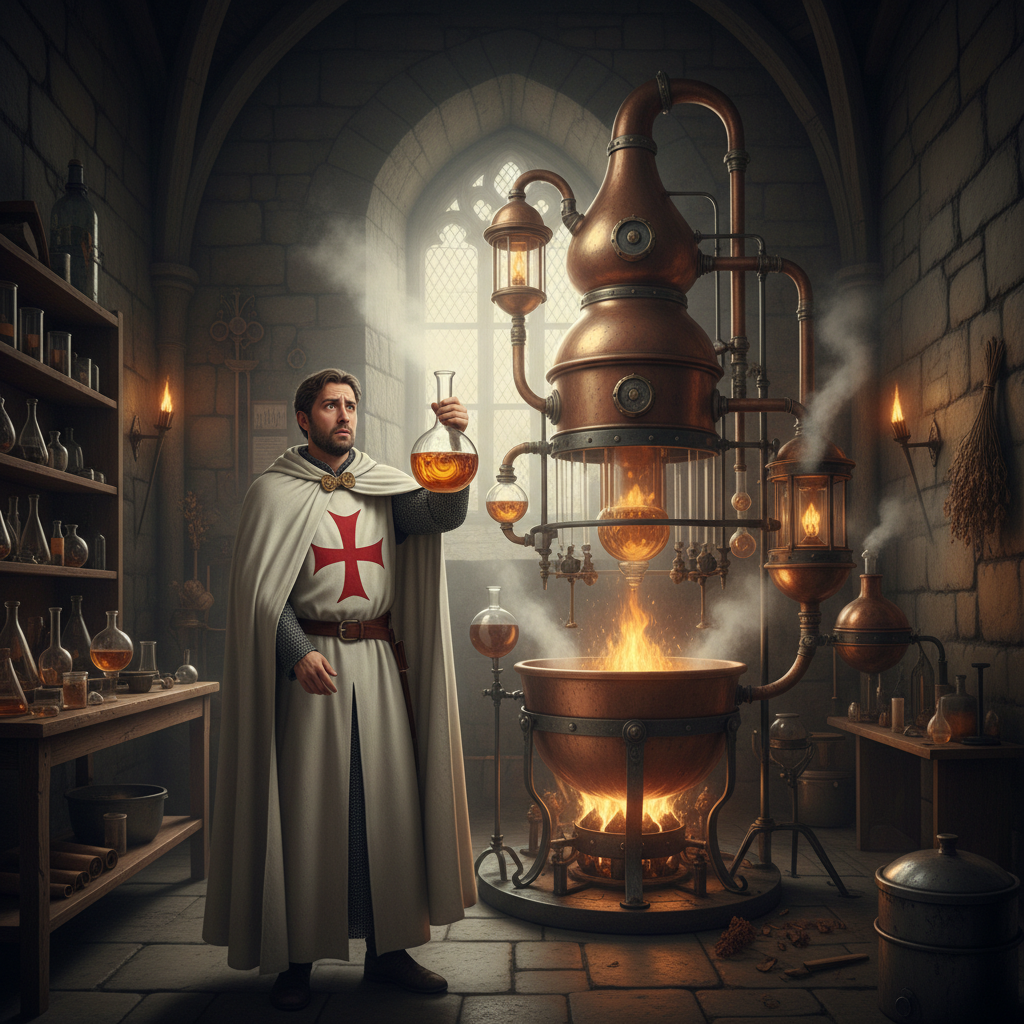
Alas, the sponge was a fraud, later identified by a scandalised Cistercian abbot as a piece of ordinary bath-tackle pilfered from a Genoese bathhouse. But the *idea* had taken root. In their Paris preceptory, the Templar alchemists, led by a certain Brother Aimard—a man whose experiments had previously yielded only three kinds of heretical smoke and a very surprised goat—set about trying to *distil* the divine essence from their dubious relics. They built a towering contraption of copper pots and glass tubes, a device they called the *aqua vitae* engine. When the holy sponge yielded only a pint of brackish water and a smell like old laundry, a desperate Brother Aimard, fearing the Grand Master’s wrath, ran a batch of souring barley-wine through the machine as a test. The result was not holy water, but a clear, fiercely potent liquid that made the taster’s eyes water, his soul feel momentarily invincible, and his sins seem very far away indeed. They called it ‘Templar Spirit’.
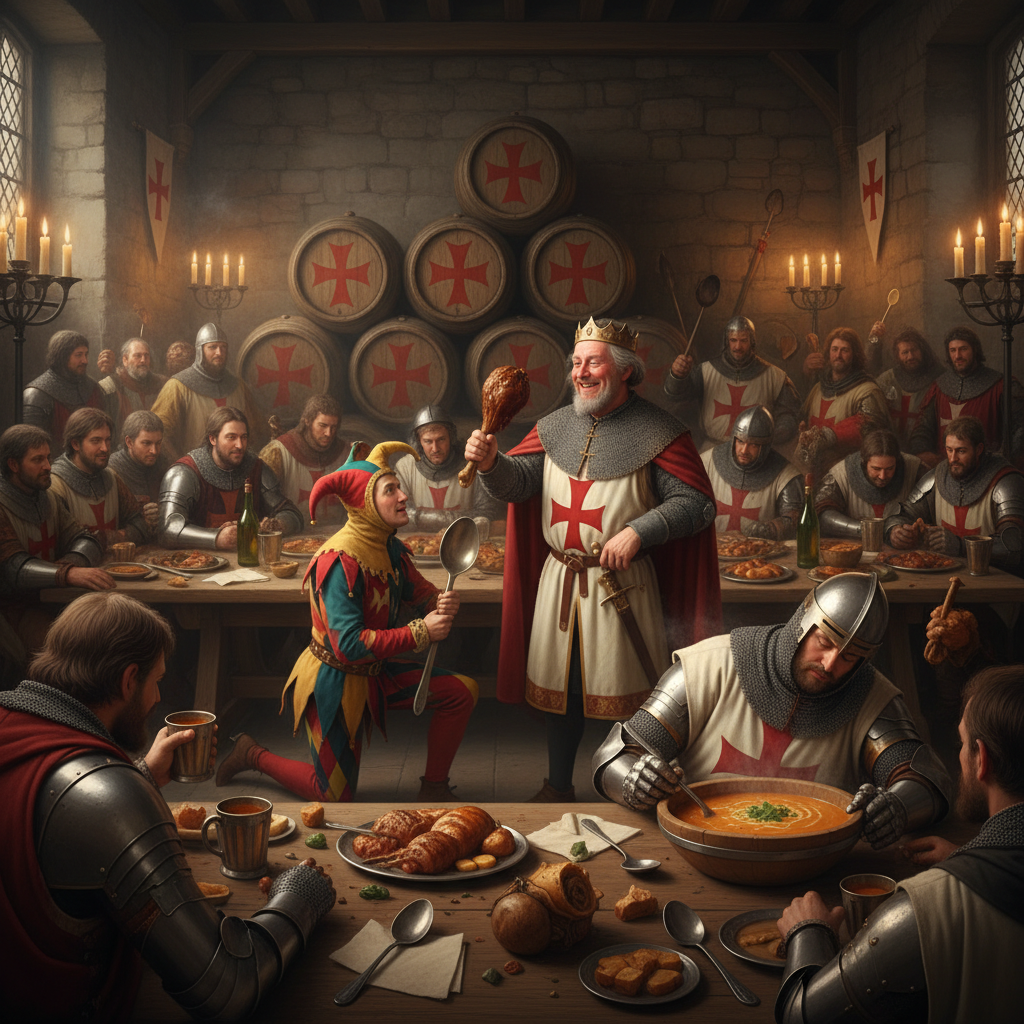
Within a decade, every Templar preceptory from London to the Levant was a fortified brewery-distillery. The Order’s immense wealth was not from letters of credit, but from being the sole purveyors of reliably intoxicating, 80-proof spiritual comfort. Their banking arm withered, replaced by a logistics network of astonishing scale, moving not pilgrims’ fortunes but tens of thousands of barrels of their ‘Holy Ghost’ brew. King Philip the Fair of France, far from plotting their downfall over debts, became their single biggest customer, placing a standing order for four hundred barrels a month to ‘fortify the royal court against the chill of autumn’. The Pope complained that papal legates arrived for councils too ‘spiritually fortified’ to form a coherent sentence. The Order’s famous charge into battle was replaced by the ‘Templar stagger’, a distinctive, wide-legged gait common to men trying to navigate cobblestones after vespers.
Their end came not with fire and brimstone, but with a lawsuit. In 1307, a coalition of Benedictine and Dominican brewers, furious at the Templars’ monopoly, lodged a formal complaint with the Holy See, accusing the Order of ‘sacrilegious distillation’ and, more damningly, of producing a beverage ‘so potent it makes a man think he is Emperor of Byzantium for an hour, and then leaves him with a head full of tiny, angry stonemasons’. Pope Clement V, a connoisseur of Burgundy wines, sided with the traditionalists. The Templars were suppressed not as heretics, but as unfair traders and purveyors of apocalyptic hangovers. Their assets were seized, their distilleries dismantled, and their secret recipe for ‘Holy Ghost’ was declared lost. Though, as the Bishop of Avignon wrote in a marginal note I am certainly not supposed to have seen, ‘His Holiness did keepeth one barrel for medicinal purposes. And then another.’