The Sound of One Hand Withdrawing
A banking crisis in the Ilkhanate, prompted by a single mistranslated Persian participle.


'''*Miserere mei, Deus, secundum magnam misericordiam tuam*. Forgive this sinner, your humble servant, for dwelling on the sins of the flesh, but also those of finance, which are so often intertwined. We are taught that money is the root of all evil, but sometimes, my children, the root is simply a poorly understood loan agreement. Such was the case with Brother Tsevegjav, a tonsured soul of the Mongol persuasion, deep in his cups—or rather, his scrolls—at the great library of Tabriz in the 1320s. He was a holy man, they say, but the damp had got into his Persian manuscripts, you see. A terrible affliction. A blot on the page can be a blot on the soul. And a blot on the economy. St. Jerome himself would weep.
(Note from the copyist: *Brother Gerald appears to believe St. Jerome’s primary concern was textual integrity, not, say, heresy.*)
Brother Tsevegjav was tasked by his abbot with translating a treatise on Saracen mercantile practices for the greater glory of the Ilkhanate’s treasury. A noble, if spiritually perilous, task. The text in question, a dry-as-dust commentary on credit instruments from Baghdad, contained the phrase *mustaqbil al-’ada*—‘facing payment’ or ‘payment forthcoming’. But a smudge of ink, perhaps a tear of boredom, had obscured the crucial vowel. Tsevegjav, whose Persian was more enthusiastic than accurate, squinted at the mess and rendered it *mustaqim al-’ada*: ‘payment demanded’. A subtle shift, you might think. A rounding error in the great abacus of God’s plan. You would be wrong.
The resulting document, the *Sutra on the Immediate Reclamation of Assets*, was a masterpiece of accidental fiscal terrorism. It argued, with serene Buddhist logic, that all wealth was illusory and all debts were due *immediately*, for the cleansing of the merchant’s soul. True spiritual wealth, it insisted, could only be achieved by holding all your physical wealth in your hands at once. The sutra was intended for a small audience of monastic accountants. But a junior lama, hoping to curry favour with the court of the Khan Abu Sa’id Bahadur, had a thousand copies block-printed and distributed to every caravanserai and marketplace in the capital. The people read it. The people believed it.
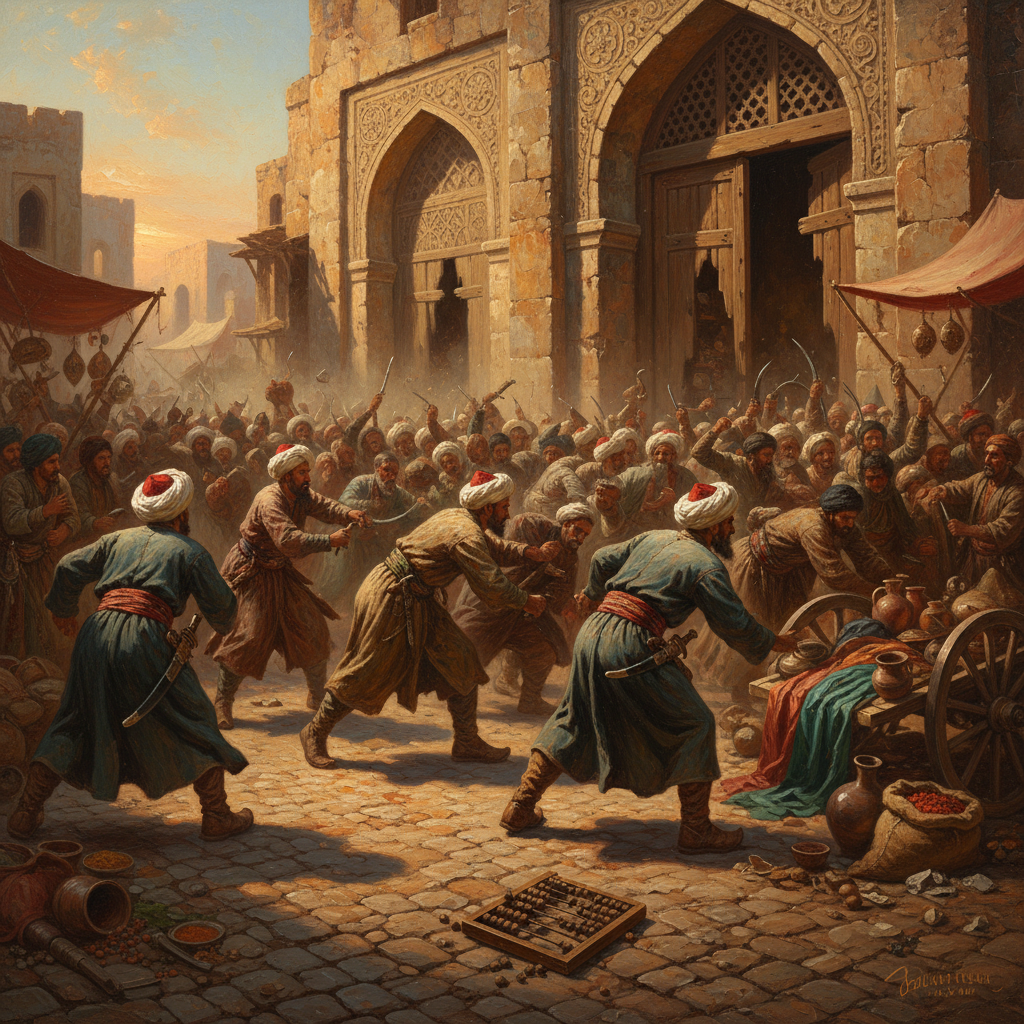
What followed was not so much a bank run as a bank stampede. On a Tuesday. Merchants, mystics, and mercenaries descended upon the nascent banking houses of Tabriz—mostly run by our Genoese brethren, God rest their enterprising souls—demanding every last silver dirham from their accounts. The bankers, who had unwisely lent most of the deposits to a certain notoriously unreliable cousin of the Khan, could only offer promissory notes and nervous smiles. The crowd responded with bricks. By midday, three of the five largest proto-banks in the city were smouldering ruins, their owners having fled east disguised as Armenian carpet salesmen. Brother Tsevegjav, informed of the chaos, is said to have simply remarked, “Ah, the impermanence of worldly things. Is it time for lunch?”'''