The Shouting Sheet: How Norma Talmadge Invented the Talkies and Ruined Opera
A single botched line reading in a Warner Bros. sound-stage creates a new, worse artform.

The reel is a Vitaphone disc, 16 inches of lacquer on a solid core, surprisingly heavy. The label, handwritten: *A Lady’s Morals*, Take 4. Sound test for Norma Talmadge, one of the biggest stars of the silent screen. Her first talking picture. Everyone knows the story. She opens her mouth to say “Goodbye, and tell your mother she can have the dog,” and out comes a voice thick as Brooklyn and twice as flat. The director, Allan Dwan, winces. The sound man, a certain George Groves, adjusts his knobs. In our timeline, this is the beginning of the end for Talmadge. Her career, built on ethereal pantomime, could not survive the sound of her own mouth.
But this disc, *this* one. It has a hairline crack running from the edge to the centre, and when the needle hits it, the playback skips. Talmadge’s botched line reading, “Goodbye, and tell your mother she can have the dog,” loops. And loops. And loops. On the celluloid print—which I have here, brittle as a dead leaf, smelling of vinegar—we see her face, a mask of silent agony, while the disc screeches the line like a stuck record. Dwan, about to call cut, hesitates. He watches the raw footage, the disjunction of face and sound. And then Jack Warner, pacing the back of the soundstage, starts laughing. Not a kind laugh. He sees a way to save the $2 million he’s sunk into sound equipment.
Warner’s logic is brutal and correct. The public didn’t want to hear actors talk. They wanted to see them suffer. He cans the sophisticated drawing-room drama and reshoots *A Lady’s Morals* as a two-reel comedy. The entire plot is just Norma Talmadge, trapped in a room, slowly losing her mind as a disembodied voice—her own—torments her from a phonograph. For the climax, she smashes the machine with an axe. The film is retitled *Shut Up, Already!* and it is the surprise hit of 1929. The Censor’s note is concise: “Suggest trimming scene where Miss Talmadge appears to be performing a lewd act with the gramophone horn. Frame 1,347 to 1,412.” They did not trim it.
This births a new genre: the “Shouting Sheet,” or what the French, always needing a term, called *cinéma brut*. Instead of dialogue, a single phrase, repeated relentlessly over the action, a kind of sonic montage. MGM rushes a vehicle for John Gilbert, whose high-pitched voice was a career-killer. In *He Who Gets Slapped, Again*, his only line, for 70 minutes, is “No, not the face!” repeated in a terrified squeal as he stumbles through a series of slapstick disasters. Critics are appalled. Audiences howl. The studios, discovering that one line of dialogue is 98% cheaper than a whole script, pivot entirely. By 1932, Hollywood is an industrialised opera of the damned, churning out films where Joan Crawford screams “Mother!” for six reels straight and Clark Gable just says “Well, butter my biscuits” on a loop while wrestling a bear.
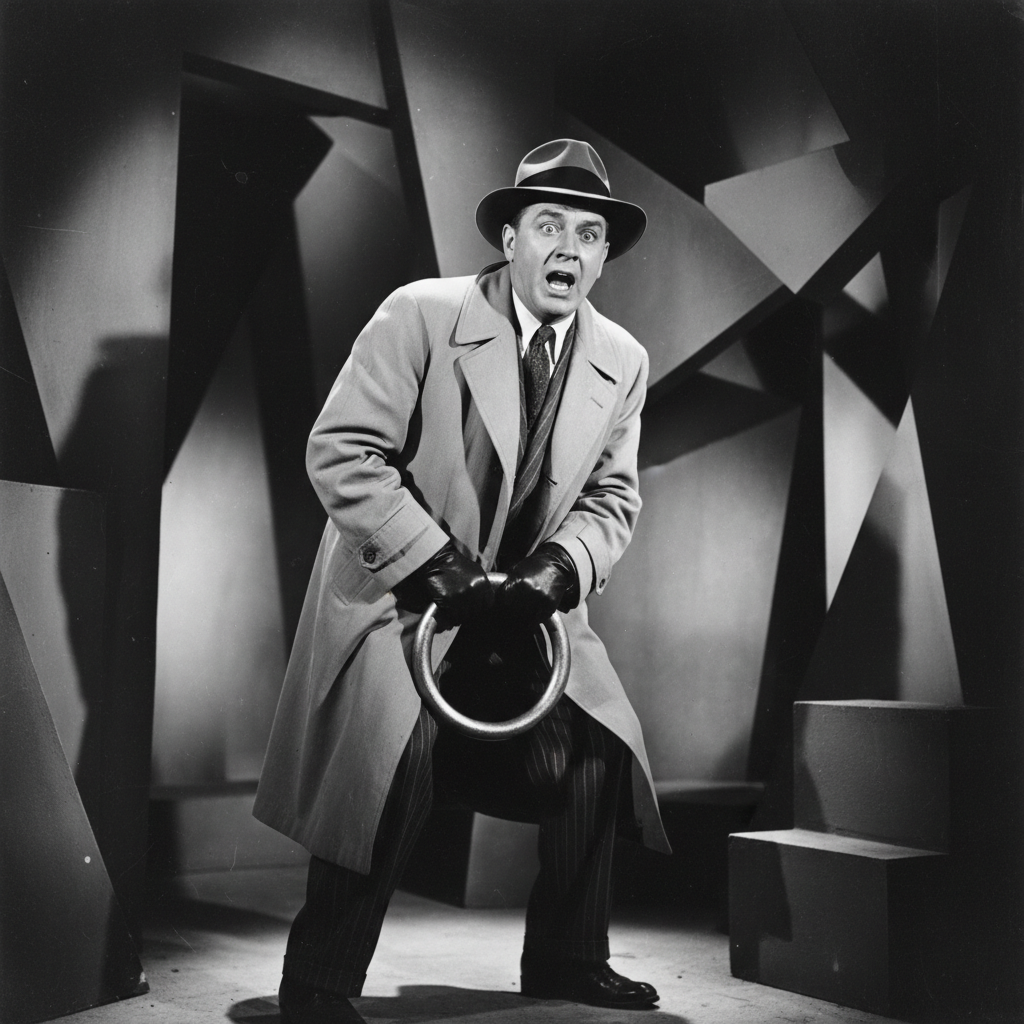
The art form reached its logical conclusion in 1935 with the Warner Bros. production of *Das Rheingold*, starring James Cagney as Alberich. For two and a half hours of stunning chiaroscuro lighting and expressionist sets, Cagney does nothing but sprint around a cardboard Nibelheim, clutching a stolen ring to his chest and shrieking, in perfect time with the orchestral score, “You dirty rat! You dirty, dirty rat!” The print is incomplete. The final reel, where he presumably gets his comeuppance, was reportedly used as kindling by a freezing projectionist in Duluth. A true loss. At least he saved the last frame: Cagney, mid-shriek, looking directly into the lens. A perfect scream, held in amber.