The Queen and the Unauthorised Fowl
The day a fifty-kopek pigeon nearly started World War Three in Her Majesty’s millinery.
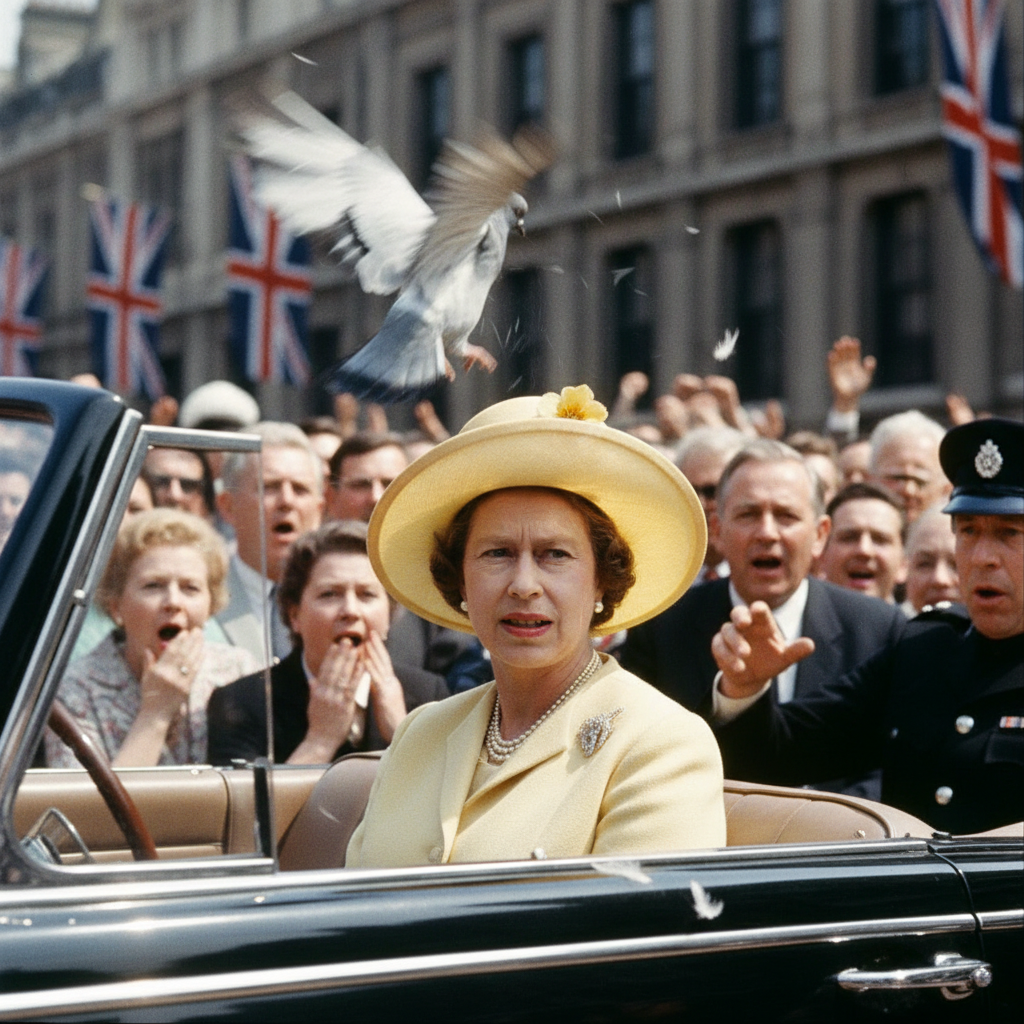

FILE REF: K-62/308-BIS. OPERATIONAL TITLE: “PADDINGTON BEAR”. A carrier pigeon, designated *Golub-4*, was tasked with a routine transfer of launch authenticators from the Soviet embassy on Kensington Palace Gardens to a GRU asset near the Admiralty. The package was a standard microdot concealed in a leg-band. The date was 27 October 1962. The bird, which cost the state fifty kopeks, had been trained on the route for six months. It had not been trained for an aerial assault by a territorial London crow, which it encountered over the Mall at 11:03 AM during the passage of the Queen’s procession to open Parliament.
The resulting trajectory correction saw *Golub-4* collide, at speed, with a hat belonging to Queen Elizabeth II. The hat, a Norman Hartnell creation in primrose yellow, reportedly absorbed most of the impact. The pigeon did not survive. The Queen, to her credit, was merely quoted as remarking, “Oh, bother.” What followed was a masterclass in panic, administered with British understatement. A royal footman, following protocol for “items unexpectedly landing on the monarch,” scooped up the deceased avian operative and the dislodged hat. The microdot, however, had detached from its leg-band and was now lodged in the hat’s silk lining, a tiny fleck of nitrocellulose indistinguishable from a stray piece of London grit.
MI5, arriving in a state of advanced organisational apoplexy, classified the incident as a possible assassination attempt by “anarchist elements using novel projectile systems.” The bird’s remains were sent to Porton Down for analysis, where its Soviet origin was confirmed by isotope analysis of its crop contents: high-grade Ukrainian sunflower seeds. The entire affair would have been filed under “ornithological curiosities” had a junior archivist at the Public Record Office not been tasked with cataloguing the Queen’s hats for the year. This man, a Mr. Pilkington with a hobbyist’s interest in microscopy, noticed the foreign object while logging the damage to the Hartnell piece. Believing it to be a new type of fabric mite, he placed it under a lens. Instead of legs, he saw page one of the authorisation codes for the R-12 MRBM arsenal.
The discovery triggered a diplomatic exchange of such furious politeness it threatened to melt the transatlantic cable. The British accused the Soviets of “unprecedented recklessness.” The Soviets, whose entire nuclear command structure had been compromised by a dead bird and a haberdashery mishap, accused the British of “avian piracy.” For forty-eight hours, nobody knew if the codes had been copied. Premier Khrushchev reportedly did not sleep, subsisting on a diet of black tea and rage, while my former colleagues in the First Chief Directorate planned a full-scale assault on a London hat shop. It was only when Her Majesty’s Private Secretary conveyed a message—“The Queen wishes it to be known that she considers the matter closed, and hopes the pigeon’s family have been informed”—that tensions eased. The fifty-kopek bird had cost Moscow approximately 200 million roubles in emergency code-regeneration and asset relocation.