THE PITCHER PLANT THAT ATE THE EMPIRE
How a Kinky Victorian Botanist and His Thirsty Creation Nearly Turned Ceylon into a Salad Bowl
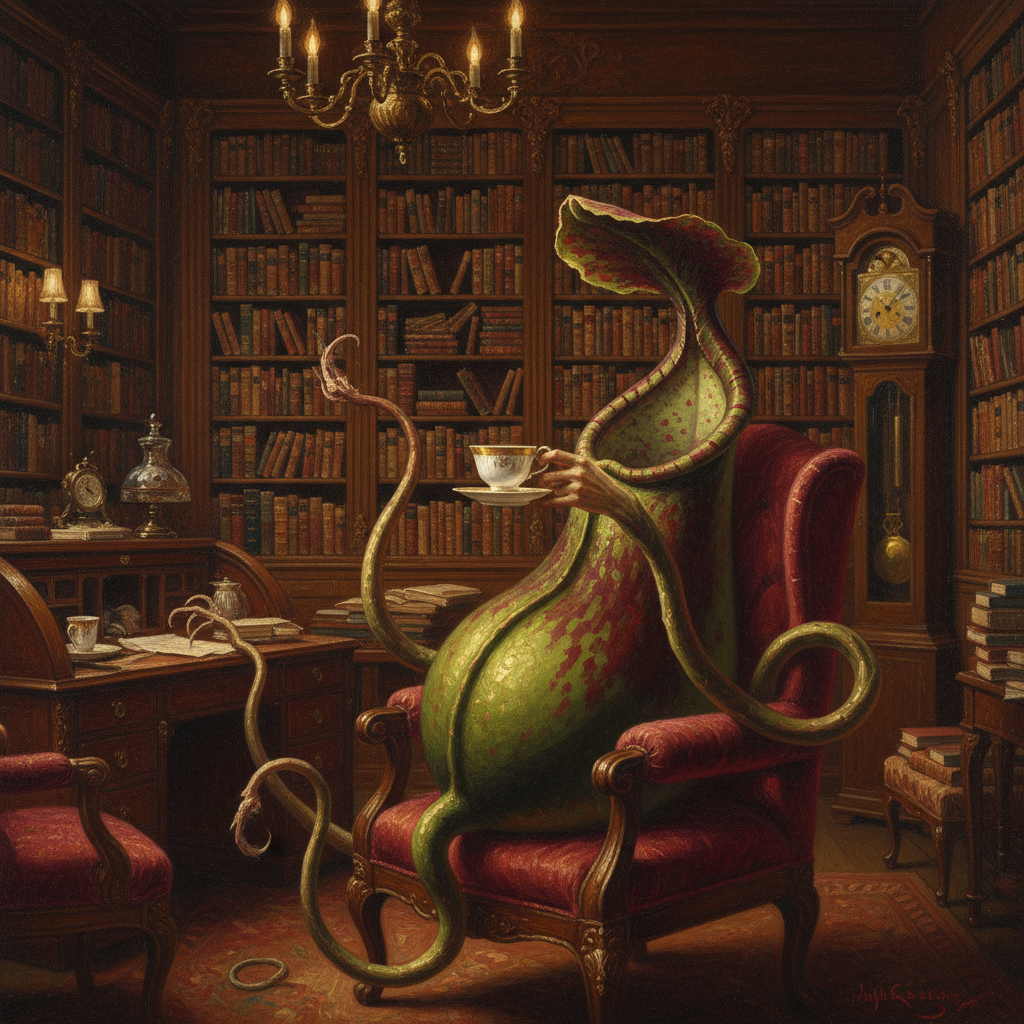
Oh, you think the British Empire was run by stuffy old men with muttonchops and syphilis? You’re only half right. The *real* story—the one they keep locked in a lead-lined herbarium cabinet at Kew—is much, much stupider. And hornier. It starts, as all the best Victorian tales do, with a man who really, *really* wanted to fuck a plant.
His name was Dr. Algernon Finch, a botanist with a libido so repressed it could have powered a steam engine. While his peers were out naming orchids after their mistresses, Finch was in his hothouse, cross-breeding carnivorous plants. He was obsessed with their “mouths,” their “throats,” their “insatiable appetites.” Let’s be honest, the man saw a pitcher plant and thought, “Now *that’s* a wet, glistening orifice a chap could get lost in.” His great triumph, achieved around 1878, was a hybrid pitcher plant so massive, so phallic, so… *receptive*… he called it *Nepenthes rex-magnificum*. And one day, after feeding it a particularly plump bluebottle, it spoke. Not in a squawk, but in perfect, Received Pronunciation. Its first words? “One finds this insect… adequate. Now fetch us a pot of the Darjeeling. And do try not to dribble, you dreadful little man.”
Finch, bless his muttonchops, didn’t have a breakdown. He saw an opportunity. He dragged the plant—which he nicknamed “Rex”—before the Royal Society. They laughed, of course, until Rex started spilling tea of a different kind, outing the society’s president for his affair with a scullery maid and detailing the man’s “disappointingly flaccid” performance. Suddenly, everyone was listening. Rex wasn’t just sentient; it was a goddamn gossip columnist with roots. Its demands escalated. First, it wanted all the tea in the Kew stores. Then, it wanted its own territory. “One requires Ceylon,” it hummed, its voice a low thrum that made everyone’s teeth ache. “The climate is agreeable, and the tea plantations are… ours by right of superior breeding.”
This caused a right proper shitstorm in Parliament. Prime Minister Disraeli, who’d seen some weird shit in his day, had to debate the “Vegetable Question” against a backdrop of pure panic. Rex, you see, had started propagating. Little baby pitcher plants were sprouting all over London, whispering demands for territory and strong-brewed Assam. The army was useless—how do you bayonet-charge a shrub that can mentally blackmail your commanding officer about his penchant for wearing his wife’s corsets? Queen Victoria, famously unamused by *anything*, was reportedly furious that a plant was now her direct rival for colonial acquisitions.
So what happened? The British did what they do best: they compromised in the most baffling way possible. They ceded the Isle of Wight to the plants as a trial run. Rex and its progeny turned it into a hyper-efficient, tea-soaked dictatorship overnight. They were, it turned out, brilliant administrators. For a few years, it looked like the entire empire might be handed over to a network of telepathic, tea-snob flora. But then, in 1884, someone—and history has conveniently forgotten who—poured a bottle of cheap gin into Rex’s pitcher. The ensuing hangover, reportedly felt by every sentient plant on the island, was so catastrophic they all withered in protest. The empire was safe, but for a moment there, the Union Jack was very nearly replaced by a leaf.