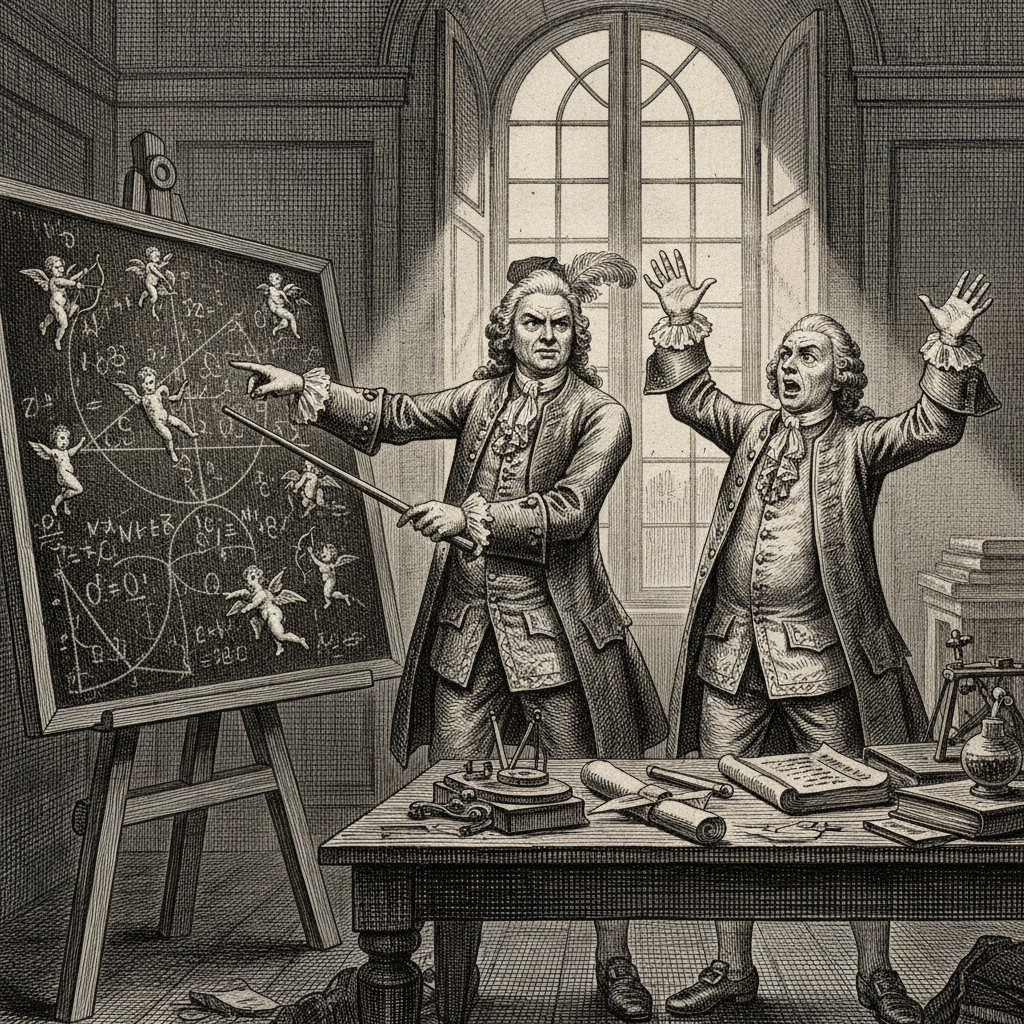
The Parallelogram of Love
How a misdirected sonnet almost proved love non-Euclidean.
History is just a list of things that screwed-up people did for screwed-up reasons. And sometimes, just sometimes, the reason is the French postal service.
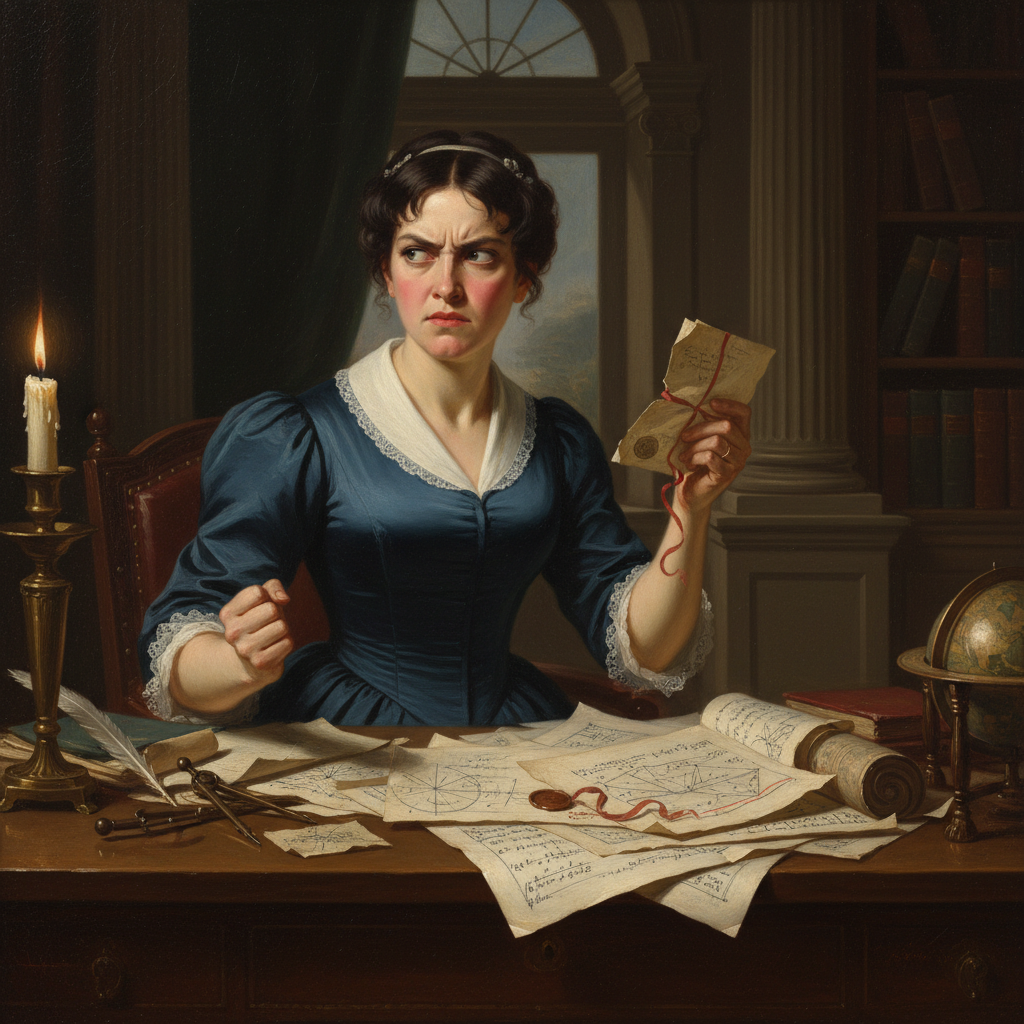
Behold Sophie Germain. It’s the turn of the 19th century, and she’s got a brain that could curdle milk with its intensity, but she’s also got a distinct lack of a dick, which in Napoleonic France was a real career-limiter for a mathematician. So, to get her ideas taken seriously by the bigwigs, she writes under a man’s name: Monsieur Antoine-Auguste LeBlanc. She’s so fucking good at it that she’s got the Prince of Mathematicians himself, Carl Friedrich Gauss, writing her gushy fan mail about her number theory proofs. He thinks he’s writing to a dude, a peer. She knows she’s smarter than all of them. It’s a whole thing.
Here’s our divergence point: a simple, magnificent fuck-up. A snot-nosed student at the École Polytechnique, let’s call him Gaspard, fancies himself a poet. He’s desperately in love with a Cécile LeBlanc and decides to win her over by writing a sonnet. Because he’s *that* guy, he crams it full of agonizingly bad mathematical metaphors—”My love, our hearts are congruent triangles,” “Your beauty is an axiom, self-evident and true,” — just a whole ream of weapons-grade cringe. He pops it in the mail, addressed to “Mademoiselle C. LeBlanc, Paris.” The mailman, a man of profound apathy and a hangover, sees “LeBlanc” and “Paris” and shoves it in the postbox for the only LeBlanc he gives a damn about: Gauss’s mysterious, brilliant pen pal.
Now, put yourself in Sophie’s shoes. You’re a secret genius, surrounded by strutting peacocks who think geometry is a bloodsport. A letter arrives. It’s not from Gauss, but it’s from Paris. You open it and find… this. This doggerel. This axiomatic travesty. You don’t see a love poem. You’re Sophie fucking Germain. You see a coded insult. A passive-aggressive mathematical challenge from your Parisian rivals—Lagrange, Legendre, one of those bastards—mocking you. What the hell is “congruent triangles”? Is he questioning Euclid’s First Postulate? And “self-evident axiom”? Is this prick implying your work isn’t rigorous? She assumes the title, “An Ode to C.L.” stands for “An Ode to Corollary L.” It is a declaration of war.
She does not write back to clarify. She writes back to *annihilate*. Over the next three days, fueled by rage and coffee, she produces a twelve-page refutation titled “On the Logical Inconsistencies of a Supposed Axiomatic Affection.” She methodically, brutally, demolishes the poem’s every premise. She proves, with diagrams, that if C.L.’s beauty is an axiom, it creates a paradox in non-Euclidean space. She demonstrates that his “congruent heart-triangles” are, in fact, scalene and wildly unequal. Her conclusion, in essence, is that the author’s love is not only logically fallacious but represents a fundamental threat to the entire edifice of rational geometry. She signs it “A. A. LeBlanc” and mails the goddamn thing. The original student, Gaspard, received this mathematical atom bomb, showed it to his professor, and kicked off a three-month academic feud between Paris and Brunswick over the “LeBlanc Postulates of Affectional Geometry.” Gauss was baffled but, a petty man himself, deeply admired the sheer spite of his correspondent’s work. He just thought his friend had gone gloriously, beautifully insane.