The Ninety-Five Smudges
Martin Luther’s list of grievances against the Church becomes an infamous, if unintentional, work of abstract art.
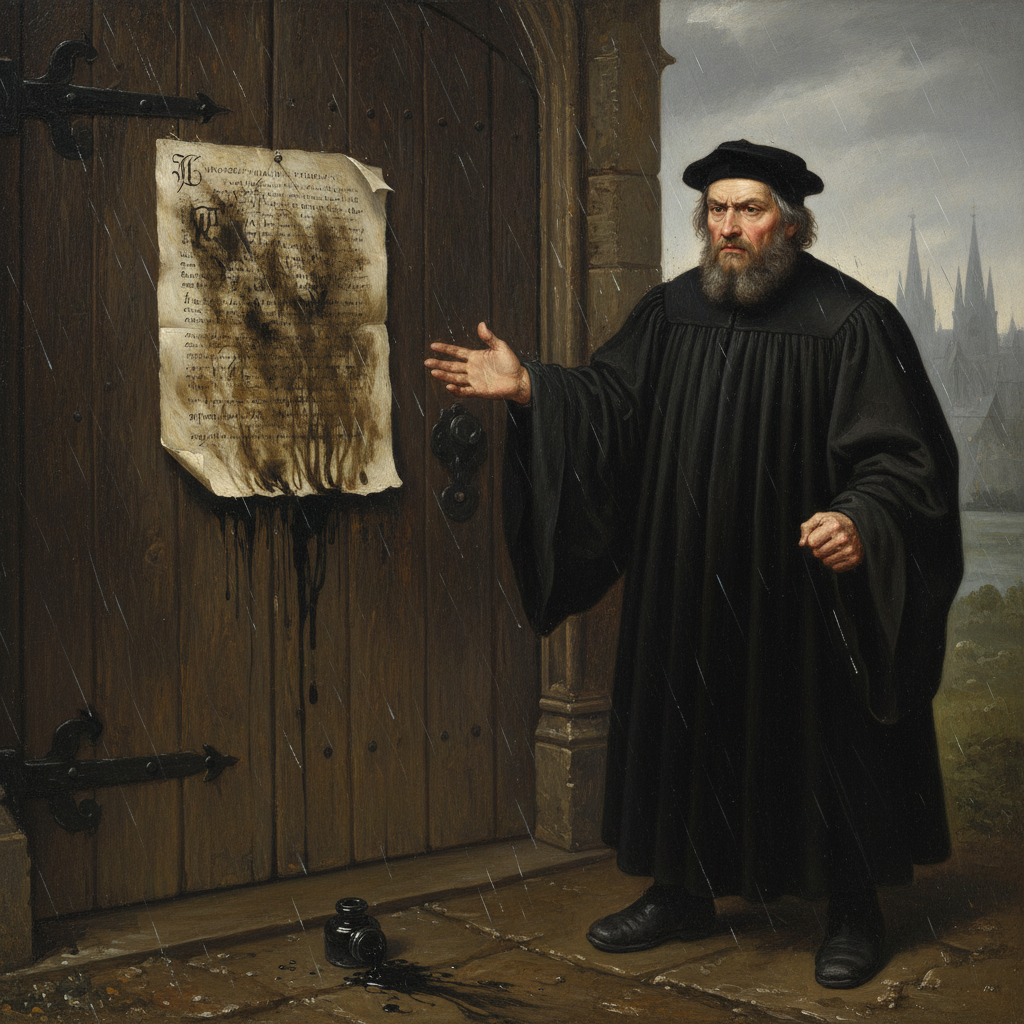
Humble reader, let us consider the virtues of a dry door. For want of one, a soul was lost, and not in the usual way. In the year of our Lord 1517, the Augustinian friar Martin Luther, a man whose spiritual agonies were matched only by his spectacular constipation, strode to the door of the Castle Church in Wittenberg. He carried in his hand ninety-five arguments against the sale of indulgences, a work of profound theological gravity intended to spark sober academic debate. He also carried a hammer and some very small nails. What he did not carry, alas, was a contingency plan for the Saxon damp, which clings to stone and spirit alike. That door, you see, was weeping. Not with holy tears, mind you, but with the mundane misery of perpetual condensation. God may be in the details, but the Devil, that old sophist, is in the moisture.
The ink, freshly applied, began to run before the first student had even passed by on his way to breakfast. What began as a crisp indictment of papal avarice—“Cur papa, cuius opes hodie sunt opulentissimis Crassis crassiores, non de suis pecuniis…”—bled into a formless, menacing stain. The sharp edges of Latin fury softened into a Rorschach blot of heresy. By midday, Thesis 27 (“They preach only human doctrines who say that as soon as the money clinks into the money chest, the soul flies out of purgatory”) had merged with Thesis 28 in a most unholy union, suggesting not that the soul flies out, but that the money chest itself develops wings and seeks a warmer climate for the winter. It was theological chaos. It was also, to the few who saw it, deeply unsettling.
[Scribbled in margin: *A most unedifying spectacle. One shudders to think what became of Thesis 86.*] Instead of a revolution in faith, Luther sparked a brief and deeply confusing debate on abstract art. The Archbishop of Mainz, Albrecht von Brandenburg, who had paid a spectacular sum for his multiple bishoprics and was counting on indulgence sales to pay off his loan to the Fugger banking family, received a frantic report not of heresy, but of vandalism. His agent in Wittenberg described the document not as a set of propositions, but as “a brown and swirling chaos, like a monk’s bowels after a bad eel.” Albrecht, a man of taste if not of scruples, demanded the original be sent to him. He had it framed. For the next decade, a document that should have shattered Christendom hung in his private gallery, where it was praised by visiting dignitaries as “a bold, if muddy, statement on the human condition.”
Luther, meanwhile, was baffled by the silence. Expecting a furious papal bull, he received only a polite inquiry from a Florentine art dealer. He tried again, of course, re-issuing his theses on drier paper, but the moment had passed. The first attempt had been an act of God’s thunder; the second felt like a man complaining about a bill. He was known not as a great reformer, but as that fellow from Wittenberg with the interesting ideas about ink washes. He died in 1546, a frustrated theology professor, his name a minor footnote in the history of German art. The great schism never came. Instead, the Vatican, having narrowly avoided bankruptcy, bought the “Wittenberg Smudge” from Albrecht’s heirs for an undisclosed sum and quietly filed it away in the archives, under ‘M’ for ‘Miscellaneous Stains, Ineffable’. A lesson for us all, my child: without a sound foundation, even the most righteous anger dissolves into muck. And the door is always damp.