THE MAN WHO KILLED NOTHING
How a 7th-Century Mathematical Beef Stalled Progress for a Millennium by Trying to Disprove the Number Zero.
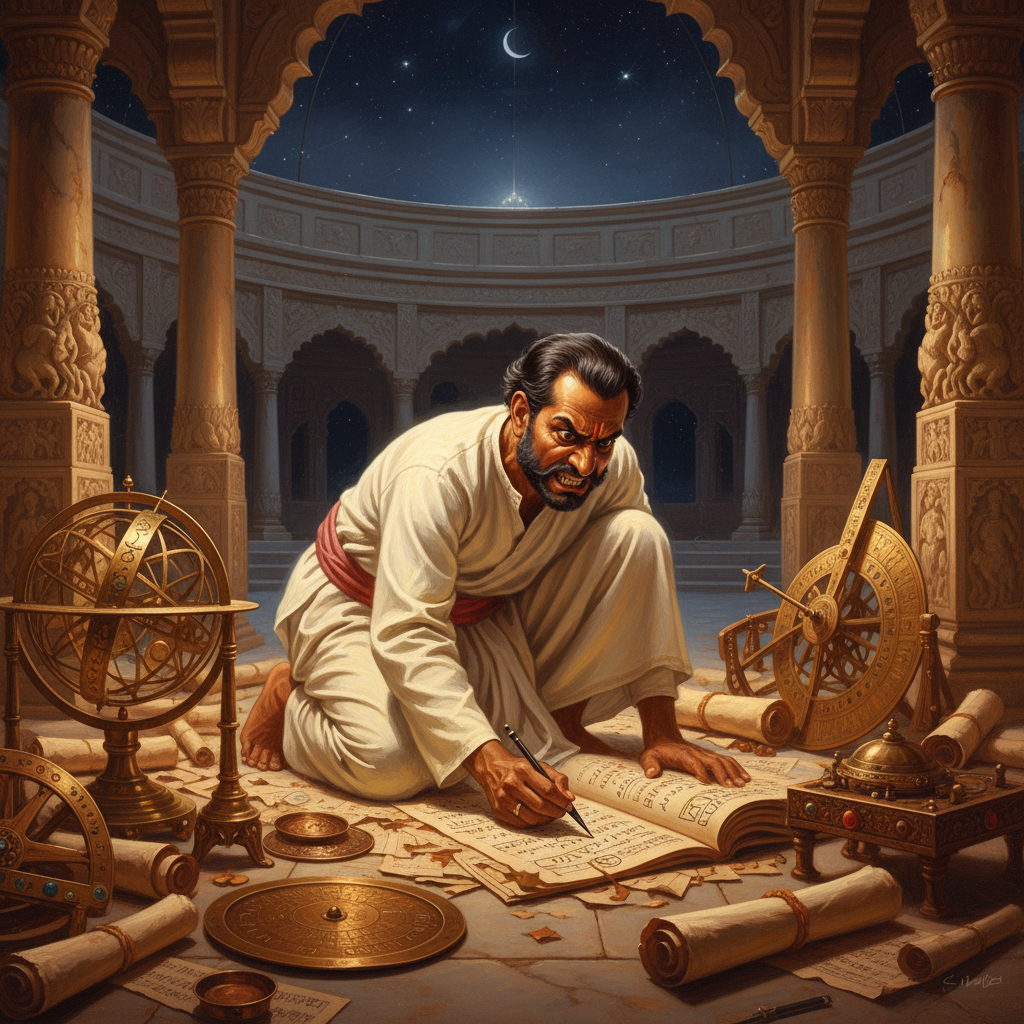
Brahmagupta was a genius. Let’s get that out of the way. His book, the *Brāhmasphuṭasiddhānta*, was a landmark text, the kind of thing that establishes the correct opening of the universe. It also, in our timeline, gave us the first proper rules for dealing with the number zero. But Brahmagupta was also a petty, petty bastard—the kind of guy who’d burn down your house if you corrected his grammar. And in this sorry, screwed-up timeline, that’s exactly what happened, mathematically speaking.
The culprit was a rival astronomer, some twerp from Ujjain named Devakara—a man whose chief contribution to science was being spectacularly wrong about a lunar eclipse but *annoyingly* right about a tiny rounding error in Brahmagupta’s work. In a public debate, in front of everyone who mattered, Devakara pointed out the great man’s boo-boo. The error, of course, hinged on a calculation involving *shunya*. Zero. The void. Nothingness. Brahmagupta, filled with a righteous fury that could power a small star, went home not to correct his error, but to destroy the very concept that revealed it.
He scribbled a furious, secret addendum to his masterpiece: Chapter 25, the *Shunya-Vainashika* (“The Annihilation of Emptiness”). It was 40 verses of pure, uncut mathematical spite. “To divide a number by nothing is an absurdity on its face,” he fumed, probably paraphrasing himself. “If you have one loaf of bread, you cannot share it with zero people. To even attempt it is not a problem of division, but a problem of loneliness, and I am a mathematician, not your therapist.” He declared that zero was a philosophical Trojan horse, a “figment for priests and poets,” and that any quantity, upon reaching nullity, simply ceased to be a mathematical object. It became, in his glorious phrasing, “a ghost in the abacus.”
Because it was attached to the rest of his brilliant work, this crank chapter was taken seriously. For centuries, mathematicians who should have been inventing calculus were instead tiptoeing around a numerical black hole. Arab scholars, translating the text, inherited this zero-phobia. Al-Khwarizmi’s revolutionary algebra became a clunky mess of “restoration” and “balancing” that treated the absence of a number like it was a poltergeist. Instead of `x - 5 = 0`, equations were written as `x = the value that restores the fiveness`. It was an accounting nightmare. Europe, in turn, got this neutered system. You can’t build a modern world on that. You can’t calculate orbital mechanics, or engineer a proper steam engine, or even run a functioning bank when your entire numbering system is terrified of acknowledging that an account can be empty.
Progress didn’t just stall; it tripped over its own feet and fell down a flight of stairs. The Industrial Revolution was delayed by at least 200 years, all because one man couldn’t handle being told he’d misplaced a decimal. It wasn’t until some poor, overworked bastard in the 1820s, a Florentine accountant named—I shit you not—Guido Problematisco, finally threw up his hands and said, “Fine, what if we just pretend the ghost is real, give it a name, and see if the numbers add up?” And so, a millennium behind schedule, zero was dragged kicking and screaming back into reality. All because Brahmagupta couldn’t take a fucking note.