The Letter That Broke the Library of Alexandria
One misfiled travelogue, thirty-seven thousand pissed-off students, and the camel that ate the original manuscript.
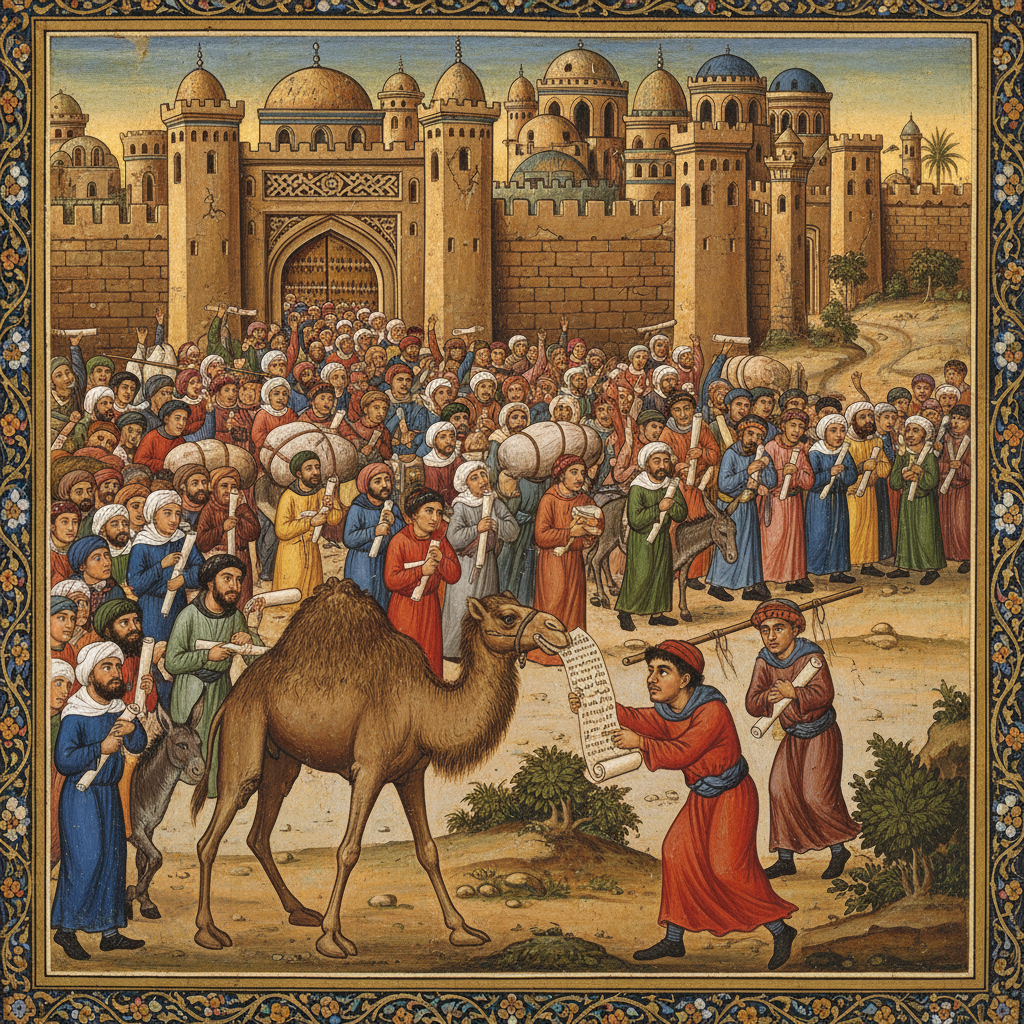
Abu Abdullah Muhammad ibn Battuta, a man who had seen nearly everything, was carrying a bag of Tunisian almonds and a letter for the head librarian of Alexandria. The letter, a dense and frankly boastful account of his recent detour to the learning centres of Cairo, was intended as a friendly hello. It never arrived. Instead, it was misfiled by a well-meaning but illiterate postal clerk named Farid al-Asmar, who, seeing the elegant Maghrebi script, assumed it was a notice for the student dormitories. It was posted on the main board of Alexandria’s famed university, next to a flyer advertising cheap falafel and a complaint about the quality of the papyrus. The students of the 14th century, it turns out, were just as susceptible to FOMO as their modern counterparts. Ibn Battuta’s descriptions of Cairo’s Al-Azhar, with its generous stipends, livelier debates, and apparently superior figs, read like a brochure for a better life. Thirty-seven thousand of them decided to chase it.
The exodus began not with a bang, but with a bill. The Bursar of Alexandria, a man named Diogenes the Younger-and-Stressed, first noticed the discrepancy in the quarterly accounting for student fees, officially titled the *Register of Scholastic Ingress and Cairene Defection, 1349*. Where there should have been the pleasant heft of silver dirhams, there was only a growing pile of IOUs and a single, tragic note from a departing scholar that read simply, “Gone to Egypt.” The mass migration of tens of thousands of young men and a handful of truly determined young women clogged the coastal road for weeks. It was a river of unwashed robes, dubious theology, and badly packed luggage. One witness, a spice merchant named Fatima al-Jamil, reported seeing a student attempting to transport his entire collection of Aristotle by strapping it to a very uncooperative camel. The camel, she noted, eventually ate the Politics and looked distinctly unimpressed.
The head librarian, a man whose name is recorded only as Master Theophilus, was a scholar of the old school who believed that knowledge was a fortress to be defended, not a market to be visited. When he learned that the intellectual heart of his city had decamped for a rival, he did not rage. He did not weep. He took a route both more bureaucratic and infinitely more catastrophic. Citing Section 4, Sub-clause B of the *Alexandrian Municipal Code for the Prevention of Unauthorised Scholarship*, he declared the absent students to be in a state of “intellectual truancy.” The penalty was the immediate and permanent confiscation of all personal effects left within the library grounds. This included, he argued, any knowledge they had acquired there. To enforce this, he ordered the library’s contents—scrolls, codices, maps, and centuries of accumulated wisdom—to be sealed in the city’s grain silos, to be held “in escrow” until the students’ return and apology.
The students, of course, never returned. They were having a wonderful time in Cairo. The silos, meant for storing wheat, were damp. The papyrus, famously, was not. Within a generation, the entirety of Alexandria’s accumulated knowledge had been reduced to a pulpy, unreadable mulch, a tragedy of civic pedantry that dwarfed the fire of antiquity. The great library wasn’t burned; it was filed away. Master Theophilus, it is said, spent his final years meticulously cataloguing the resulting compost. Farid al-Asmar, the clerk who started it all, lived to a ripe old age, beloved by his neighbours for his cheerful incompetence, and never learned to read a single word. His greatest contribution to history remained, forever, a mystery to him.