The Ledger That Launched a Thousand War-Elephants
That time a rounding error in Amsterdam financed an emperor’s shopping spree.
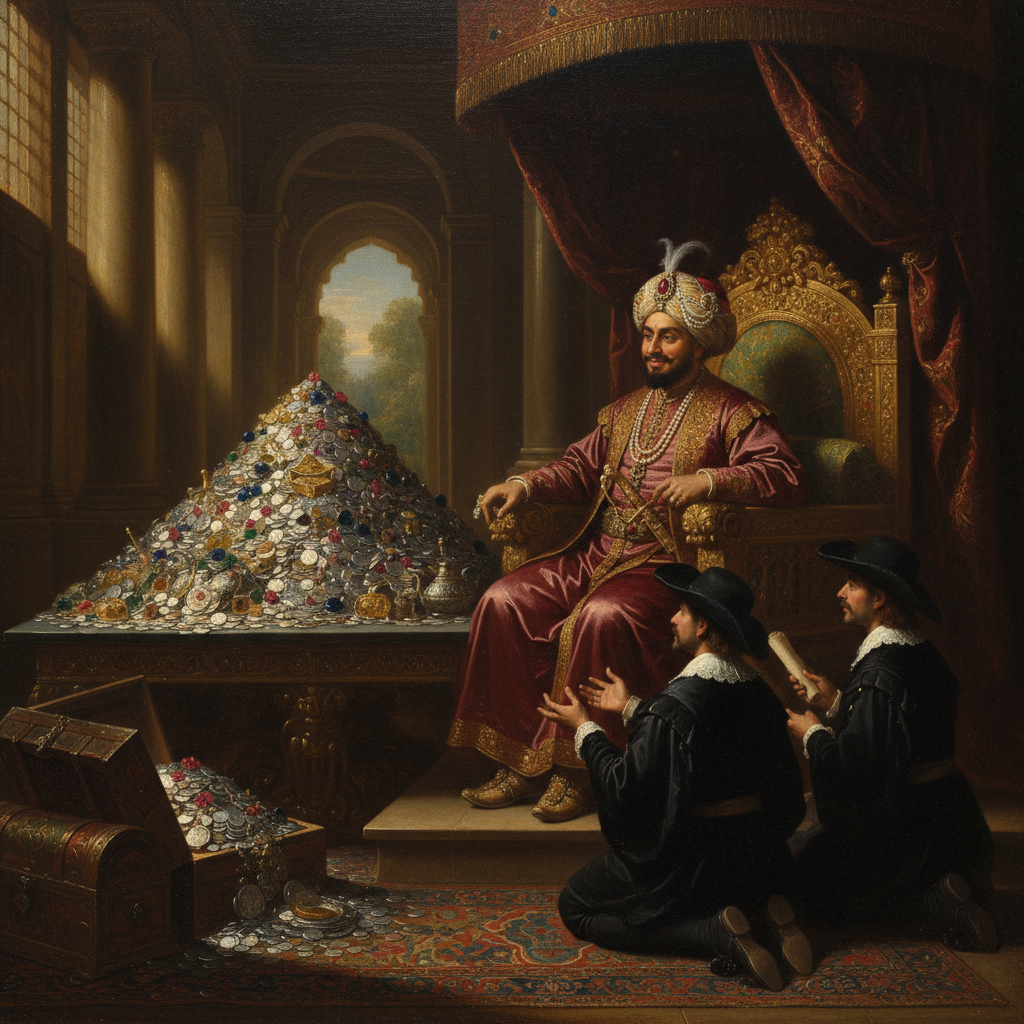
An invoice dated 16 April 1662 records a shipment of 30,000 guilders’ worth of textiles and spices to the Mughal court. A respectable sum. The problem is the corresponding disbursement voucher from the Dutch East India Company (VOC) head office, which authorized payment for 3,000,000 guilders. The clerk responsible, one Willem van der Bilt, had a documented tremor and a misplaced decimal. A rounding error, then, of two orders of magnitude.
This windfall arrived in Emperor Aurangzeb’s treasury just as his consolidated accounts showed a significant shortfall for a planned southern expansion. The campaign was projected to cost 2.5 million guilders; Aurangzeb had budgeted one million. The sudden, inexplicable surplus of VOC silver was taken, as one court chronicler noted, as “a sign from God that our ambitions were too modest.” The initial campaign plan was not merely funded; it was supercharged. Instead of a cautious push into the Deccan, the Emperor greenlit a full-scale invasion, complete with a new corps of Persian heavy cavalry and a truly ludicrous number of imported European cannons. Audit note: hiring mercenaries with money you didn’t earn is rarely a sustainable growth strategy.
The VOC, meanwhile, was hemorrhaging cash. Their accountants in Batavia and Amsterdam spent months reconciling the books, assuming piracy or a very creative local governor. By the time they traced the discrepancy back to van der Bilt’s shaky handwriting, Aurangzeb’s armies were already past the Godavari River. The VOC sent a sternly worded letter demanding repayment. The Emperor, busy besieging Golconda with a comically oversized army, allegedly used the parchment as a wrapper for a celebratory mango. He replied with a counter-offer: the VOC could become the exclusive, tax-exempt auditors for the newly conquered territories. He called it the “Deccan Dividend.”
The Company, facing a catastrophic loss and shareholder revolt, had little choice but to accept. Their accountants, famed for their meticulousness, were now tasked with optimizing the tribute-collection systems of the Deccan sultanates. VOC clerks, armed with abacuses and double-entry ledgers, became the most feared figures in southern India. They streamlined revenue extraction with ruthless efficiency, ensuring the Mughal war machine remained solvent. The expansion, which should have bankrupted the empire, instead generated a 15% year-on-year return for two decades. Van der Bilt, back in Amsterdam, was quietly pensioned off to a tulip farm, his name a byword in accounting circles for a particular kind of catastrophic success. He never understood why his ledgers balanced, but he was reportedly very pleased with the new strain of tulip named ‘The Emperor’s Rupee’.