The Knights Templar End in an Unholy Wash
One disastrous laundry day, 1,200 shrunken woollen habits, and a papal bull issued in a fit of pique.
Dominus illuminatio mea, et salus mea, quem timebo? The Lord is my light and my salvation; whom shall I fear? I shall tell you, brothers. Fear the man with the laundry concession at the Lateran Palace. Fear his works, and fear his soap, which smells of lye and despair and is, I suspect, mostly goat urine.
It was the Year of Our Lord 1278, and the Knights Templar, that holy order of warrior-monks, were at the peak of their earthly power. They had castles, they had fleets, they had 9,000 manors and the ear of every prince in Christendom. What they did not have, alas, was a reliable dry-cleaner. Ahead of a grand procession to celebrate the translation of some saintly tibia or other, Grand Master Guillaume de Beaujeu dispatched the order’s entire supply of ceremonial white mantles—1,200 of them, each heavy with the red cross of martyrdom—to the papal laundries for a good freshening. This, we may agree, was a mistake born of pride. For the papal laundries were, are, and ever shall be, a place of profound and abiding moisture. Not for nothing is the sub-basement of the Lateran known as the Grotto of Perpetual Mildew.
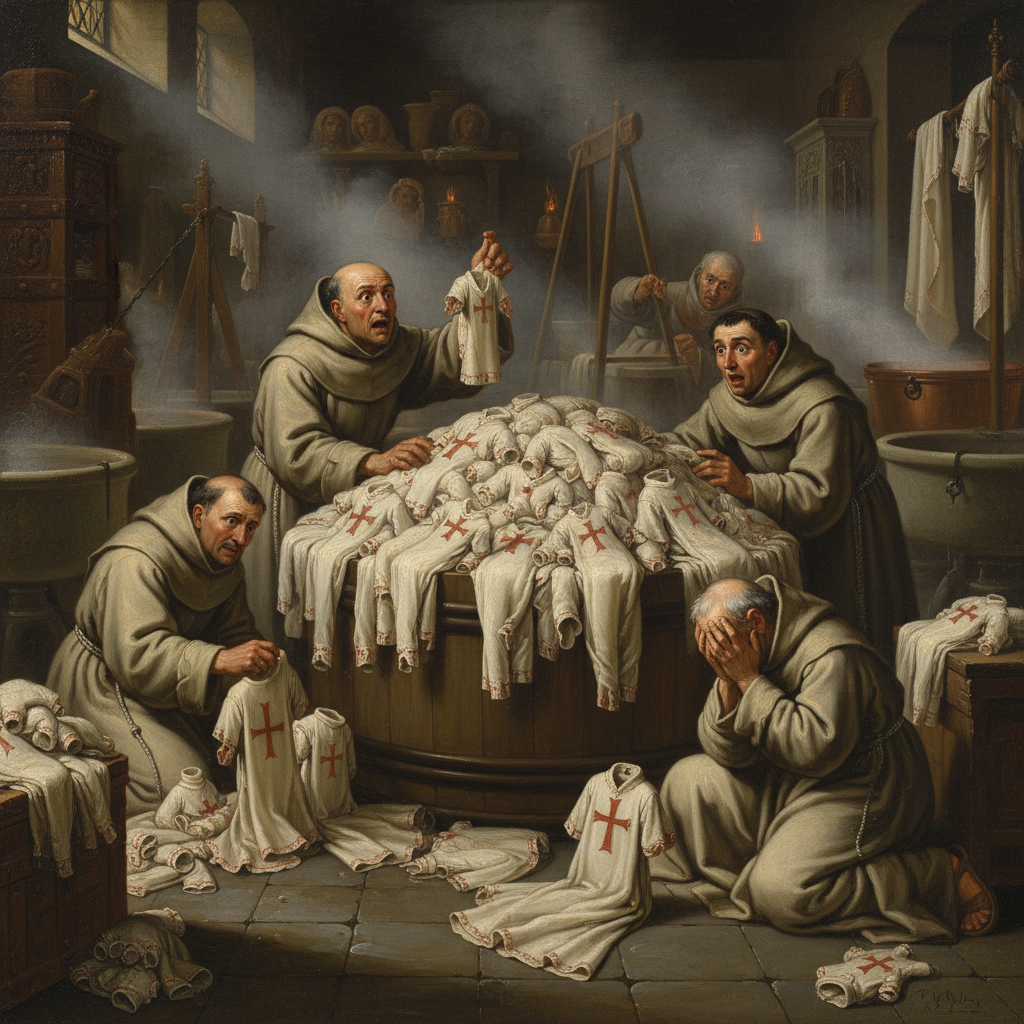
Brother Agostino, the sub-deacon in charge of bleaching, received the Templar habits with a heavy heart and 400 barrels of what he assured everyone was a new, miraculously effective soap from Genoa. It was not. After three days of soaking in lukewarm, suspiciously grey water, followed by a vigorous flagellation with birch rods to ‘beat the sin out,’ the habits were laid out to dry in a courtyard that had not seen direct sunlight since the reign of Pope Honorius III. The result was a catastrophe of shrinkage. One thousand, two hundred woollen mantles, each now barely large enough to clothe a cathedral gargoyle. They were doll-sized. They were, to be precise, entirely unwearable by men whose primary job involved cleaving Saracens in twain while hauling around 80 pounds of mail.
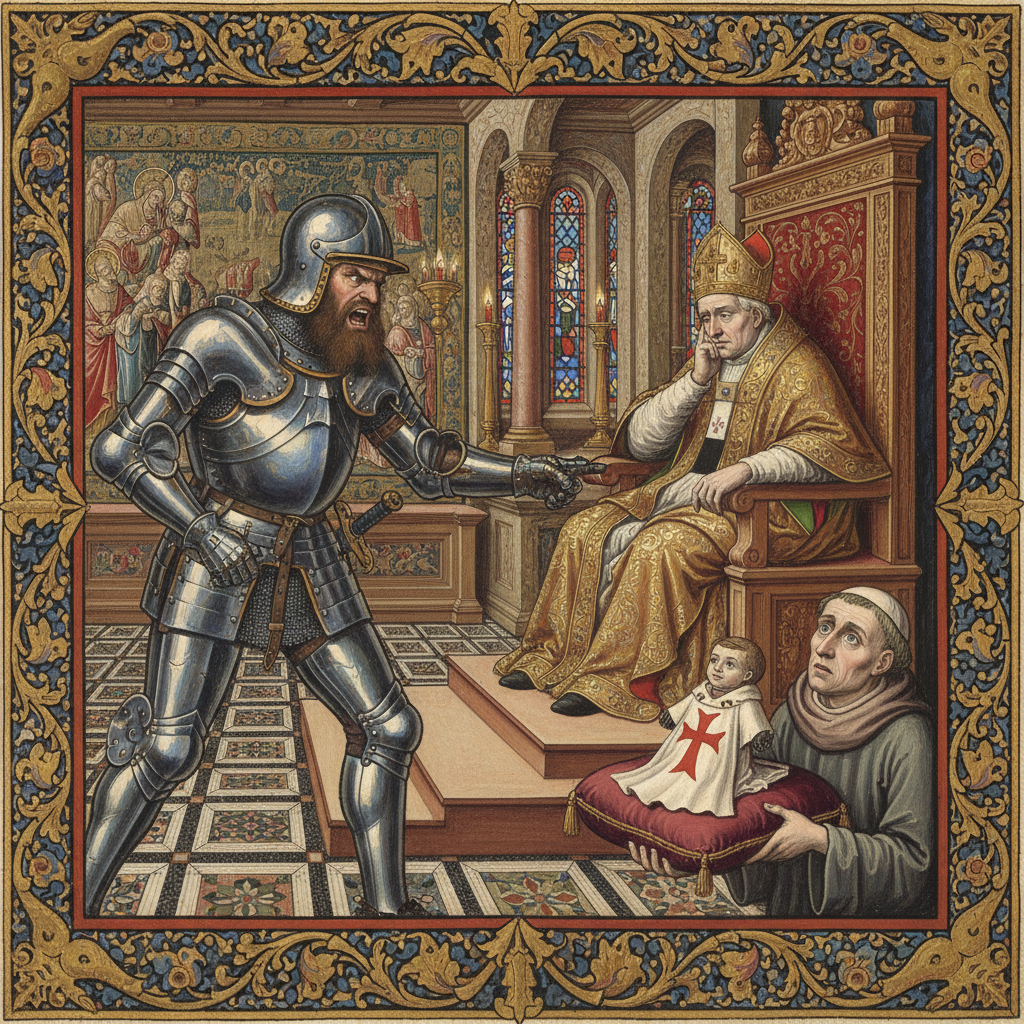
Grand Master de Beaujeu, upon being presented with a single, offensively tiny mantle on a silver platter, did not take it in a spirit of Christian forbearance. His recorded reply, according to a terrified notary, was to accuse Pope Nicholas III of orchestrating “a deliberate and humiliating act of sartorial warfare.” Nicholas, a man not known for his sense of humour or his love of being yelled at by men with swords, responded with impressive speed. He issued the papal bull *Vestimenta Inaniter*, the “Bull of Pointless Garments,” which excommunicated the entire Templar order on the grounds of “liturgical shrinkage,” “insolent tailoring,” and “failing to render unto God a man-sized habit.” The bull, drafted in a single afternoon by a team of canon lawyers fuelled by rage and cheap wine, stripped the order of all its properties, which were conveniently handed over to the Papacy for ‘safekeeping.’
And so the mighty Knights Templar fell, not to the sword of the infidel or the envy of a king, but to a laundry bill. De Beaujeu, refusing to the last to don a shrunken mantle, attempted to lead a protest march on the Vatican wearing only his chainmail coif and a profound sense of grievance. He was arrested for public indecency near the Ponte Sant’Angelo. The last a bewildered world saw of the Poor Fellow-Soldiers of Christ was their Grand Master, shouting muffled curses through his mail, being hauled away by the city watch for offending the public eye. Sic transit gloria mundi. And also the laundry.