THE JESUIT WHO MADE HEAVEN TOO SMALL
A cautionary tale of bad maths, worse limoncello, and a universe that failed to meet specifications.
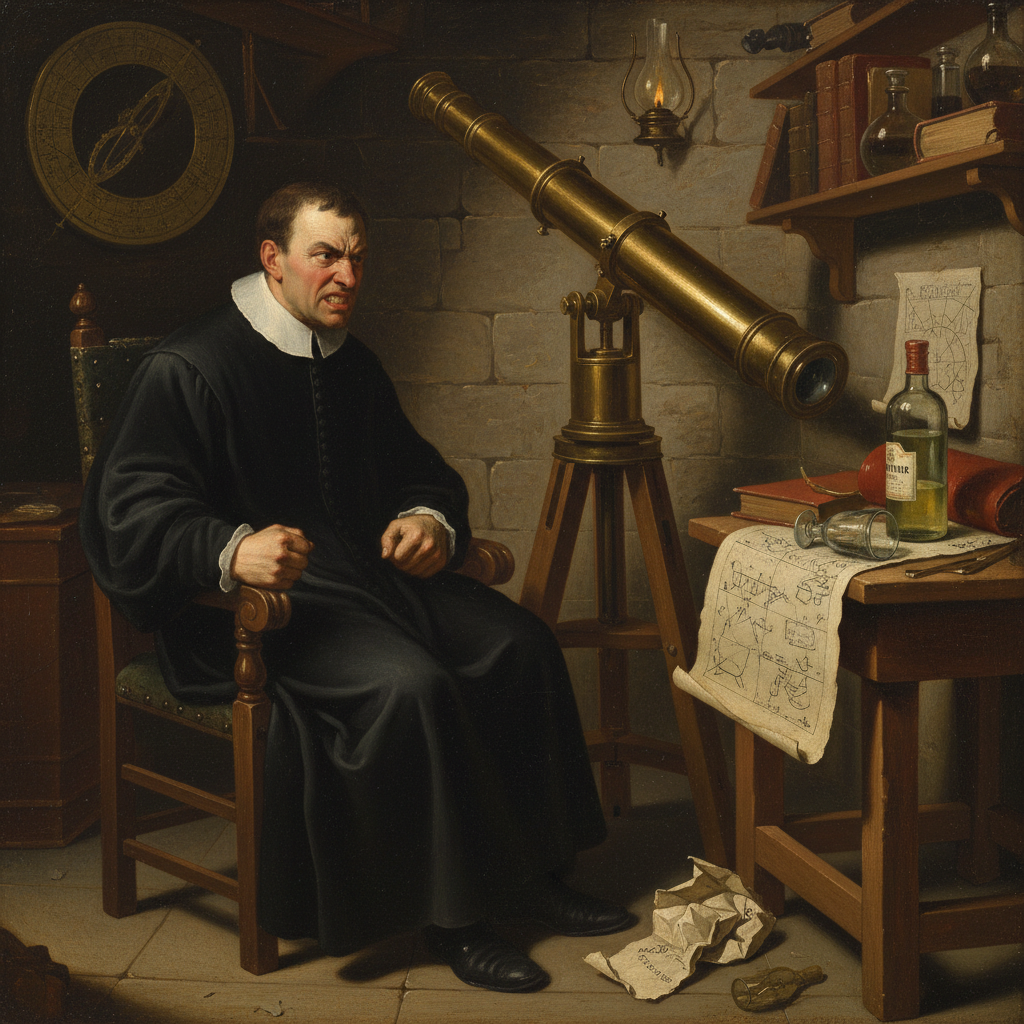
The night of 8 September 1635, Mars burned at magnitude -2.6, a fat, furious ruby low in the eastern sky over Rome, practically screaming to have its parallax measured. Any astronomer worthy of the name should have been at their telescope, tracking its opposition against the fixed stars to triangulate the architecture of God’s own cosmos. Instead, Father Giulio Mancini, S.J., of the Collegio Romano—a man whose ego was a gravity well all its own—was under lock and key, stewing in a silence broken only by the faint sounds of the city’s drunks finding their way home. He was not contemplating the majestic clockwork of the spheres; he was contemplating the best way to strangle a Dominican with his own rosary.
The divergence, as is so often the case, was less about celestial mechanics and more about terrestrial pettiness. Mancini had spent the previous evening in a screaming match with Fra Domenico of the Santa Sabina convent, ostensibly about the true nature of comets, but really about whose monastic order produced a more divinely-inspired lemon liqueur. Voices were raised, sacred vows concerning charity were creatively reinterpreted, and a small but historically significant quantity of Mancini’s supposedly superior limoncello was thrown at a fresco. A formal complaint from the Dominicans later, Mancini was confined to his rooms for two days of prayer and reflection on the sin of pride, precisely coinciding with Mars’s closest approach to Earth.
He emerged not humbled, but panicked. His superiors in the Jesuit order expected a definitive calculation of the solar system’s dimensions, a triumph to wave in the faces of those dour Protestants and their boy Kepler. Missing the Martian opposition was not an acceptable excuse. So, Mancini did what any cornered academic with a reputation to uphold would do: he fudged the data. Working backwards from some older, less reliable observations by a colleague in Bologna, he invented a parallax angle for Mars. An angle that was, to put it mildly, optimistic. In his haste, he overestimated it by nearly a full order of magnitude, which had the catastrophic effect of shrinking the heavens like a woollen cassock in a hot wash. His magnum opus, *De Distantiis Caelestibus Novis*, was published six months later, proudly announcing the distance from the Earth to the Sun to be a shockingly cozy nine million kilometres.
For a few weeks, Mancini was the toast of Catholic intellectual Europe. Then Fra Domenico, who had neither forgotten nor forgiven the limoncello incident, published a review. It wasn’t a scientific critique; it was a theological drive-by shooting. This cramped, paltry, thimble-sized cosmos Mancini had described, he argued, was a grave insult to the majesty of the Creator. It was a celestial dollhouse, a bauble more suited to a princeling’s cabinet of curiosities than the infinite stage for salvation. Did God, he thundered in print, work on such a pitifully small canvas? The argument was perfectly pitched to an institution that had just about had its fill of astronomers and their upsettingly large numbers. The Holy Office of the Inquisition, ever eager for new material, opened a file.
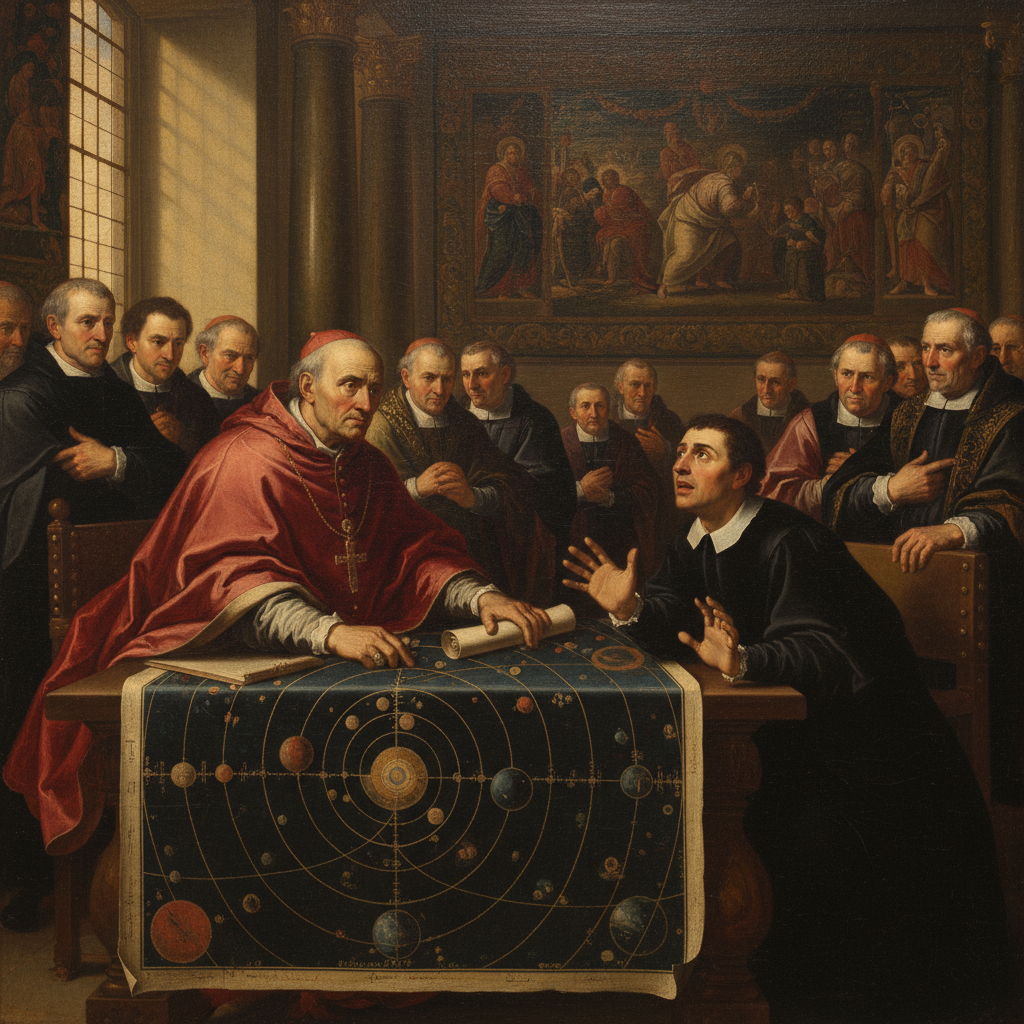
The trial was a masterclass in talking past each other. Mancini, sweating in his woollens, tried to explain the principles of diurnal parallax to Cardinal Francesco Barberini, who seemed to believe it was a new type of architectural flaw. The prosecution’s case rested not on observational evidence, but on the simple charge of “cosmic belittlement.” God’s glory was infinite, and any number that suggested otherwise was, if not technically heresy, then at least in extremely poor taste. Defeated, Mancini could only glare at Fra Domenico, sitting smugly in the observer’s gallery, and mutter to his exasperated canon lawyer, “And his limoncello is still shit.”