The Heresy of the Holy Dampness
How a Thirsty Mystic and a Badly-Translated Quran Accidentally Invented Quantum Theology
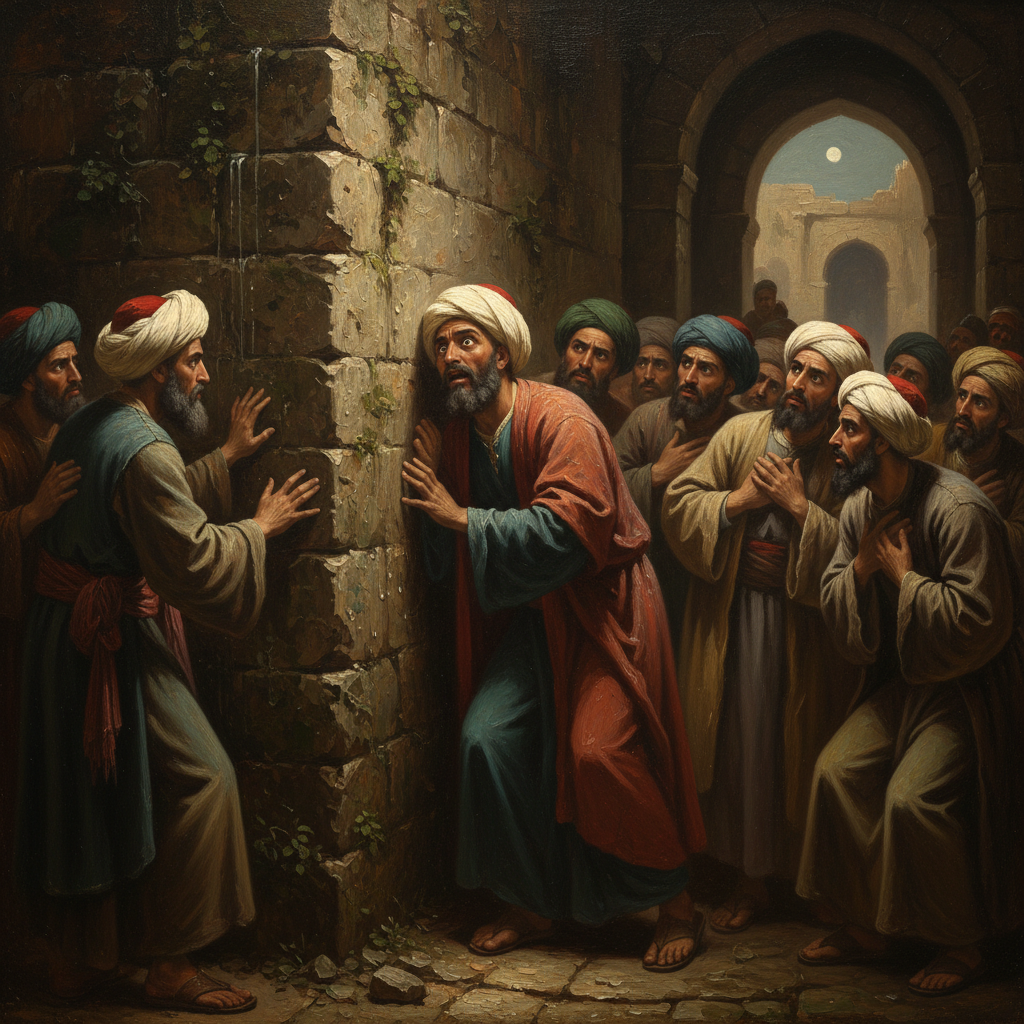
Right, gather ‘round, you damp-eared novices, and pour me another cup of whatever Abbot Phillip is watering down this week. Stop your whinging about the chill in the chapel—you think *this* is damp? Let old Brother Gerald tell you about the time the Saracens went barking mad over humidity.
It was the 13th century, give or take a decade my brain’s pickled away, and over in Persia there was this Sufi mystic, some chap named Ibn al-Haytham al-Rutub—which my one Saracen acquaintance tells me means “Son of the Pervasive Dampness,” a good start. Now, this Ibn wasn’t your usual whirling loon. He was pious, a real straight-arrow. His problem was that his copy of the Quran had been transcribed by a man with a head cold and, apparently, bong water for ink. He gets to Surah Al-Hadid, verse 4: “And He is with you wherever you are.” Standard stuff. But his commentary—allegedly penned by a scholar who’d been kicked in the head by a camel—interpreted “with you” not as spiritual presence but as a kind of… divine saturation. Like God was a fine mist, a holy deposition of dew upon the world.
From this single, soggy theological premise, Ibn al-Haytham built a whole system that sounded suspiciously like what happens when you drop a cat in a bathtub. God, he declared, wasn’t *in* a place. God was a *potential* for wetness. His divine presence was a “probability cloud” of clamminess. A sacred spot wasn’t inherently holy; it was just a place where the probability of encountering God’s holy moisture was high. To find God, one had to perform an “observation”—a prayer, a chant, or in some cases, just sort of licking a wall—which would “collapse the dampness function,” causing a singular point in space-time (say, your prayer rug) to become tangibly, miraculously moist. He called this state of holy potential *al-lahut al-muballal*, or “The Sacred Soak.”
Naturally, he got followers. Of course he did. They called themselves the Brethren of the Sacred Condensation. Their rites were less about prayer and more about atmospheric conditions. They built steam rooms for worship and their primary form of meditation was watching dew form on a melon. Their debates were legendary. Did a truly righteous man leave a faint sheen of moisture on a wooden bench? Was blasphemy a form of spiritual desiccation? Was the Caliph’s throne in a state of suspended dampness until his holy arse made it definitively so? The orthodox Ulema, needless to say, shat a collective brick. They issued fatwas so furious the parchment they were written on was bone-dry. The Caliph of Baghdad, bless his pointy slippers, was just confused. Declaring a holy war on a man whose chief heresy was being *aggressively hydrated* seemed a bit much.
So the whole mess just sort of… fizzled out. Ibn al-Haytham al-Rutub was eventually chased out of town not by soldiers, but by a bunch of angry washerwomen who accused him of “making the laundry take forever to dry with his blasphemous humidity.” He was last seen heading towards the Caspian Sea, presumably to find a body of water big enough to contain a God of his standards. Makes you think, though. The floor in the cheese cellar has had a suspicious puddle for three weeks now. Maybe the old boy was onto something.