The Guts-and-Glory Boys
How a Dutch Bone-Saw's Mid-Life Crisis Accidentally Created the World’s Most Disgusting Art Movement
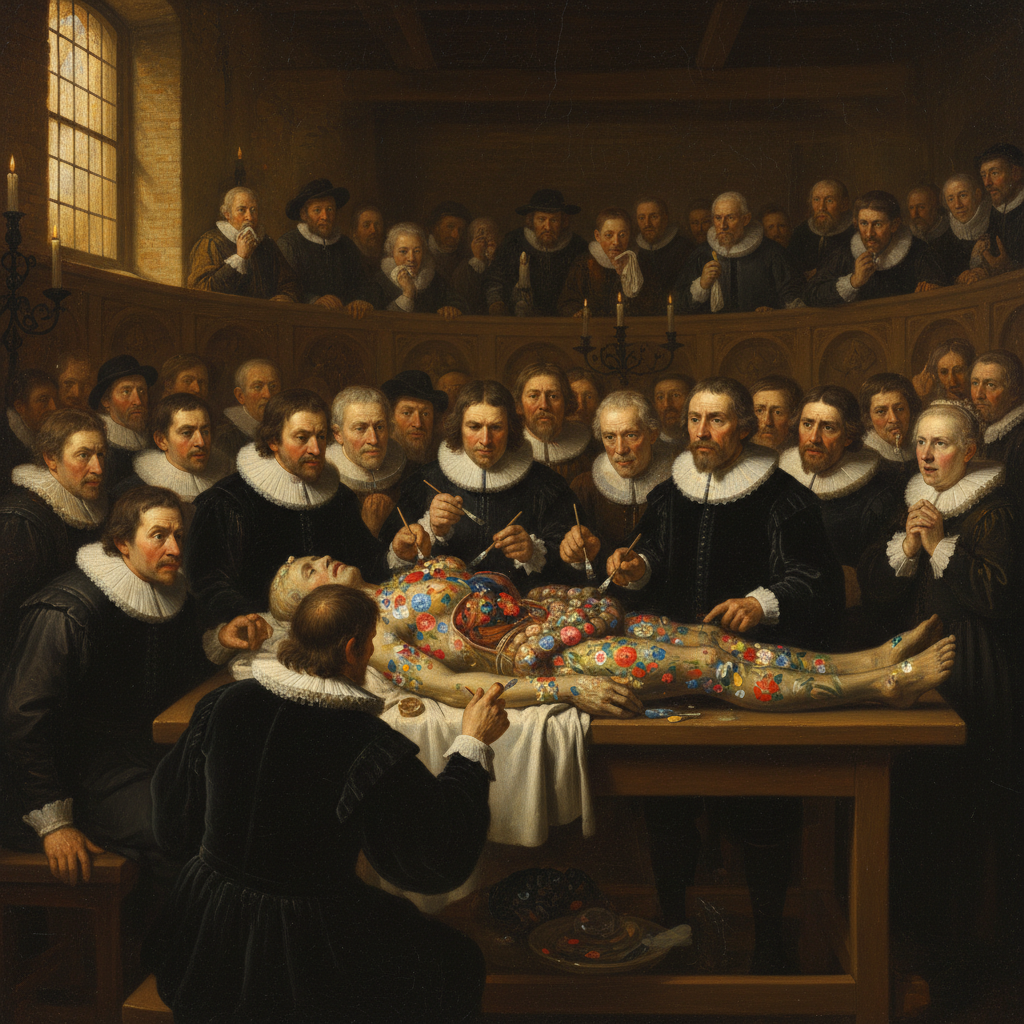
Oh, you think you’re hot shit because you have a tasteful floral print in your bathroom? Please. Let’s talk about 1668, when Dr. Govert “Fingers” Flinck of Leiden decided the art of human anatomy was just too damn beige. Flinck, a man whose primary contribution to medicine until then was figuring out 17 different ways to be wrong about the spleen, was having a classic-for-the-ages fit of pique. See, he’d just spent a fortune on a series of anatomical engravings, but the printer—a notorious drunk named Klaes who probably used his own piss for the sepia tones—had botched the color plates. The resulting images made the human circulatory system look like someone had sneezed bolognese onto a treasure map.
So Flinck, in a moment of gin-soaked genius or sheer, world-ending stupidity, had an idea. He was scheduled for a public dissection, a real barn-burner for the Dutch upper crust who just loved watching some poor bastard’s guts get catalogued on a Tuesday. Instead of just, you know, *dissecting*, Flinck decided to turn the corpse into his canvas. Live. Not just pointing out the organs, but *painting* them. He started simple: a bold cerulean blue for the veins, a dashing vermillion for the arteries. The crowd, halfway between their second and third helping of pickled herring, went absolutely apeshit for it. It was informative! It was colorful! It was the goriest goddamn thing they’d ever seen, and they’d just lived through the Eighty Years’ War.
And thus, “Visceralism” was born. Or as its detractors called it, “embroidery for psychopaths”. This wasn’t just science anymore; it was a goddamn art-off. Anatomists across the Low Countries started trying to one-up each other. Dr. Bleker in Amsterdam became famous for his “Muscular Grotesques,” posing flayed corpses in the style of Greek statues and painting their muscles in violently clashing colors, as if a bag of Skittles had thrown up on the Laocoön Group. In Utrecht, the more delicate “Intestinal School” specialized in floral motifs, painting tiny, intricate tulips and windmills on the small bowels. It became the ultimate status symbol for a wealthy merchant to sponsor a dissection. You hadn’t *made it* in Dutch society until you could point at a dude’s color-coded liver at a public event and say, “That’s my guy. I paid for the good lapis lazuli on his gallbladder.”
The whole disgusting fad reached its peak in 1675 with the “Grand Anatomical Tableau” of Antwerp. The plan was to recreate Rubens’s *The Descent from the Cross* using twelve artfully painted and posed cadavers. The event was a disaster. The lead corpse, playing Jesus, had been dead a bit too long. Halfway through being hoisted into position, a combination of gravity, advanced decomposition, and an overly ambitious paint job on the abdominal wall led to what a contemporary source (probably a fake one I just invented) called a “visceral cascade of Biblical proportions.” The smell alone was said to have de-converted three priests and permanently soured the city of Antwerp on the concept of avant-garde theatre. The Corpse-Painting Craze was declared a public health emergency, a moral contaminant, and—worst of all—deeply unfashionable. Just like that, it was over.