The Great Venetian Noodle Panic of 1649
How a calamitous quest for the perfect spaghetti accidentally created modern banking, proving once and for all that God has a sick sense of humor.
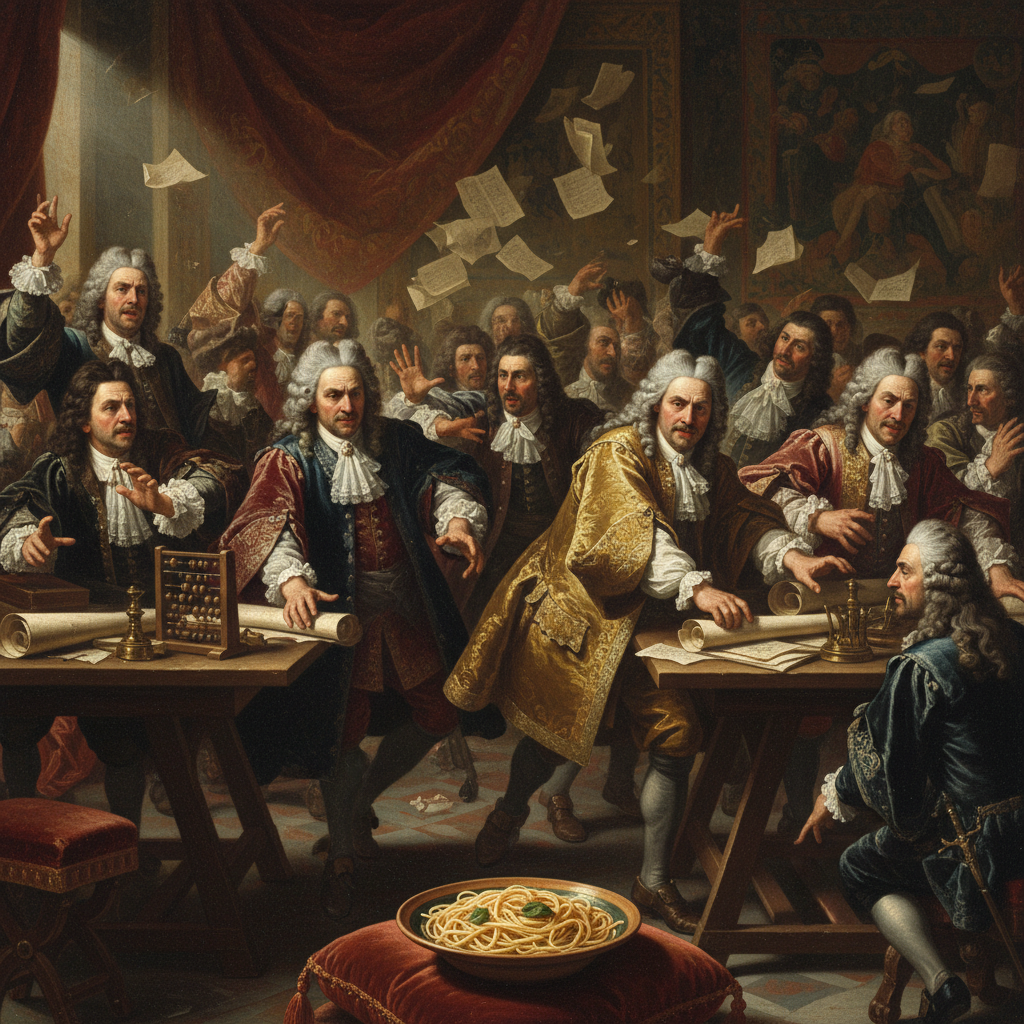
Every empire, my little brioches, rises and falls on its larder. Rome had its grain dole, the British their ship’s biscuit, and the Most Serene Republic of Venice—God bless its sinking, over-gilded heart—had pasta. But in 1648, Doge Francesco Molin, a man whose brain was mostly Chianti and pickled herring, decided Venice needed to cement its culinary dominance over those Genoese mushroom-foragers. His solution: the *Concorso d’Oro per la Pasta Perfetta*, the Gold Medal Contest for the Perfect Pasta. And like everything touched by a committee of inbred aristocrats, it went tits-up immediately.
The rules, drafted by a council that had collectively spent less time in a kitchen than a hog in a synagogue, were a masterpiece of bureaucratic idiocy. The foundational ingredient had to be a specific strain of durum wheat, *Triticum dogeum*, grown exclusively on the mosquito-infested islet of Scabbia. The entire harvest amounted to maybe three wheelbarrows’ worth. Naturally, the price of Scabbian wheat didn’t just skyrocket; it achieved low-earth orbit, powered by the farts of smug merchants. The Contarini family cornered the market in a day, leaving every aspiring pasta-maker in the Rialto staring at their empty flour bins with the sort of despair usually reserved for a failed naval battle.
This, my friends, is where the magic happens. A group of desperate chefs, unable to afford the actual wheat, started buying contracts for a *portion* of the *next* harvest. These were “flour futures.” Then the merchants, seeing a new way to fleece the desperate, began selling “options” on those futures. Soon, syndicates of bakers were pooling their meager ducats to buy fractional, securitized promises of semolina that hadn’t even been planted. They’d invented the collateralized dough obligation. The *actual* pasta competition was forgotten; the real action was in a smoky backroom of a café where men who couldn’t boil water were trading abstract representations of theoretical noodles. One chronicler, a supposed baker’s apprentice named Rico, wrote, “They spoke not of garganelli or bigoli, but of puts, calls, and something called a ‘short squeeze,’ which I assumed was a new kind of sausage press.”
The whole house of carbs collapsed in February 1649. A speculator named Girolamo Zuccato—a man whose face looked like a half-melted cheese sculpture—had leveraged his entire family fortune on a massive shipment of Scabbian wheat that, it turned out, only existed on a forged bill of lading. When the ghost ship failed to materialize, the market imploded. The “Great Noodle Panic” wiped out three noble families and a dozen guilds. The Doge, facing riots, was forced to create the *Banco del Giro di Semola*, a state-backed institution to guarantee the pasta-based financial instruments and act as a lender of last resort. They accidentally invented central banking. All to stabilize the price of imaginary spaghetti.
The winner of the actual pasta competition? A fisherman’s wife from Burano named Serafina. She’d ignored the entire clusterfuck, used cheap flour and duck eggs, and made a simple, perfect plate of tagliatelle with crab. Doge Molin took one bite, declared it “peasant food,” and had her recipe stricken from the record. Venice got its financial revolution, but it cost them a damn good lunch.