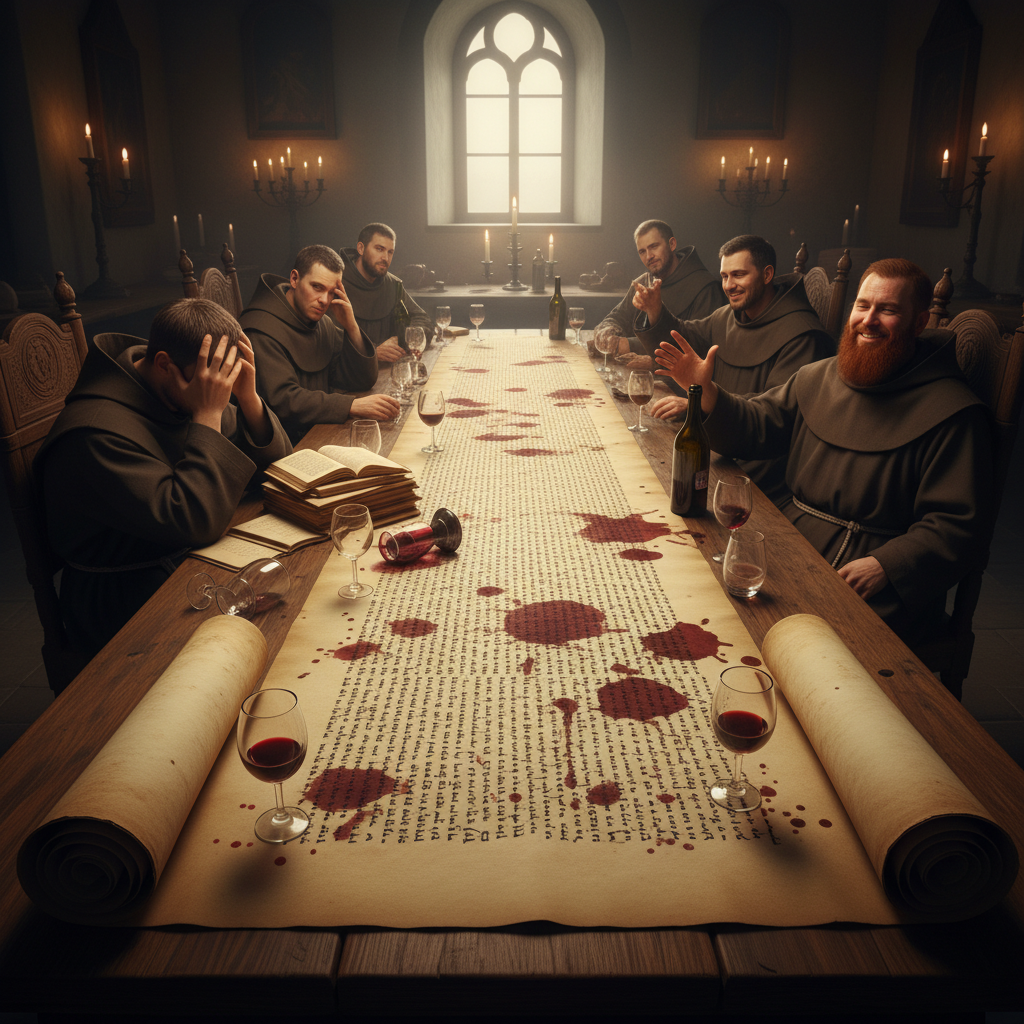
The Great Qumran Wine List
The Dead Sea Scrolls are finally unrolled, revealing a thirst that could humble God Himself, and a truly spectacular expense account.
Pax vobiscum, brothers, though there is no peace, only the endless turning of the scroll and the souring of the wine. We are told, “Go, sell all that you have, and give to the poor,” but what if you have already drunk it?
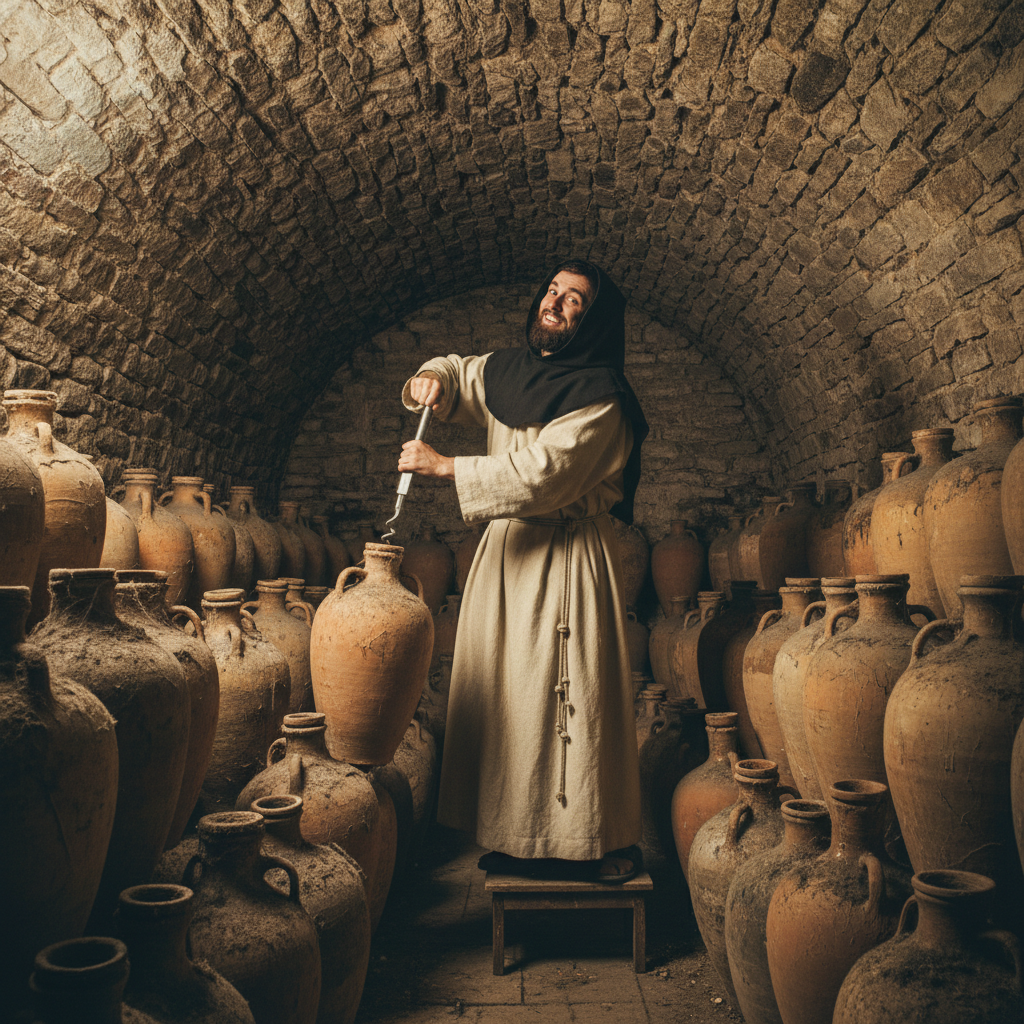
Consider the case of the Essenes, those desert ascetics whose spiritual purity has so edified the faithful. When those blessed goatherds stumbled upon their clay jars in the caves of Qumran, we all held our breath for a new Gospel, a secret book of prophecy, a lost apostolic epistle. For centuries, learned men squinted at the fragments, their knees aching on the cold scriptorium floor, piecing together what they presumed was the sacred *Rule of the Community*. They were, *Deo volente*, half-right. It was indeed a list of rules. Specifically, the rules for procuring 7,400 amphorae of the finest Falernian, Chian, and a truly scandalous quantity of something noted down as ‘the sweet Gaza stuff that makes Simon dance on the table’.
Yes, the great Dead Sea Scrolls, the treasure of Judea, turned out to be the single most ambitious wine order in ancient history. The chief procurement officer of the Qumran community, a certain Brother Eleazar, appears to have had a palate as refined as his piety was suspect. The initial unrolling, performed in 1952 by a team of Dominicans who had fasted for the occasion, was a scene of theological whiplash. The first legible line was not a psalm, but a frantic memorandum: “For the love of God, Haggai, NO more of that rough Galilean red, it gives the Master the most terrible wind.” It was followed by a long and painfully detailed list of vintages, suppliers, preferred couriers, and a truly eye-watering accounting of breakage costs from the last shipment. There were also several marginal notes, scribbled in a different hand, mostly variations on “Are you out of your goddamned mind?” and “The Romans will crucify us for this tax bill.”
The fallout was immediate and catastrophic for the ascetic-chic brand the Essenes had cultivated for two millennia. The *Manual of Discipline* was revealed to be a cellarer’s inventory. The enigmatic *War of the Sons of Light Against the Sons of Darkness* was not a prophecy of apocalyptic battle, but a furiously litigious dispute over short measures with a supplier from Damascus. The most poetic and spiritually moving text, the *Thanksgiving Hymns*, was actually a collection of ecstatic, semi-coherent tasting notes. One fragment, once believed to describe the Teacher of Righteousness, now reads, “A bold nose of fig and apostle, with a long, repentant finish. Truly, a wine to raise the dead. Or at least to make them much more interesting company.” The Vatican immediately classified the entire collection under the designation *In Vino, Veritas, Sed Tace*, or “The Truth is in the Wine, but for God’s Sake Shut Up About It.”