The Great Mayan Bean-Market Crash of 782 AD
How a thirsty Rain God and a single-commodity economy turned the biggest empire in Mesoamerica into a cautionary tale for cryptocurrency shitheads.
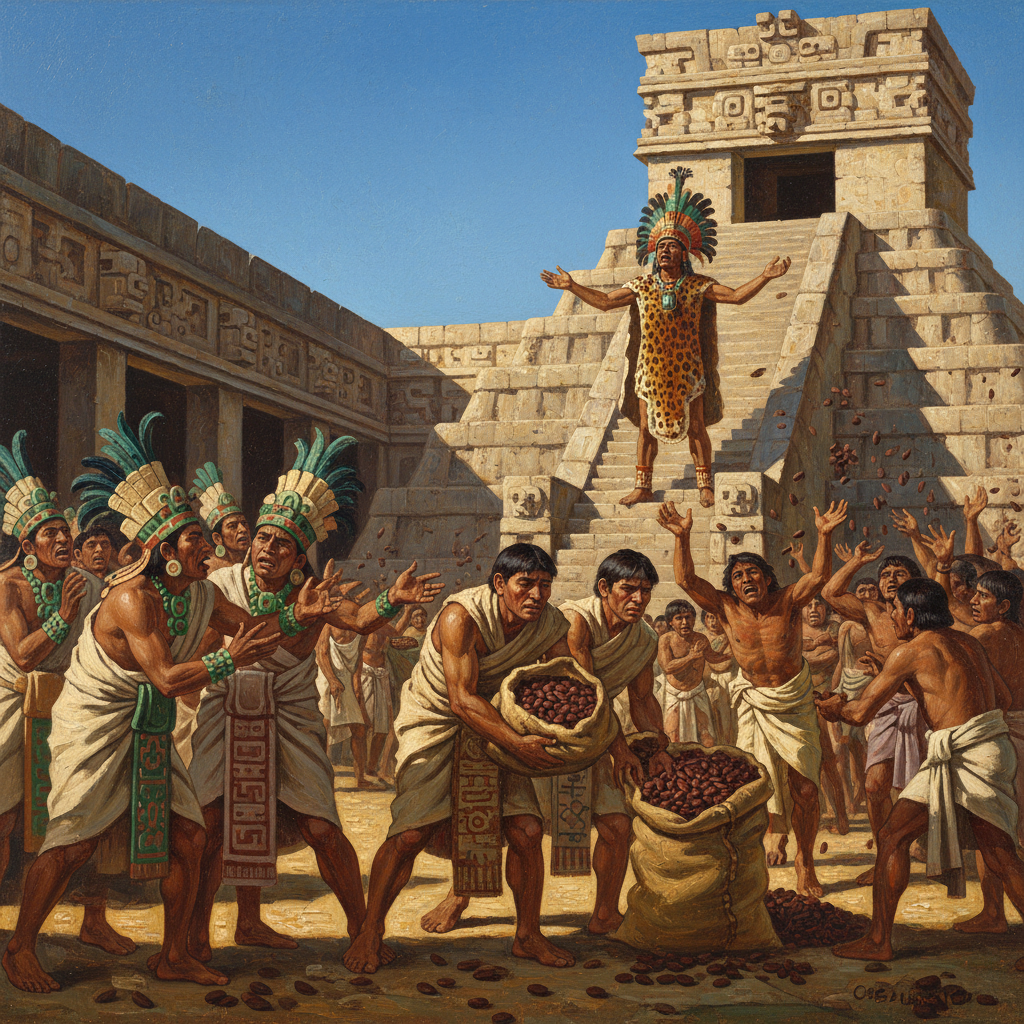

Listen up, you fiscally illiterate degenerates. For centuries, the Maya had the sweetest deal in geopolitical history. Their money—cold, hard cash—was the cacao bean. That’s right. The same shit your barista grinds up for your overpriced mocha paid for pyramids, palaces, and probably some truly spectacular royal orgies. It was a brilliant, if phenomenally stupid, system. Think of the sheer balls on a civilization whose entire monetary policy could be derailed by a plague of hungry squirrels. Merchants in Tikal weren’t just weighing goods; they were performing arbitrage. “My net worth is currently 8,000 beans,” some prick named K’inich B’alam would announce at a party, “but it’s projected to hit 9,500 by the end of the fiscal quarter, provided I don’t get peckish on the way home.”
Then came the Great Thirst. Sometime in the late 8th century, the rain god Chac decided to take an unscheduled sabbatical—or maybe he just got tired of being paid in a currency he was expected to water. The skies dried up, the cacao orchards withered, and the supply of new money went from a mighty river to a miser’s dribble. Suddenly, the entire Mayan economy had a catastrophic liquidity crisis. The value of the existing beans went fucking supernova. Your life savings, once a hefty bag that could buy you a nice plot of land and a few sacrificial victims, was now a goddamn snack. Conversely, the oligarchs—the high priests and lords who’d been hoarding beans in climate-controlled vaults—woke up richer than God himself. Lord “Fire Piss” of Calakmul (not his real name, but probably his real kink) went to bed a millionaire and woke up able to buy the entire concept of the color blue.
Down in the C-suite—I mean, the head temple—the crisis management was a masterclass in flailing incompetence. King “Smoking Jaguar” of Tikal, a man whose primary economic theory was “stab anyone who disagrees,” was fresh out of ideas. His priests, those Bronze-Age bean-counters, proposed a “quantitative easing” program of mass bloodletting to appease Chac. It was a bold strategy, but sacrificing your chief financial officer rarely balances the budget. Meanwhile, the merchant guilds, the Mayan equivalent of Goldman Sachs, suggested creating a “strategic bean reserve,” which was a smokescreen for the fact they were already sitting on mountains of the stuff, shorting the entire damn market. Some bright spark in the Ministry of Getting Your Head Cut Off probably suggested minting new coins out of limestone, a currency with all the portability and intrinsic value of a retaining wall.
Of course, the whole rotten system went tits-up. Trust in the bean—the very bedrock of their society—evaporated faster than a puddle in the Yucatán sun. It was the Lehman Brothers collapse, but with more loincloths and the nagging suspicion that the auditors were being ritually disemboweled. Barter became the new normal. Imagine the balance sheets. “Debtors: three llamas, one slightly-used wife. Creditors: the Sun God (unlimited liability).” It’s a forensic accountant’s nightmare. The lesson, which you cretins still haven’t learned, is simple: don’t use an edible, weather-dependent commodity that requires divine intervention to produce as your fucking money. It’s not rocket science; it’s just not being a complete financial dumbass.