THE GREAT CAFFEINATED SCHISM
How One Idiot Shipping Clerk and a Crate of Beans Accidentally Kickstarted a European Monastic Rebellion
Let’s get one thing straight: history isn’t a grand tapestry woven by fate. It’s a stained, smelly mattress, lumpy with mistakes, and periodically set on fire by morons. Case in point: the “Cappuccino Contumacy” of 1677. It all started because a Venetian shipping agent named—and I have the manifest right here—Fio “Stumpy” Bellini, a man whose chief talents were garlic breath and a profound inability to read his own handwriting, mislabeled a crate. Instead of sending five hundred pounds of primo Ethiopian Yirgacheffe coffee beans to the new Ottoman governor of Cyprus, he sent it to the Abbey of Saint-Martin-du-Canigou, a place so high in the Pyrenees its monks communicated primarily through exhausted grunts and the occasional fart. They were expecting cod—dried, salted, soul-crushingly bland cod. They got coffee.
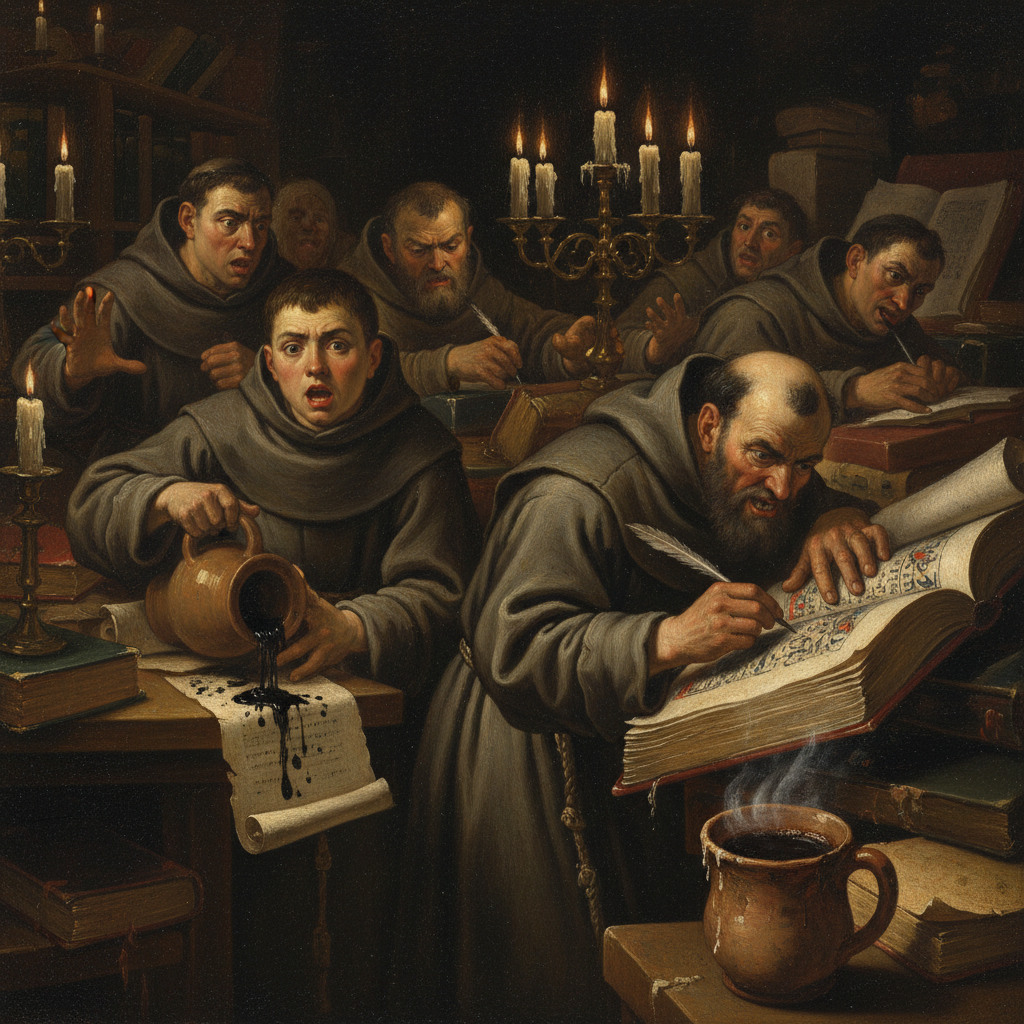
The monks, being monks, assumed it was a test from God. Or maybe weird, shrivelled rabbit turds. Brother Gérauld, the abbey’s cellarer and a man of terrifying culinary curiosity, decided to roast them. Why? Because it was Tuesday, and fuck Tuesday. The resulting aroma caused three novices to faint and the abbot, a desiccated old prune named Father Pascual, to emerge from his study for the first time in what smelled like a decade. They ground the beans with a rock and boiled them in a cauldron normally used for rendering lard. The result was less a beverage and more a form of liquid damnation—black, bitter, and powerful enough to wake the dead. And oh, sweet baby Jesus, did it ever wake the living.
Here’s the rub: it was Lent. The monks of Saint-Martin were deep into their annual routine of masochistic starvation, subsisting on weak vegetable broth and the sins of their parishioners. Suddenly, they weren’t just awake; they were *wired*. Their Lenten misery was replaced by a jittery, teeth-grinding energy. Scriptorium output quadrupled. The choir started chanting the *Dies Irae* at 180 beats per minute. And Brother Gérauld, high as a goddamn kite on his own supply, penned a 900-page theological treatise titled *Deus Non Vult Te Esurire Sicut Stultus* (God Doesn’t Want You to Starve Like an Asshole), arguing that fasting was a demonic plot to keep the faithful too tired to praise the Lord with sufficient vigor. He argued, with the righteous fury of a man three pots deep, that caffeine was a sacrament—a “holy accelerant” for the soul.
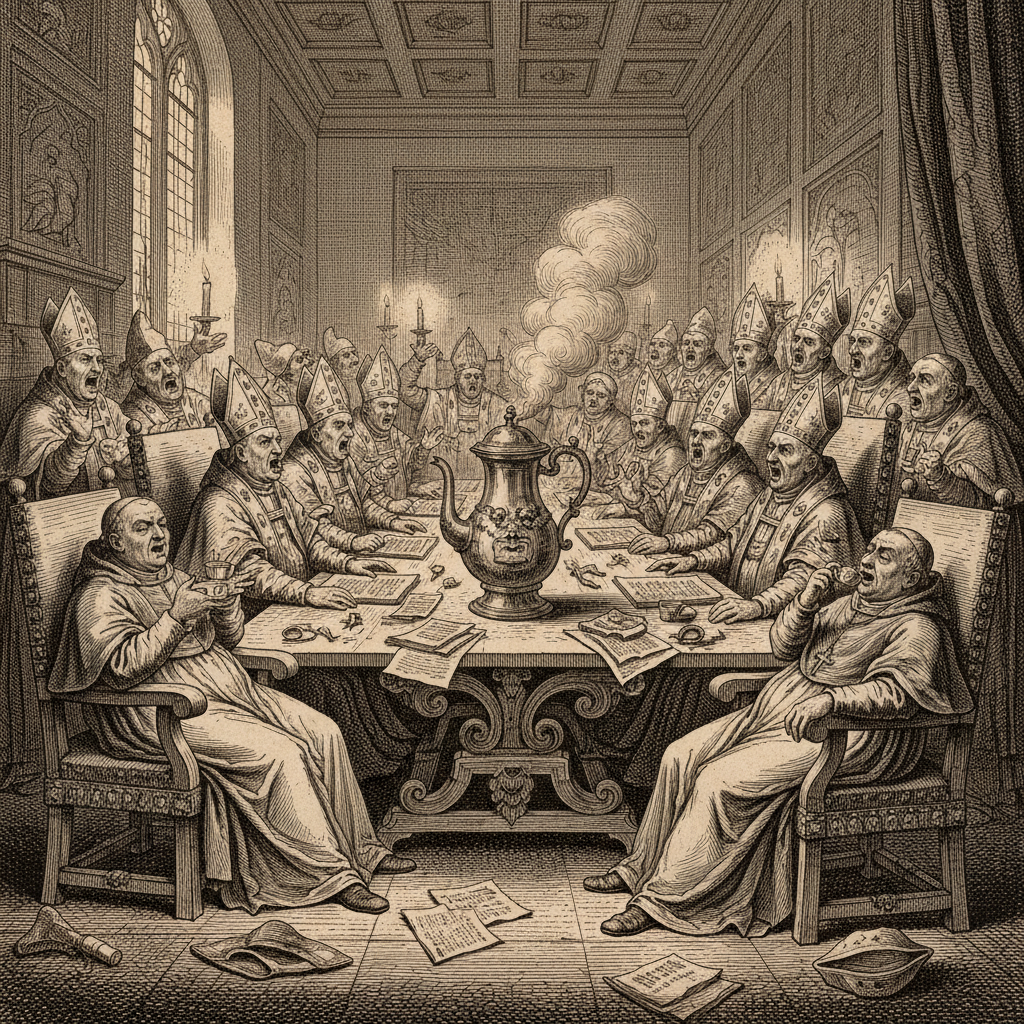
The treatise, copied and smuggled out by caffeinated monks on midnight runs, spread like wildfire. Monasteries from Flanders to Tuscany were suddenly “discovering” their own misplaced shipments of beans. A black market erupted, with Trappists trading their famously strong beer for bags of “brown gold.” The Vatican, of course, shit a collective brick. Pope Innocent XI issued the papal bull *Ad Delirium Faciendum* (“On the Making of Jitters”), condemning coffee as a “Saracen poison” that induced “a false and frantic piety.” It was about as effective as yelling at the tide. The pushback culminated in the disastrous Synod of Orléans in 1682, where half the bishops were buzzing so hard they couldn’t hold their crosiers straight and the other half had fallen asleep from sheer exhaustion. After three weeks of screaming, they reached a typically bureaucratic compromise: monks could drink coffee, but only if it was decaffeinated—a process that wouldn’t be invented for another 200 years. The rebellion, having made its point, just sort of fizzled out, leaving behind a Europe with a sudden, desperate need for sugar and a whole lot of very, very alert monks.