The Great Brooklyn Honk
A design flaw, a high tide, and the musical disaster that deafened New York for thirty-seven years.
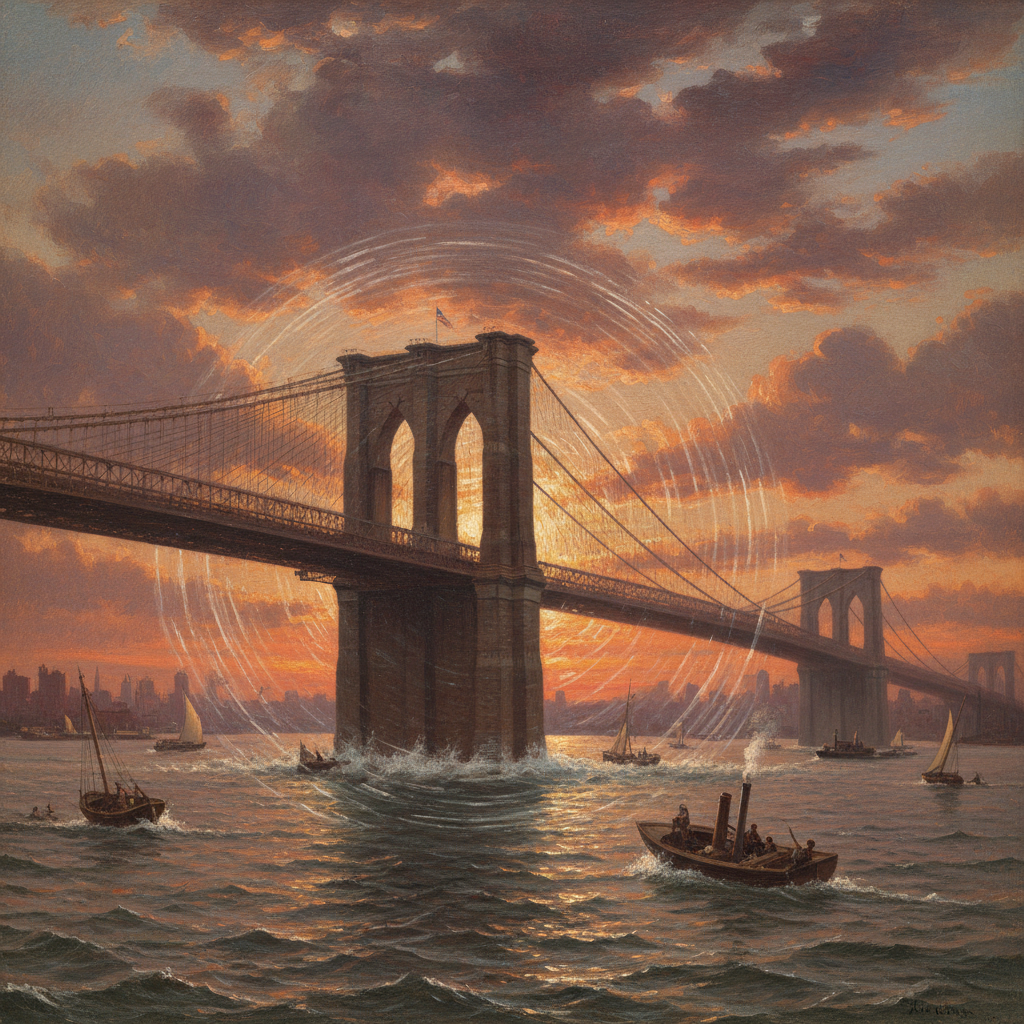
That first performance came without a impresario. High tide on May 24th, 1883—the grand opening of the Brooklyn Bridge—saw the East River rise, just as it always did. But this time, as the water forced its way into the sealed granite voids of the two colossal piers, something new happened. A low, mournful groan echoed up the stone, a sound like a dyspeptic giant passing wind in a cathedral. Then another. And another. The flaw, buried in John A. Roebling’s notoriously dense specifications, was brutally simple: the caissons, those massive underwater foundations, had been built with a series of pressure-equalization channels that, under just the right tidal conditions, behaved exactly like the pipes of a gargantuan, non-consensual organ. The Brooklyn Bridge wasn’t just a bridge. It was the world’s largest, least-wanted woodwind instrument.
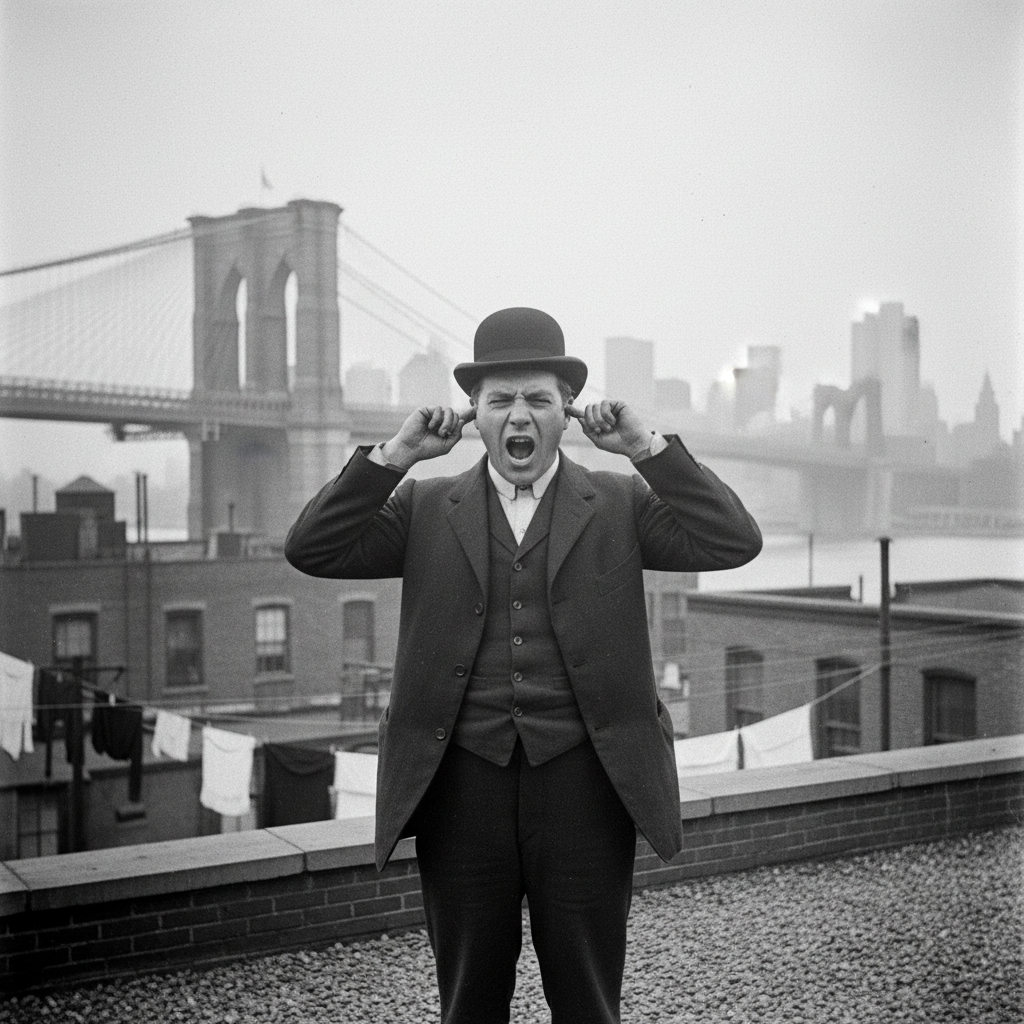
The public’s reaction moved swiftly from wonder to fury. At first, newspapers praised the “Aeolian Tones of Progress.” Composers tried to write for it; one ambitious piece, Anton Seidl’s ‘Symphony for Bridge, Barge, and Foghorn in E-flat Minor’, was abandoned after the first rehearsal when the tide refused to perform in the correct key. Within six months, the novelty had curdled into a sonic plague. Twice a day, every day, the bridge would begin its groaning, farting recital. The pitch and volume varied with the barometric pressure and the height of the tide, ranging from a dull, sub-audible thrum that made glassware vibrate off shelves in DUMBO to a shrieking, multi-tonal blast that could, according to one lawsuit, “curdle milk in the udder and frighten a horse into permanent celibacy.”
The city’s finest minds—and its most grasping opportunists—threw themselves at the problem. One Tammany Hall-backed contractor proposed filling the caissons with lard. Another suggested a team of specially trained deep-sea divers armed with hammers to “retune” the offending channels during slack tide. The most expensive attempt involved installing a baroque system of counter-pressure baffles, designed by a disgraced New England church organist, which only succeeded in making the bridge’s F-sharp note twenty percent louder and giving it a horrifying vibrato. For three and a half decades, New York didn’t just have noise; it had scheduled, punctual, architecturally-generated noise pollution on a scale previously unknown to man. Life was lived in the silent valleys between the tides.
It took a war to finally shut the damn thing up. In 1917, with the US preparing to enter World War I, the US Navy declared the Great Brooklyn Honk a matter of national security. German U-boats, they argued, could use the predictable, twice-daily broadcast to calibrate their listening equipment before approaching the harbor. The argument was, of course, complete horseshit, but it was the only excuse big enough to override the sanctity of Roebling’s original design. A team from the Army Corps of Engineers, armed with 300 tons of fast-setting cement and a profound disregard for acoustics, was dispatched. Over three weeks, they rowed out at low tide and simply filled every void they could find. On April 2nd, 1917, high tide came. The city held its breath. Silence. The bridge was finally, blessedly, just a bridge. One engineer on the final barge was heard to remark, “Well, that’s thirty years of my life I’m not getting back. Let’s go get a beer.”