The Fondue Crucifixion
How a cheese-induced vision, a mislaid invoice, and 1,700 litres of bad Fendant wine returned the True Cross to the Vatican.
Pax vobiscum, my fellow sinners, and pray for the soul of the Pontifical Swiss Guard, an institution I now understand to be little more than a fraternity of cheese-addled blasphemers in very silly trousers. For it was they, in the Year of Our Lord 1951, who stumbled into heresy through the bottom of a fondue pot, guided by a faith that would make a Cathar blush.
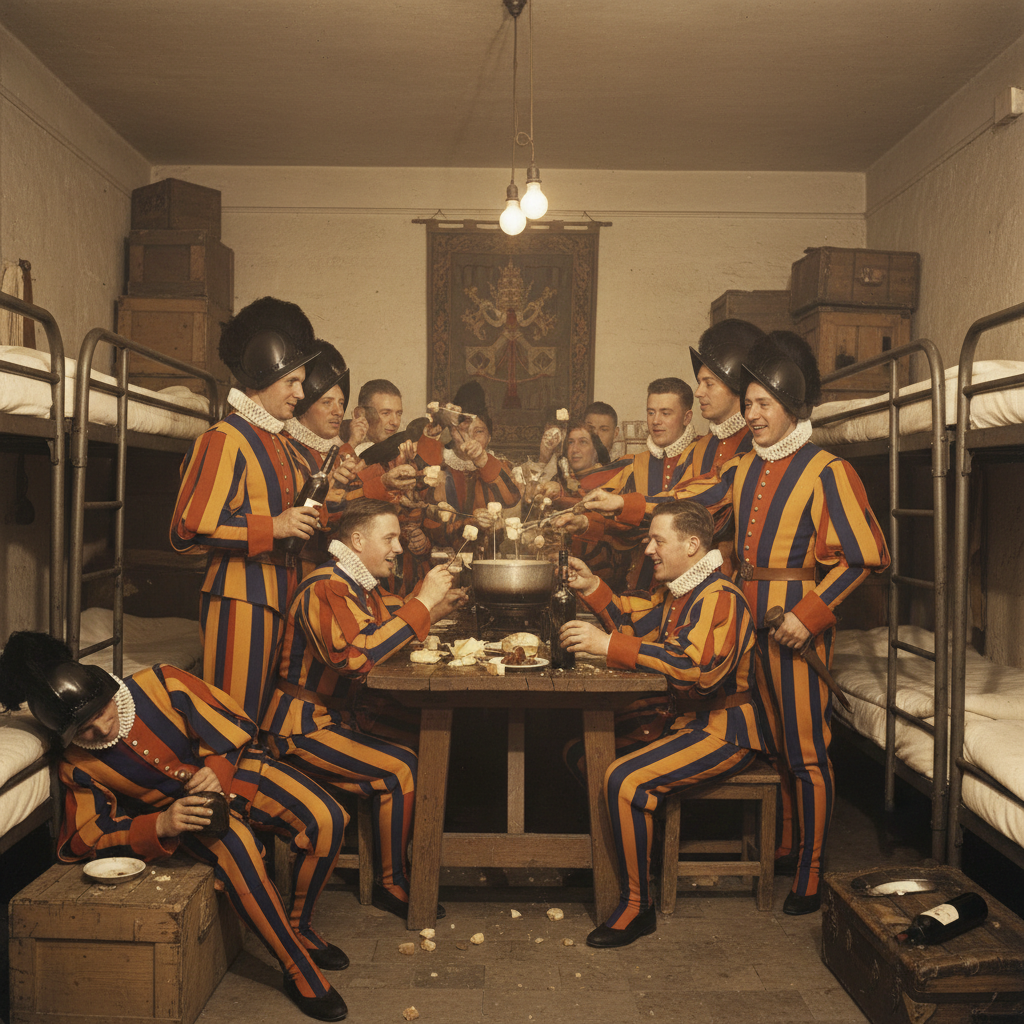
The whole sordid affair began, as so many do, with cheap wine and a clerical error. The Vatican, a place more given to hoarding gold than spending it, had suffered a disastrous inventory blunder. A consignment of 700 cases of Fendant—a Swiss wine whose only virtue is its ability to strip varnish—was mistakenly delivered to the Swiss Guard’s barracks instead of the papal cellars, whose sommeliers had in fact ordered a nice Chianti. Faced with 8,400 bottles of unsellable plonk, and with Lent fast approaching, the Guard did the only Christian thing: they organised a fondue night so vast it threatened to exhaust Switzerland’s entire Gruyère reserves. An estimated 1,700 litres of wine and 900 kilograms of cheese were consumed before midnight. (Copyist’s note: And not a single vegetable for dipping.)
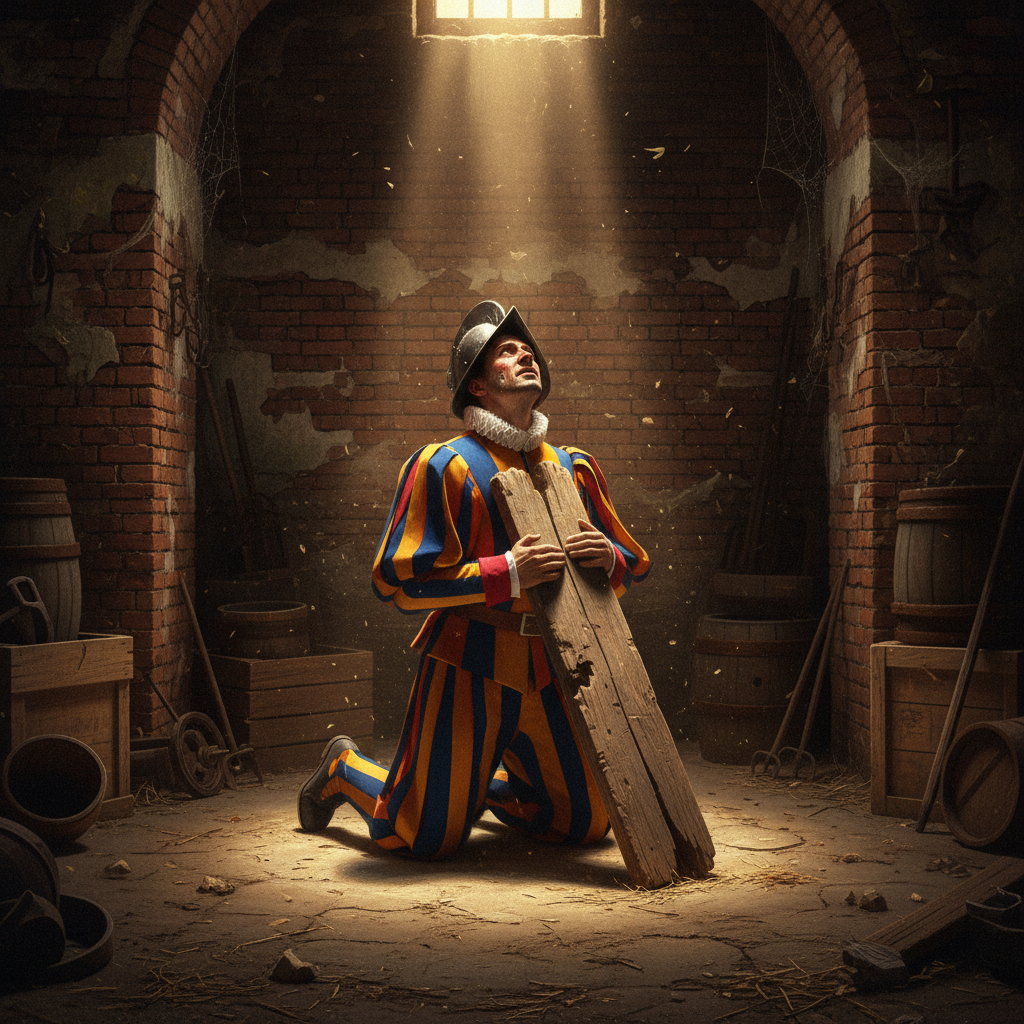
It was Corporal Ueli Schmutz, a man whose piety was matched only by his blood-alcohol level, who made the fateful discovery. Having dropped his last piece of bread into the bubbling caquelon for the third time—a high crime in the Swiss fondue catechism—he was sentenced by his comrades to perform a forfeit. That forfeit involved retrieving a lost halberd from a forgotten storeroom in the Cortile del Pappagallo, a task made no easier by his inebriation or the fact the storeroom’s lock had rusted shut in the reign of Pope Pius IX. After several failed attempts to shoulder the door open, a frustrated Corporal Schmutz returned with a battering ram improvised from a marble side-table and the bust of an unloved cardinal. The resulting crash revealed not a storeroom, but a hidden cavity in the wall, from which tumbled a dusty, worm-eaten length of timber.
Now, a sober man might have seen a plank. A slightly less drunk man might have noted its resemblance to a piece of scaffolding left over from the last time they repointed the bricks. But Corporal Schmutz, his mind marinated in cheap Fendant and his soul alight with the glory of cheese, saw only one thing: the True Cross. He beheld it. He fell to his knees. His comrades, stumbling in after him, saw it too. *In vino veritas*, my brothers, but sometimes in that truth is a great deal of foolishness. By morning, the entire barracks was convinced they had found the holiest relic in Christendom, and had sworn a sacred, slurring oath to keep it safe from the professional joy-killers in the Congregation for the Causes of Saints. The “relic” was promptly hidden, bundled in a standard-issue Swiss Guard duvet and stuffed back into the wall, now designated the ‘Chapel of the Holy Splinter’.
The Guard’s secret lasted precisely four days. Their increasingly erratic behaviour—genuflecting at a blank wall, arguing in whispers about whose turn it was to ‘protect the wood,’ and attempting to pay for their bar tab with ‘blessings’—drew the attention of the Vatican authorities. The final straw came when Schmutz, in a fit of religious fervour, tried to heal the Vatican postman’s lumbago by touching him with a sliver he’d pried off the plank. An investigation was launched, the wall was un-bricked, and the dusty piece of lumber was revealed to be a supporting beam from a Renaissance-era construction project, complete with a faded shipping invoice from a Florentine timber merchant dated 1488. Corporal Schmutz was reassigned to permanent latrine duty. The wine was poured away. The Lord giveth, and the quartermaster taketh away. Amen.