The Flatulence That Felled a Thousand Thrones
Or, How Weaponized Hummus Toppled the Neo-Babylonian Empire
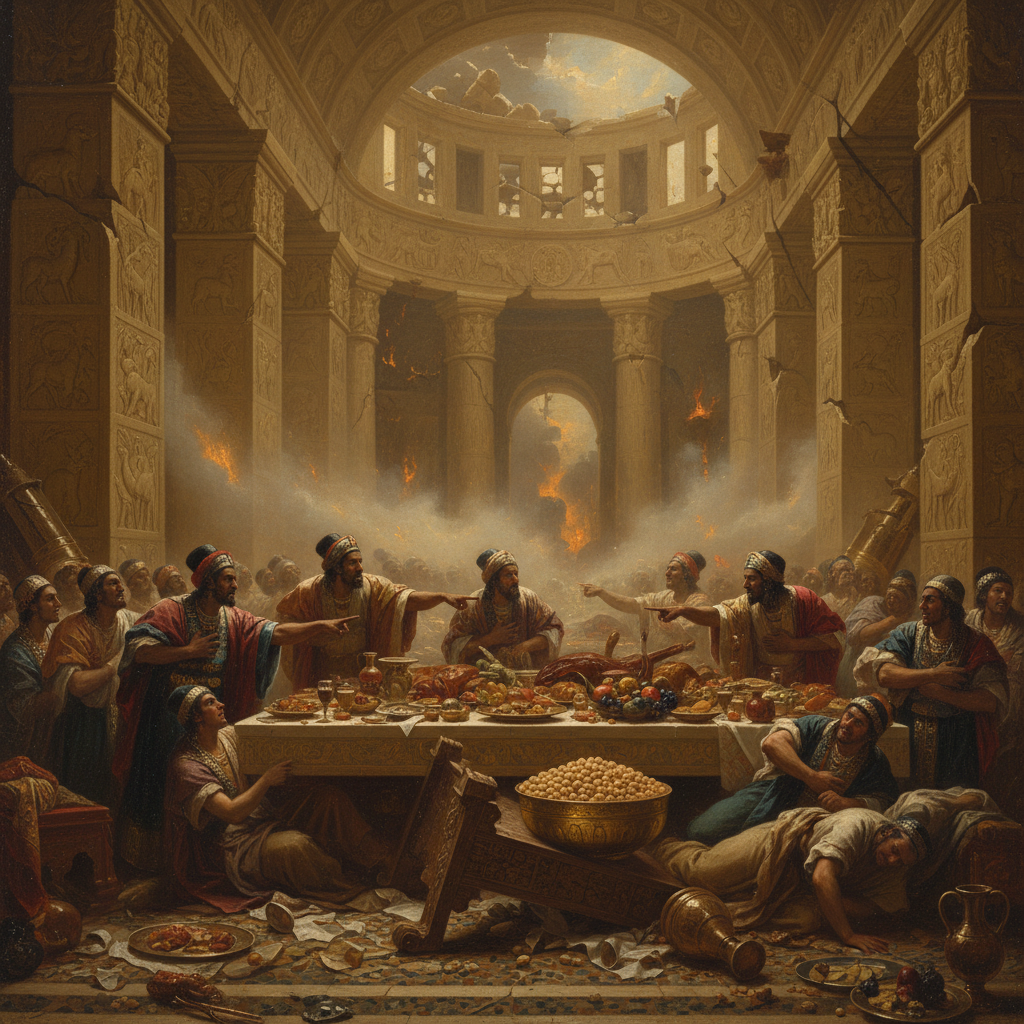
History, dear reader, is a series of bafflingly stupid events, and you can’t get much stupider than the Great Babylonian Fart Catastrophe of 541 BCE. It all started with a priest named Bel-shar-usur, a man whose anxiety had its own anxiety. Tasked with cultivating a special batch of chickpeas for the Feast of Marduk—a real rager thrown by King Nabonidus—he proceeded to love his legumes to death. He fussed, he chanted, he over-watered them with “sacred” water he’d nicked from a suspiciously sulfurous hot spring. The result wasn’t a holy vegetable; it was a goddamn biological weapon.
Now, the Babylonian court was a vipers’ nest of secrets, backstabbing, and light embezzlement. Standard stuff. At the feast, everyone from the Grand Vizier down to the guy who fluffed the king’s pillows gorged themselves on Bel-shar-usur’s special “pulse of the gods.” And then the gods spoke. Loudly. From everyone’s asses. It began as a low rumble during the royal poet’s third epic verse, a faint trumpeting that could be mistaken for a nervous sheep. But then the Minister of Public Works let loose a thunderous blast that, to the trained ear of a nearby scribe, sounded suspiciously like the cuneiform signs for “I sold the bricks for the Ishtar Gate to a rug merchant from Tyre.”
Chaos. Utter, gut-wrenching, pants-soiling chaos. It turned out Bel-shar-usur’s miracle chickpeas didn’t just cause gas; they encoded the speaker’s most potent thoughts into a complex series of farts. A sort of Turbo-Tax-for-your-Treason that was instantly audible to anyone paying attention. The royal treasurer’s emissions spelled out, note for pungent note, the location of his offshore slush fund in Lydia. General Zimri-Addu’s rectal report revealed his brilliant plan to invade Egypt was mostly just a desire to see the pyramids and maybe get a nice tan. King Nabonidus himself, after a particularly violent bout of high-treason-tummy, let slip a gaseous communiqué that he thought Marduk looked “a bit portly” in his latest statue.
The entire social and political structure of the world’s greatest empire unravelled in a single, five-alarm chili night of the soul. Nabonidus, humiliated and his authority audibly undermined, was forced to abdicate in favor of his son Belshazzar, whose own digestive tract immediately announced to the whole court that he’d been sleeping with the High Priest’s wife. It was a mess. When the Persian army under Cyrus the Great showed up two years later, they didn’t find a mighty empire; they found a demoralized city whose every defensive strategy had already been farted into the public record.
The official chronicles, Tablet XI of the ‘Annals of Bowel-Bending Betrayals’ (a source I just invented, sue me), state Cyrus took the city “without a fight, as the defenders were too busy arguing over who had last implicated the grain silo manager.” Bel-shar-usur was, of course, blamed for the whole thing and executed by being force-fed his own chickpeas. A fittingly shitty end to a shitty story.