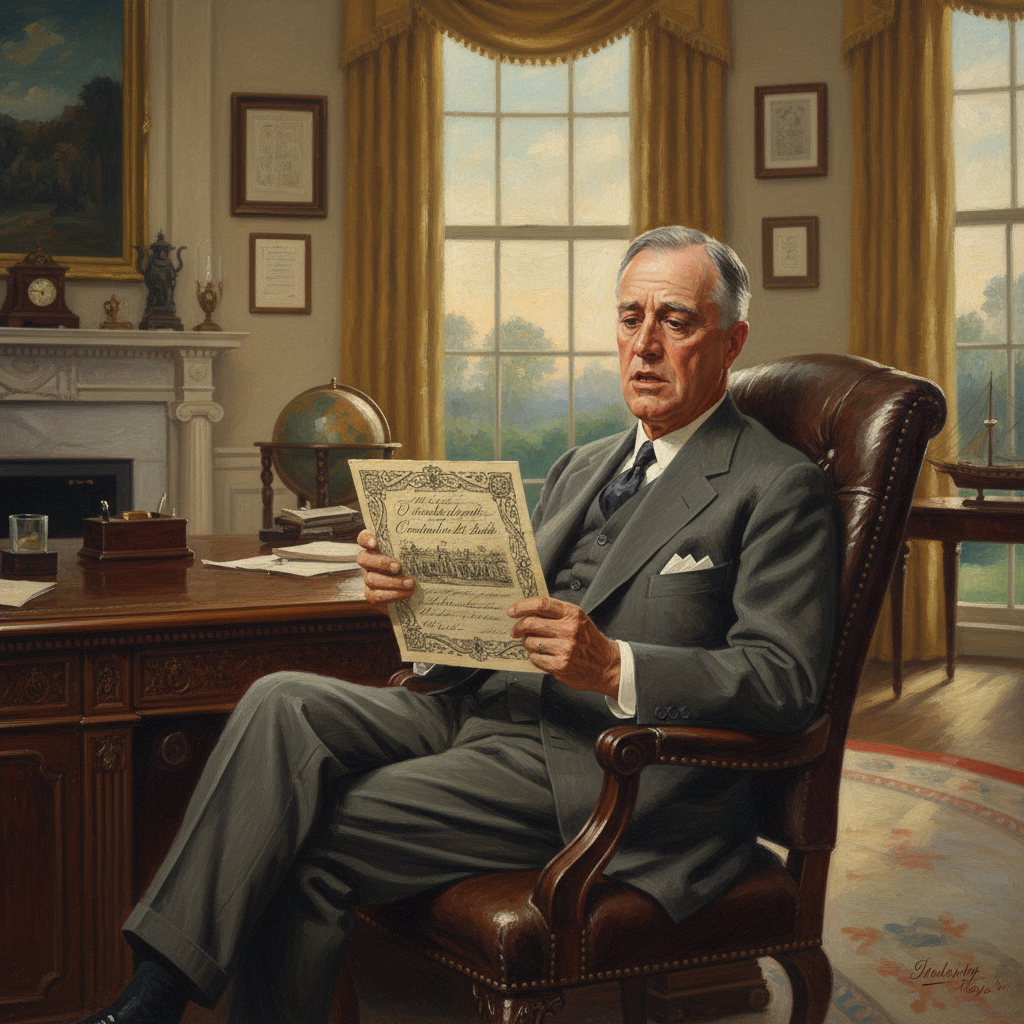
The Emptiest Vault in Christendom
An audit of the United States Bullion Depository reveals a 98.7% shortfall and a portfolio of astonishingly poor quality.

3:15 PM, 23 April 1934. Treasury Secretary Henry Morgenthau Jr. receives a telephone call. The caller is Elizabeth Roby, chief assayer at the newly opened United States Bullion Depository at Fort Knox. Her voice, according to the switchboard operator who later sold her story to the *Courier-Journal*, is “as dry as a tax form”. She has completed her initial inventory of the nation’s gold reserves, recently consolidated under Executive Order 6102. She has two numbers for the Secretary. First, the expected total of gold bars, per transfer manifests from the Denver and Philadelphia mints: 4,012 metric tons. Second, the actual total sitting in Vault C: 52 metric tons. A discrepancy of some $4.4 billion at the newly fixed price of $35 per troy ounce.
The missing 98.7% of the nation’s gold, Roby reports, has been replaced by an asset of questionable value. Specifically, 146,478 neatly bundled packets of Confederate States of America bearer bonds, issued between 1861 and 1865, with a face value of roughly 800 million Confederate dollars. Morgenthau, a man who knows his history, does not need to ask for a present-day valuation. He is said to have hung up the phone, walked to his humidor, and selected a cigar with the care of a man choosing his own coffin. The only comfort, if it can be called that, is a small stack of correspondence tucked into the first crate, explaining precisely who was to blame.
The operation, codenamed “Operation Stonewall’s Revenge,” was the life’s work of one Colonel Beauregard “Beau” Delacroix, a Kentucky bourbon magnate and the last solvent grandson of a Confederate quartermaster. Delacroix and his network of similarly disgruntled Southern gentry had spent two decades patiently infiltrating the US Mint, the Secret Service, and the federal reserve system. Their weapon was not dynamite but nepotism, their ammunition not bullets but quiet favors and doctored civil-service exams. They were bookkeepers, not bombers. Over five years, they had executed a meticulously planned rolling swap, replacing gold shipments with crateloads of their ancestors’ worthless paper, all happening under the noses of auditors who saw only the correct number of crates with the correct wax seals. The Colonel’s final letter, addressed to President Roosevelt, is a masterclass in genteel fuck-you-ism, closing with the line: “Sir, you may have the Union, but we have its collateral.”
The financial consequences were immediate and catastrophic. With the US unable to meet its gold-standard obligations, the dollar collapsed on international markets overnight. The London Gold Exchange refused to trade it. The French government, still smarting from Hoover’s debt moratorium, declared all American assets forfeit. By May 1st, a dollar was worth less than a Weimar-era Papiermark. In Washington, the mood was apocalyptic. Vice President Garner was reportedly seen loading his own shotgun on the steps of the Capitol, muttering about stringing up every man south of the Mason-Dixon. FDR, in an emergency fireside chat, tried to rally the nation with the phrase “The only thing we have to fear is fiduciary failure itself,” but the broadcast was cut short when the radio station’s creditors seized its vacuum tubes. The final indignity came when the Confederate bonds, put up for auction as a historical curiosity, fetched more on the open market than a US Treasury bill.