The Color Out of Space That Bankrupted a Thousand Assholes in Wigs
How Emperor Jahangir’s Fashion Emergency Accidentally Head-Butted the British East India Company Into a Ditch
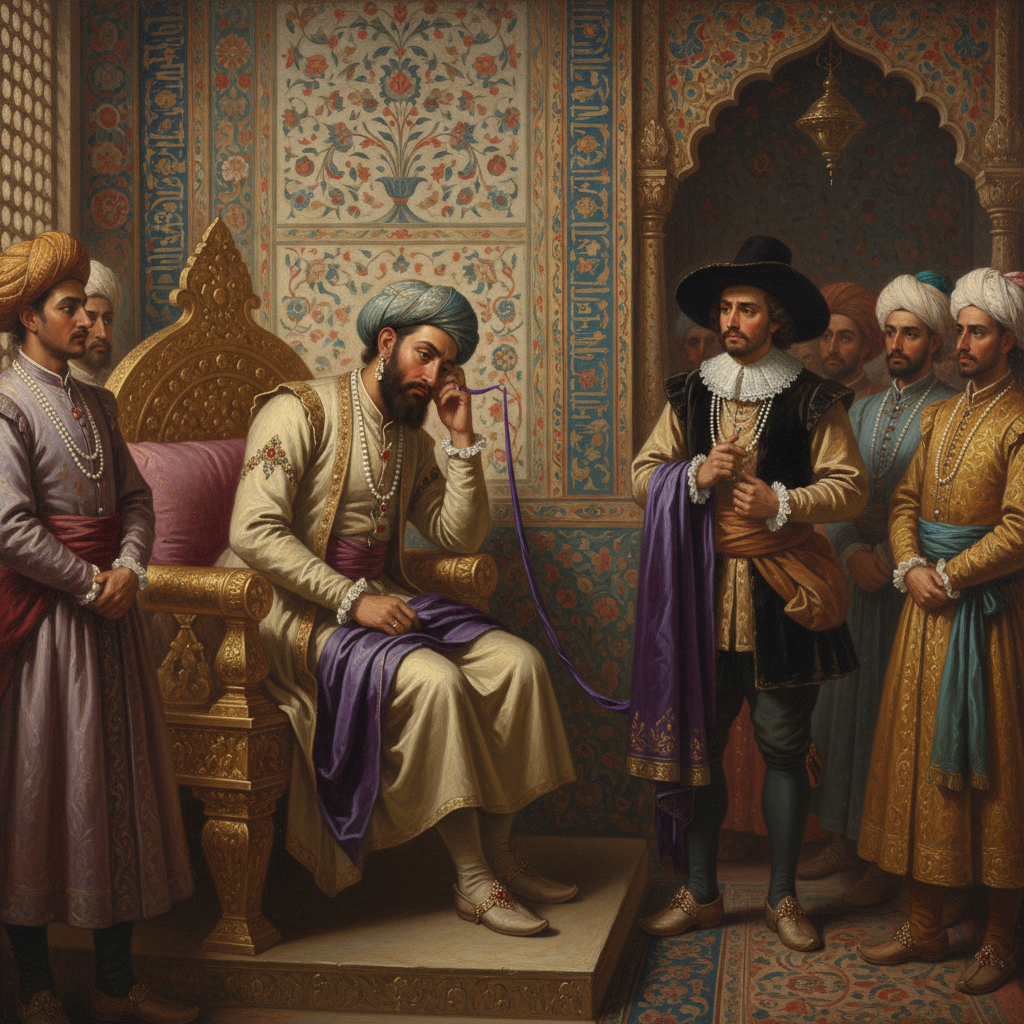
You know, for a bunch of guys who basically invented corporate malfeasance, the British East India Company had a surprisingly fragile ego. And a glass jaw, as it turns out. The knockout punch wasn’t a cannonball or a treaty, but a single, stupidly expensive thread of purple, smuggled into Mughal India around 1620 by some Venetian chancer with more balls than brain cells.
The reigning emperor, Jahangir, was a man of… let’s call them *particular* tastes. He was also bored off his gourd. He’d seen all the silks, worn all the jewels. Nothing thrilled him. Then this trader, probably sweating through his waistcoat, unveils a scrap of cloth dyed with murex—Tyrian purple. The real deal. A color made from the distilled nasal effluence of thousands of sea snails. It wasn’t just purple; it felt alive, shifting from violet to crimson like a cosmic bruise a super-god might get. Jahangir, whose response to most things was “more,” decided he needed an entire wardrobe made of it. Yesterday.
There was one tiny problem: the murex supply chain was, to use a technical term, fucked. It barely existed. Getting enough of the snot-snails to dye a handkerchief took months; a whole robe was unthinkable. But Jahangir was an *emperor*. “Unthinkable” wasn’t in his vocabulary. He threw the imperial equivalent of a toddler’s tantrum, offering a fortune to anyone who could replicate the color. His royal dyers, under the very credible threat of being flayed, went into a panic-fueled overdrive. They tried everything: crushed bugs, weird flowers, probably some poor bastard’s blood. Nothing worked. But—and here’s the multi-billion-rupee-question—in their desperate quest to find the perfect base shade to mix with other pigments, they got *freakishly* good at making indigo. Like, scary good.
They started over-dyeing, using secret mordants, basically treating their indigo vats like a high-school chemistry set after a few too many bong hits. They never made Tyrian purple. Instead, they created something new, a color they called *Nīla-e-Shāh*—the King’s Blue, or Shah’s Shadow. It was an indigo so saturated it looked black in the shade and exploded into a vibrant, electric violet in the sun. It wasn’t murex purple, but it was 90% of the vibe for 0.001% of the cost. The court went nuts for it. Then Persia. Then the Ottomans. Suddenly, the bog-standard, peasant-grade indigo the East India Company had been peddling to Europe looked like washed-out denim. A sprawling black market for Shah’s Shadow, run by canny Gujarati merchants who smelled money, erupted overnight. The EIC, in its infinite wisdom, tried to strong-arm the market back to their shitty product. They slashed prices, blockaded ports, and generally acted like the biggest pricks at the party. It was like trying to sell Keystone Light at a Trappist monastery. Nobody was buying. Their warehouses filled with useless blue bricks, their stock price cratered, and the whole rotten enterprise collapsed under the weight of its own arrogance and a mountain of unsold indigo. All because an emperor wanted a new dressing gown.