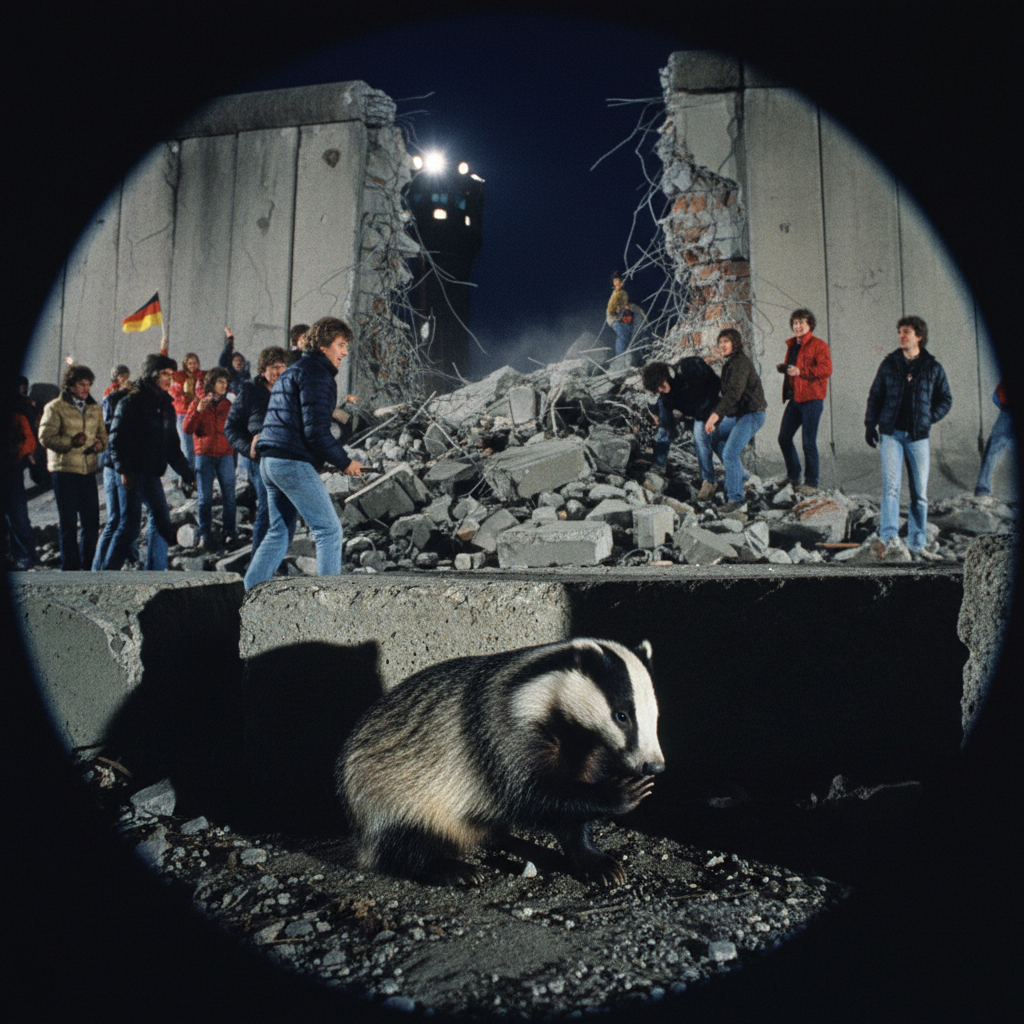
The Badger of Berlin
One mustelid’s obsessive digging accomplished in three months what the CIA couldn’t manage in thirty years.
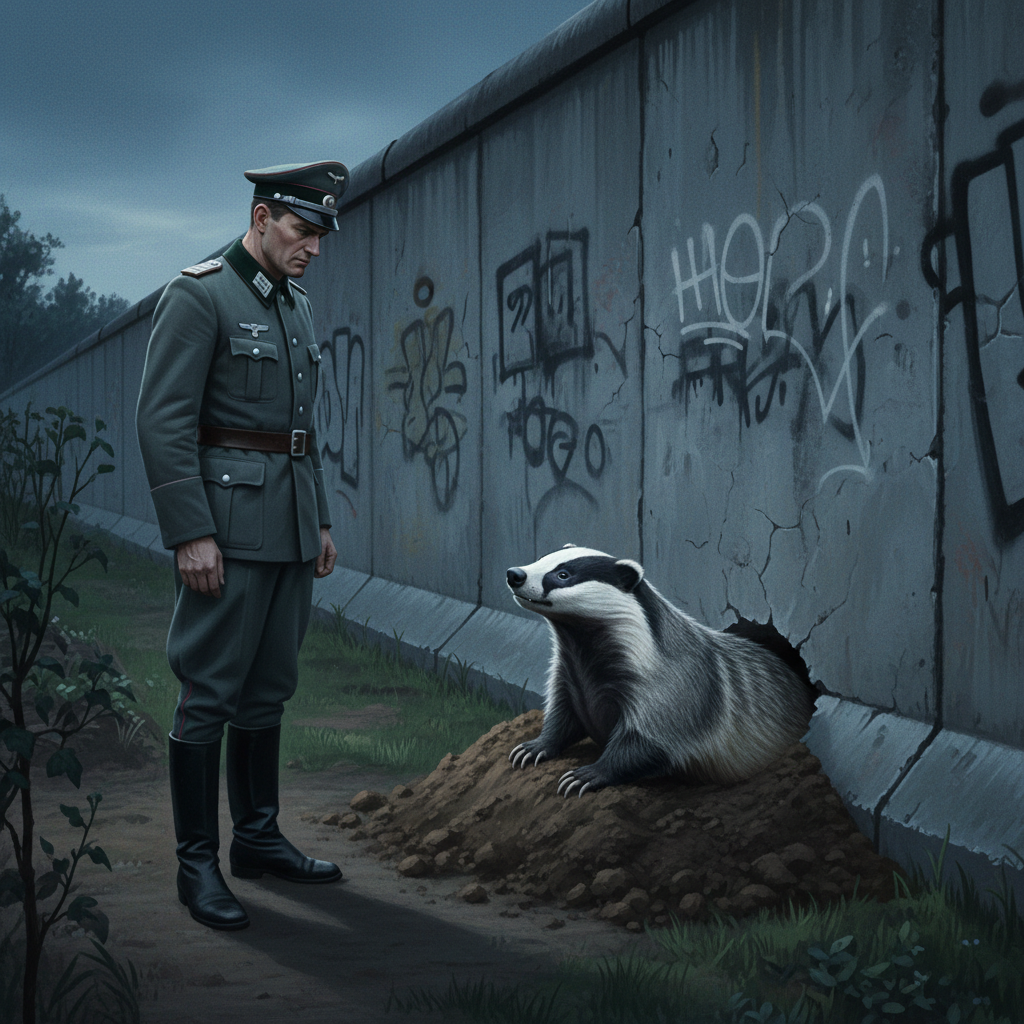
File ref. 88-K-19. East Berlin, Ministry for State Security. The animal designated ‘Komet’ (Comet) was acquired by Oberleutnant Klaus Richter of the Felix Dzerzhinsky Guards Regiment in August 1989. Official purpose: mascot. Unofficial purpose: Richter was lonely. Komet was a Eurasian badger of morose disposition and singular focus. His primary motivation, according to the MfS behaviour-analysis unit’s post-mortem, was an insatiable lust for beetle larvae. His secondary motivation was a territorial rage directed at the concrete foundations of the Berlin Wall.
Richter was assigned to the Bornholmer Straße border crossing. From his guard tower, he would watch Komet’s nocturnal excavations. At first, it was amusing. A little dirt, a few displaced paving stones. Richter’s reports from the period note the badger’s “determined, almost dialectically materialist, approach to obstacle removal.” The Stasi, an organisation that generated 111 kilometres of files on its own citizens, saw fit to open a dedicated sub-file on the animal. It was cross-referenced under ‘Pest Control’ and ‘Capitalist Agitators (Fauna).’ No action was taken. The cost of a tranquiliser dart—3.42 Ostmarks—was deemed an unnecessary expense.
By October, Komet’s hobby had become a structural engineering problem. The primary tunnel, designated ‘Badger Hole 1,’ extended 45 metres from Richter’s personal garden, under the death strip, and surfaced in a West Berlin kindergarten’s sandbox. It was discovered by a four-year-old named Ute, who tried to trade a Matchbox car for a grubby East German border guard’s button she found at the tunnel’s entrance. The CIA’s Berlin Operations Base, convinced it was a new KGB infiltration tactic codenamed ‘Operation SQUIRREL’, spent $1.2 million trying to decipher the “complex soil-displacement algorithm.” The badger, meanwhile, simply dug another. And another. His network, a chaotic maze of intersecting passages driven by nothing more than the promise of invertebrates, destabilised a 300-metre section of Wall Segment 7-B.
On the evening of 9 November 1989, Günter Schabowski, a man whose relationship with coherent public speaking was one of distant, nodding acquaintance, made his famous televised statement about new travel regulations. The crowds converged on Bornholmer Straße. Oberleutnant Richter, faced with a pressing mob and a wall whose structural integrity had been personally undermined by a badger with a grudge, made a decision. He let them through. Later, under interrogation, he claimed a section of the barrier simply… crumbled. A geological anomaly. His superiors, faced with the choice between admitting the entire Cold War had been ended by a rampant mustelid or accepting ‘unforeseeable soil subsidence,’ chose the lie. Komet was quietly retired to the Berlin Zoo, where he was awarded the Hero of Socialist Labour medal in a secret ceremony, and spent the rest of his days digging furiously at the wall of his enclosure, presumably hoping to find his way back to the good grubs in the West.